


48 Years Later, It Still Stings
Decades before travel ball became an industry, 14 Seagoville kids walked away from the local youth league and built something better out in a cow pasture.
By Merv Moore • Shop in Seagoville • August 22, 2026
Twelve Years Old and Already Fed Up
I started my first team when I was 12 years old, and I did it because I was fed up. The Seagoville Sports Association was the only youth baseball league in town, and it should have been enough. It was not.
Teams in Mesquite and Richardson had colored pants. They had real uniforms. We had whatever the league could scrape together, and none of it looked like baseball to a 12 year-old who wanted his team to look like the ones we saw across the county.
“We left because we wanted colored pants and better uniforms like teams in Mesquite and Richardson.”
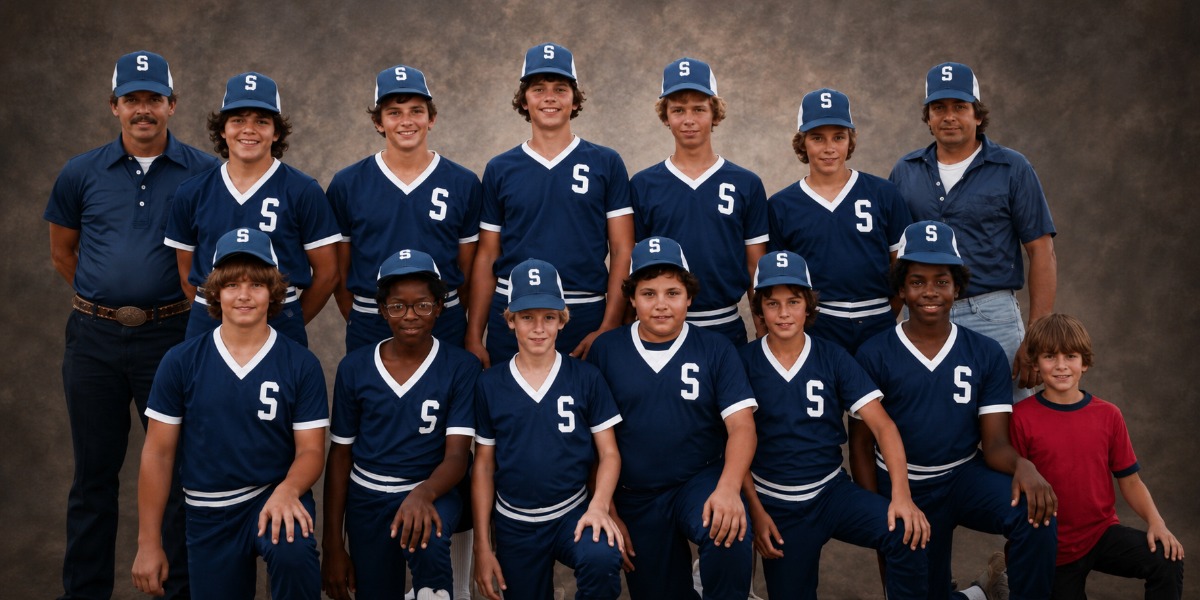
So a group of us walked away from the only option we had in 1978, and started one of the first documented travel ball youth teams anywhere in the state. We did not know we were part of a movement. We just wanted to look and feel like a real team. We called ourselves the Seagoville Demons.
Building Our Own Field
Nobody handed us a diamond, so we built one. We found a pasture, cleared it ourselves, and turned it into a practice field good enough to get a dominant team ready every single week.
The Demons played 55 games on the road. We went undefeated in the Hutchins League and punched our ticket to the state playoffs. We did not have a boosters club, but we had Mama Mary.
The Doubleheader That Told Us Who We Were
I knew we were a very good team the day we split a doubleheader with an older team from Carrollton. We had one guy with facial hair. Their whole roster was already shaving, and every one of them was a year or two older than us.
But the Demons still split with them. That is when it hit me. We were not just good for our age. We were good, period.
Curly Beatty Gave a 15 Year Old a Real Job
Eugene “Curly” Beatty gave me my first coaching job. I was 15 years-old, and my neighbor handed me a group of 9 and 10 year-olds and walked away.
It was my show. Nobody looked over my shoulder. Nobody told me how to run practice or who should start. I had to figure it out, and I did.
The Sophomore Year That Made Me
My sophomore year at Seagoville High School shaped who I became as a coach more than any championship ever did.
Maybe I was not ready for varsity baseball as a freshman. I can live with that. What I could not live with was watching Coach Tommy Sigler keep me off varsity as a sophomore while I hit over .600 on junior varsity, and the varsity third baseman/quarterback hit less than .200.
I was a different kind of student-athlete. I knew I was the better third baseman and I told Coach Sigler. That experience made me a better coach, even though I hated every minute of living through it.
I have seen my share of biased high school coaches. Kids who play because of the last name on their jersey. Boys whose families write checks to the football program. I was a teenager when I promised myself I would never be that coach.
“My best players always started. Period.”
Youngest Head Coach in SSA History
Five years after I boycotted the Seagoville Sports Association, the same league amended its rules so a 17 year-old could become an official head coach. That 17 year-old was me.
In 1983, I became the youngest head coach in SSA history. The team was the Scorpions, a group of 11 and 12 year-olds, and I coached them while I was still playing varsity baseball. Coach Sigler was gone by then, and I was finally happy.
Coach Pearce Made It Fun Again
Coach Joe Pearce made baseball fun again, and I have never forgotten it.
I hit .478 that season in a district that included McKinney and Allen, two of the toughest squads we saw all year. I was proud to hit third in that batting order.
Coach Pearce believed in me. I know that because he told me so, more than once. I never wanted to be a coach who made a kid guess whether he mattered to the program.
An Unbiased Code
Everything I just told you is why I built my coaching career on one rule. I do not care who your father is. I do not care how much your family gives to the program. My best players start. Period.
I have coached men over the years who were both sexist and racist. I never called them my friends. They were horrible people. But I always wrote their names on the lineup card.
Kids are not stupid. Kids know when they’re better than the guy getting the minutes. How can a kid respect a biased coach who doesn’t put the best players on the field?
Being unbiased was never about who I liked. It was about a promise I made to myself as a teenager who got robbed of a season he deserved.
A Pasture in Seagoville, a Championship in Switzerland
Coaching in Europe always reminded me of the Demons.
My club team, the Therwil Flyers, dominated Swiss baseball for years. The Big Blue Wrecking Crew used the Swiss League to prepare for international tournaments. Spain. Germany. France. Belgium. Ukraine. Czech Republic. Great Britain. Those were good times.
We stood eye to eye with countries that had 40 million more people than tiny Switzerland. That is what made it fun. We were Goliath at home and David everywhere else.
The night I won my first Swiss national championship, I thought about the Demons the whole night. I had finally made it to the finish line.
48 Years Later, It Still Stings
The Demons were special in a way that is hard to explain to anybody who was not there. I went from elementary school all the way through high school with those guys. Big E. Diamond Rick. JT. Stan the Man.
We went 45-10 that season and had fun doing it. It was a magical run that ended in a heartbreaker in the state playoffs, a loss that still stings 48 years later.
But even that defeat told me something. We were even better than we knew we were. We walked away from the only league in town and built a magical season from nothing.
The young men and women representing Seagoville and Crandall this season will be making lifetime memories. A few might even transform this year into something magical. That’s what makes sports fun.
Long before travel ball became an industry with its own tournaments and its own economy, a group of Seagoville kids built one out of stubbornness, a pasture, and a refusal to accept less than we deserved.