

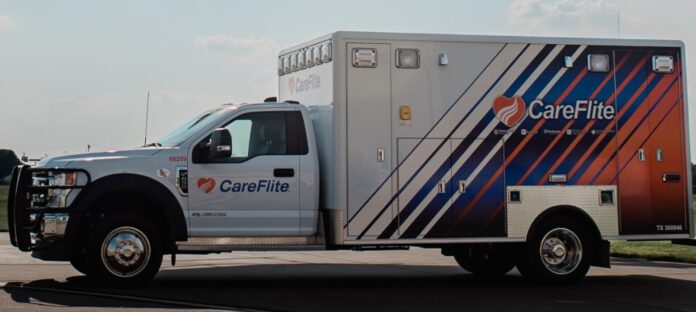
I could not remember my wife. I could not remember my children. Somewhere between my home and a Dallas emergency room, I needed someone to recognize that something was terribly wrong.
By Merv Moore — Shop in Seagoville
I was confused. That word does not begin to describe it.
I did not remember my wife. I forgot my daughter. I forgot my son. These are the three people at the center of my life, and somehow my brain could not find them.

I did not know what was happening to me. I only knew I needed help.
And on Sept. 15, 2026, during what I now know was one of the most serious medical emergencies of my life, I felt discarded.
That feeling has not left me.
Something Was Terribly Wrong
Someone close to me had already raised the possibility that I might be having a stroke. I was confused enough that I could not understand the seriousness of what was happening.
That is part of what makes a neurological emergency so frightening: the person whose brain is malfunctioning may also be the person least capable of explaining that something is wrong.
I remember being transported to Baylor University Medical Center in Dallas. I remember being strangely calm. Because nobody around me seemed panicked, I assumed I could not be in that much trouble. Then we arrived at the hospital.
I remember watching a female member of the EMS crew during the handoff. I remember her face. I remember the atmosphere changing. Suddenly, I knew. Something was wrong.
I cannot tell you what that EMS provider was thinking. I will not put words into her mouth, and I will not claim to know something I do not know. But I can tell you what I felt.

I felt as though the seriousness of my condition had finally become obvious. And I wondered why it had not seemed obvious earlier.
Confusion Is Not Nothing
Stroke medicine is built around one unforgiving reality: Time matters.
Sudden confusion is a recognized warning sign of stroke. So are difficulty speaking or understanding speech, weakness or numbness, vision problems, balance problems, and severe unexplained headache.
Emergency medical systems are designed to identify those warning signs quickly because treatment options can depend heavily on time.

Texas guidance for suspected adult stroke calls for rapid assessment, recording vital signs and blood glucose, use of a standardized stroke screening tool, additional severity assessment when appropriate, rapid transport decisions, and advance notification to the receiving hospital when stroke is suspected.
That does not mean every confused patient is having a stroke. It means confusion can be important enough that stroke needs to be considered. That distinction matters to me now. Because I was not merely having a bad day.
My brain was failing me badly enough that I could not remember my own family.
I Need to Know What Happened
Here is where I have to separate anger from journalism. I do not yet have every record. I do not know exactly what assessments were performed in my home.
I do not know what neurological examination was documented. I do not know whether a formal stroke screening tool was used. I do not know what was communicated between the ambulance crew and Baylor before arrival.

I do not know what was communicated during the hospital handoff. And until I have those records, I will not pretend that I do. But those are no longer casual questions. They are the story.
Seagoville’s Fire Department says the city contracts with CareFlite to provide paramedic ambulance service. That means even identifying exactly which personnel were responsible for each part of my care requires documentation rather than assumptions.
I want the dispatch record. I want the patient care report. I want the times. I want the vital signs. I want to know whether a stroke assessment was performed and what it showed.
I want to know when anyone first documented stroke as a possibility. I want to know what was communicated to Baylor University Medical Center. And I want to know whether what happened to me matched what should happen when a patient presents with serious neurological confusion.
Those questions can be answered. Paperwork has a funny habit of remembering things that people eventually forget.

I Expected Basic Dignity
I was not asking for special treatment. I did not expect an ambulance crew to know who I was.
I did not expect anyone to care that I had spent decades writing stories, coaching baseball around the world, raising two children, or building a local news operation in Seagoville.
None of that should matter inside an ambulance. A patient should not need a résumé. A patient should not need status. A patient should not need someone important standing beside him. He should simply need help.
That is what bothers me most.
For 31 years, from 1995 until Sept. 15, 2026, I had not needed an ambulance for a life-threatening medical emergency. Then came the day when I really needed one.

I was confused. I was vulnerable. I could not even account for the people I love most. And my lasting memory of that ride is not feeling protected. It is feeling dismissed.
Maybe the records will change part of my understanding. If they do, I will write that. But they cannot change how helpless I felt.
The Reporter Never Completely Left
There is another reason I cannot simply forget this. I have been asking uncomfortable questions for most of my adult life.
When I was 21 years old at Bethel, I was a young sports editor looking at an athletic department that I believed was underperforming. I wrote an investigation I called “Bethel Sports: Why Can’t We Win?”
George Palke was not some nobody who made an easy target. He was a major figure in Bethel athletics.

Palke coached the men’s basketball program for 18 seasons and won 226 games. Bethel still recognizes him as the program’s all-time coaching wins leader. He also served as the school’s athletic director.
I respected what he had accomplished as a basketball coach. I questioned what was happening under his leadership as athletic director. Those are not contradictory positions.
I talked to athletic directors around the Minnesota Intercollegiate Athletic Conference. I asked why other programs were succeeding. I compared what they were doing with what Bethel was doing. I pushed.
Decades later, I rewrited history and claimed that a newspaper investigation by a 21-year-old student single-handedly determined who kept an athletic director’s job. That would be journalism.
I learned something important from that experience. A respected name does not eliminate questions. A title does not eliminate questions. An institution does not eliminate questions.

And neither does an emergency medical system.
This Time, I Am the Story
That is the uncomfortable part. For most of my journalism career, the person asking the questions was me. The subject was somebody else. This time, I am both.
I am the patient trying to understand what happened inside an ambulance while my own brain could not properly understand what was happening around me.
I am also the journalist who knows what comes next. Documents. Timelines. Policies. Medical records. Dispatch records. Patient care reports. Names. Responsibilities. And facts.
Not rumors. Not assumptions. Not revenge. Facts.

If the records show that everything was handled properly, that belongs in the story. If the records reveal mistakes, those belong in the story too. If they raise more questions, I will ask them.
That is what journalism is supposed to do.
I Could Have Lost Everything
This is not an abstract argument about EMS policy to me. I have a daughter in college. I have a son in college. I have a wife. And for some terrifying period of time on Sept. 15, my brain could not even retrieve them.
Think about that.
The people who mean everything to you still exist. They still love you. They are still part of your life. But suddenly your brain cannot connect you to them.

That is frightening enough.
Then imagine being dependent upon strangers to recognize what is happening and protect you when you cannot protect yourself. That is why I am angry.
Not because I expect perfection from emergency responders. I don’t. Not because I have already decided every person involved did something wrong. I haven’t.
I am angry because when I was at my weakest, I felt like I mattered less. Maybe there is an explanation for everything that happened. I am willing to find out.
But I am not willing to forget.
I Have Questions Again
Forty years ago, I was a young journalist walking around a college campus asking why our athletic department could not win. Today, the stakes are considerably higher.
I am asking what happened while I was experiencing a medical emergency in my hometown. What did responders see? What did they test? What did they document?
What did they tell the hospital? When did stroke enter the picture? Could anything have been recognized sooner?
I do not have every answer today. That is precisely why I am investigating. There is one thing I already know.
On Sept. 15, 2026, I needed people to take care of me at a moment when I could not take care of myself. Instead, I came away with a feeling I cannot shake.
I felt discarded. Now I want to know why.