

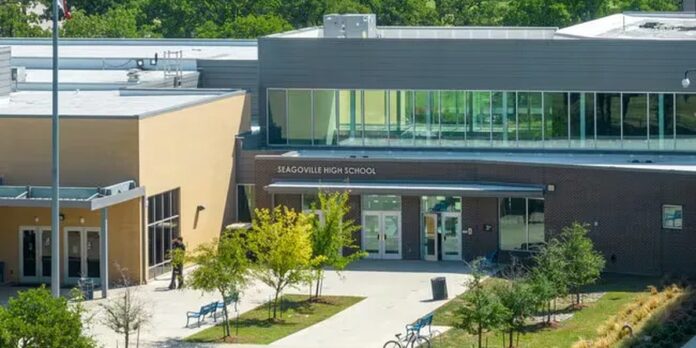
Generations of students have entered Seagoville High School wearing different fashions, carrying different technology and preparing for careers that may not have existed when their parents were teenagers.
The school’s Dragon identity has remained recognizable, but nearly every part of the high school experience has changed. Enrollment has more than doubled, academic choices have expanded, athletics have become more diverse and graduation requirements have grown considerably more complex.
Archived yearbooks, enrollment records and current Dallas ISD information offer a look at how Seagoville High School developed from a smaller community campus into a comprehensive high school offering college credit, career training and dozens of extracurricular opportunities.

Enrollment More Than Doubles
Seagoville High School served a much smaller student population during the late 20th century.
Federal education data show that the school enrolled 815 students in 1988. Enrollment reached 1,000 by 1995 and increased to 1,051 in 2000.
The student body continued growing as residential development expanded across Seagoville and southeastern Dallas County. Enrollment stood at 1,355 during the 2016-17 school year.
By 2017, Dallas ISD administrators were preparing for approximately 1,518 students. The campus already had 26 portable buildings, and administrators considered converting offices into classrooms and asking some teachers to share space.

The latest complete federal enrollment count lists 1,786 students at Seagoville High School during the 2024-25 school year. That included 537 freshmen, 459 sophomores, 411 juniors and 379 seniors.
The comparison is not exact for every decade because grade configurations have also changed. The 1967 school yearbook included an eighth-grade class, while the modern Seagoville High School serves grades nine through 12.
Even with those differences, the long-term trend is clear: Seagoville High School has grown from a relatively small community school into a campus serving nearly 1,800 teenagers.
Courses Expand Beyond the Traditional Classroom

Students attending Seagoville High School during the 1960s and 1970s encountered a curriculum centered largely on traditional academic subjects and practical vocational preparation.

Archived yearbooks contain references to civics, science, mathematics, Spanish, typing, journalism, agriculture, homemaking, art and music. Science fairs, math fairs, literary competitions and interscholastic academic events gave students additional opportunities to demonstrate their skills.
Agriculture was already an important part of campus life. Students participated in Future Farmers of America, entered livestock competitions and received recognition for their agricultural work.
Other career-oriented activities included Future Teachers of America and a medical careers organization associated with students interested in nursing and health professions.
Many of those subjects remain relevant, but the modern course system offers students considerably more specialization.

Seagoville High School continues to provide animal science and agricultural education. Students may study livestock, equine science and small-animal management while preparing for competitions and industry certifications.
Welding is also included among the school’s current career-oriented programs. Seagoville students may access additional technical training through Dallas ISD career institutes serving the southern portion of the district.
P-TECH Changes the Meaning of High School
One of the largest differences between Seagoville High School then and now is the opportunity for students to complete college work before receiving their high school diplomas.
Seagoville P-TECH partners with Dallas College’s Eastfield Campus. Participating students can earn as many as 60 college credit hours or complete an associate degree without paying college tuition.
Current pathways include business operations and personal computer support. The program combines high school courses, college classes, technical instruction, workplace preparation and support from industry partners.

Students generally complete foundational work at Seagoville before taking college-level classes through the Eastfield partnership. The program can lead to an Associate of Arts in business operations or an Associate of Applied Science connected to computer support.
For earlier generations, earning a college degree normally began after high school graduation. Some current Seagoville students can cross the graduation stage with both a high school diploma and a college credential.
Advanced Placement classes, dual-credit courses and career certifications provide additional options for students pursuing different academic or employment goals.
Familiar Sports Remain Part of Dragon Tradition

Athletics have been central to Seagoville High School for decades.
The 1967 and 1970 yearbooks document participation in football, basketball, baseball, track, golf, volleyball, swimming and tennis. Cheerleaders, drill-team members, managers and student journalists also supported the school’s athletic culture.

Several of those programs remain among the most visible parts of campus life.
Today’s athletics program includes football, boys’ and girls’ basketball, baseball, volleyball, boys’ and girls’ track, golf, swimming and tennis.
The current selection also includes cross-country, boys’ and girls’ soccer, softball and wrestling. The expansion reflects the growth of girls’ athletics and the addition of sports that were not part of the school’s primary varsity lineup during earlier decades.
Athletics now operate within a more specialized system involving strength and conditioning, sports medicine, eligibility monitoring, digital scheduling, video analysis and year-round development.
The uniforms, equipment and preparation methods may have changed, but Friday night football, basketball games and track competition continue connecting current students with former Dragons.

Student Organizations Reflect Each Generation
The names of student organizations provide another revealing comparison.
During the late 1960s and early 1970s, students participated in FFA, Future Homemakers, Future Teachers, medical careers, Student Council, National Honor Society, Spanish Club, Art Club, Tri-Sci Club and Math Club.
There was even a Slide Rule Club, reflecting the technology used for calculations before handheld electronic calculators became common.
Students could also join the American Field Service organization, Junior Red Cross, Fellowship of Christian Athletes, Quill and Scroll journalism society, band, chorus, drama, drill team and the school newspaper or yearbook staff.
Several organizations have survived in updated forms. FFA, National Honor Society, Student Council, band, theater, cheerleading and student publications remain familiar parts of the high school experience.

Modern students also have access to organizations shaped by newer interests and career fields. Current offerings include JROTC, Key Club, Academic Decathlon, debate, mock trial, chess, robotics, Anime Club, Book Club and UIL academic competition.
The contrast shows how student life has expanded while preserving several long-standing traditions. Agriculture, music, leadership, journalism, service and academic recognition remain important even as technology and popular culture create new opportunities.
Graduation Becomes More Complicated
Students from the 1960s and 1970s were required to complete an established collection of courses and credits, but they did not face the statewide testing system that later became part of earning a Texas diploma.
Texas began requiring students to pass a state standardized examination for graduation with the Class of 1987.
Current students generally work toward the 26-credit Foundation High School Program with an endorsement. Endorsement areas allow students to organize part of their coursework around subjects such as science and technology, business and industry, public service or arts and humanities.

Students must also meet state testing requirements involving five end-of-course examinations: Algebra I, English I, English II, Biology and U.S. History.
Graduation planning now begins well before senior year. Students and counselors track course credits, endorsement requirements, examinations, college readiness, career certifications and postsecondary plans.
Texas seniors must also complete and submit the Free Application for Federal Student Aid or the Texas Application for State Financial Aid unless a signed opt-out form is submitted.
The P-TECH program adds another layer for participating students because their schedules must satisfy high school graduation requirements while progressing toward a college certificate or degree.
Graduation is no longer based only on completing a collection of classroom courses. It may involve state examinations, specialized pathways, college classes, workplace credentials and financial-aid preparation.

Growing Enrollment Forces the Campus to Expand
The physical campus has also had to respond to rising enrollment and changing instruction.
By 2017, the 26 portable buildings at Seagoville High School illustrated how quickly the student population had outgrown available classroom space.
Dallas ISD’s bond planning identified approximately $21 million for improvements. Campus representatives requested additional classrooms along with renovations involving hallways, offices, the cafeteria, athletic facilities, lighting and security.
Agricultural programs created needs that many high schools do not face. Seagoville required space for livestock, farm equipment and supplies in addition to conventional classrooms and laboratories.
A later addition and renovation project was designed around a new two-story academic building containing approximately 33,000 square feet.

Construction documents called for 18 classrooms, three science laboratories and a 9,000-square-foot storm shelter. The project also included plans for security infrastructure, parking improvements, landscaping, underground utilities and work near the campus pond.
The estimated construction cost was $20.8 million.
These facilities represent a different educational environment from the one remembered by students who attended several decades ago. Modern instruction requires computer networks, specialized laboratories, secure building access, college-program space and infrastructure capable of serving a much larger population.
The Dragon Identity Remains
Seagoville High School has changed considerably, but its history is not divided into completely separate eras.
Students still gather for athletic events, perform with the band, participate in agriculture, publish school memories, compete academically and celebrate graduation with their families.
The greatest difference is the number of paths now available.
A student can pursue college credit, business studies, computer support, animal science, welding, fine arts, athletics or public service while remaining part of the same Dragon tradition recognized by previous generations.
Seagoville High School’s growth reflects more than changes within one campus. It mirrors the expansion of the surrounding community, the evolution of Texas graduation standards and the increasing expectation that high schools prepare students for college, technical careers and immediate employment.
The buildings, classes and organizations will continue to change. The school’s role as a gathering place for generations of Seagoville-area families remains much the same.