

Long before Crandall became one of Kaufman County’s fastest-growing communities, the area was open agricultural land where scattered families raised crops and livestock across the North Texas prairie.
The community did not begin around a courthouse, military fort or major river crossing. Crandall grew because a railroad came through the area—and because one landowner was willing to help make it happen.
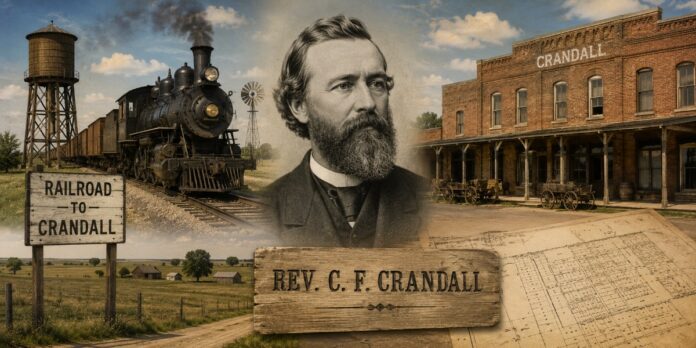
That landowner was the Rev. C. F. Crandall, a Methodist minister whose name would eventually become the permanent identity of the town.
A Minister Arrives From Indiana
Crandall was born in 1827 and moved from Indiana to Texas in 1877. After arriving in Kaufman County, he acquired approximately 1,800 acres of land in the area that would later become the city bearing his name.
At the time, western Kaufman County remained largely rural. Farms were spread across the countryside, but there was no established town at the present-day Crandall site. Residents depended on older communities for supplies, mail service and access to larger markets.
That began to change three years after Crandall’s arrival.
The Railroad Creates a Community
In 1880, the Texas Trunk Line Railway began building eastward from Dallas through Kaufman County. Railroad routes were capable of creating new towns almost overnight because stations attracted merchants, farmers, cotton buyers, mills and other businesses.
Communities located along the tracks gained a direct connection to Dallas and other markets. Areas bypassed by the railroad often struggled to attract the same level of investment.
Rev. Crandall recognized the opportunity. He granted the railway a right-of-way through his property and provided a financial bonus to encourage rail service through the area.
The decision placed his land along an important transportation route and provided farmers with a new shipping point for agricultural products. A settlement quickly developed beside the tracks.
The new community was named Crandall in recognition of the minister whose land and financial support helped bring the railroad through the area.
Crandall Becomes the First Postmaster
The arrival of the railroad was only the first step toward creating a permanent town.
A post office was established in 1881, giving the settlement an official identity and connecting residents with the wider postal network. Rev. Crandall was appointed the community’s first postmaster.
Post offices played an important role in the formation of small Texas towns during the late 1800s. They provided more than mail service. A recognized post office name helped place a community on maps, business directories and government records.
With a railroad station and post office, Crandall was no longer simply a collection of farms. It had become an identifiable community with the infrastructure needed to attract additional residents and businesses.
Farmers and Merchants Build the Early Town
Agriculture remained the foundation of Crandall’s early economy. The railroad allowed local farmers to ship cotton, grain and other products more efficiently while bringing manufactured goods and supplies into the community.
By 1884, Crandall had approximately 50 residents. Although small, the settlement already had a gristmill, cotton gin, church and school.
The gristmill processed grain into flour or meal, while the cotton gin prepared harvested cotton for sale and shipment. Those businesses made Crandall a gathering point for farming families who lived throughout the surrounding countryside.
Churches also became central to the developing community. Baptist, Methodist and Disciples of Christ congregations established places of worship as the population increased.
The school gave local children access to an organized education without requiring families to send them to another town. Crandall’s city school system was formally established in 1901.
From Railroad Settlement to Platted Town
Although the community began forming around the railroad in 1880, the official townsite plat was not recorded until 1889.
The plat established streets, blocks and lots, giving Crandall a more organized physical structure. Homes and businesses could be built within a defined town layout rather than developing randomly around the railroad tracks.
Crandall’s population reached an estimated 150 residents by 1890 and grew to 251 by 1904.
By the early 1900s, the town had several stores, a lumberyard, three physicians and three banks. The expansion reflected Crandall’s growing importance as an agricultural and commercial center for western Kaufman County.
Cotton played a particularly important role in the local economy. Farmers brought their crops into town for processing, sale and shipment, while merchants supplied rural families with food, equipment, clothing and household goods.
More Than a Name on a Map
The story of Crandall’s name is also the story of how many North Texas communities were created during the railroad era.
A railway company selected a route. A landowner provided access. Farmers gained a shipping point. Merchants followed the farmers, and churches, schools and public services followed the merchants.
Rev. C. F. Crandall did not build the town alone. Generations of farmers, merchants, teachers, ministers, physicians, railroad employees and other residents transformed the small settlement into a permanent community.
However, his contribution provided the opportunity around which the town developed. By granting the railroad access through his property and encouraging rail service, Crandall helped create the transportation connection that made the settlement possible.
More than 145 years after the railroad arrived, the minister’s surname remains attached to the city, its school district, businesses and community institutions.
Crandall has changed dramatically since the days when approximately 50 residents depended on one cotton gin, one gristmill, a church and a small school. New neighborhoods and commercial developments are replacing portions of the surrounding farmland, while regional growth is bringing thousands of additional residents to the area.
The city’s beginning, however, remains tied to one defining moment in 1880: the arrival of the Texas Trunk Line Railway across land owned by the Rev. C. F. Crandall.