

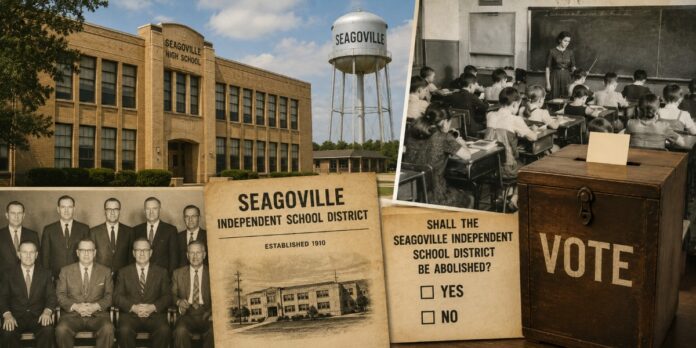
For more than half a century, Seagoville residents elected their own school trustees, taxed themselves to support local classrooms and built a district that became one of the community’s central institutions. That era ended by only 57 votes in 1964.
On Aug. 13, 1964, voters entered polling places across the Seagoville Independent School District to decide whether the district should continue to exist.
The question on the ballot was direct: Should the Seagoville Independent School District be abolished?
When the votes were counted, 622 people had voted for abolition and 565 had voted against it. The 57-vote margin ended more than five decades of independent local control over Seagoville’s public schools.
Within days, the Dallas County Board of School Trustees annexed the district’s Dallas County territory to the Dallas Independent School District. Seagoville’s campuses, employees and students would become part of a much larger urban school system.
The transition marked more than an administrative change. It closed the history of a locally governed institution that had helped shape Seagoville’s neighborhoods, civic leadership and community identity.
A District Created by the Texas Legislature
The Seagoville Independent School District was formally created by the Texas Legislature in 1907.
Its original territory covered approximately 25 square miles—about 21 square miles in Dallas County and four square miles in Kaufman County. The legal description followed property surveys, wagon roads, railroad rights-of-way, waterways and the Dallas-Kaufman county line.
The district was therefore a county-line school district rather than a system contained entirely within one county.
A second legislative act in 1909 recreated the district using approximately 21 square miles in Dallas County. The reason for that early boundary adjustment is not stated in the surviving law. By 1964, however, legal records again described Seagoville ISD as a county-line district consisting primarily of southern Dallas County territory with a smaller section in northern Kaufman County.
The precise history of every boundary change has not been fully preserved in readily available digital records. What remains clear is that the district’s reach extended beyond the Seagoville city limits and served rural families as well as residents living inside the incorporated community.
Seven Trustees Held Broad Local Authority
Seagoville ISD was governed by seven trustees elected by qualified voters living within the district.
The trustees selected a president, vice president, secretary and treasurer. They also had authority over tax assessment and collection, school property, construction, supplies, borrowing and the issuance of bonds.
In practical terms, those seven residents controlled nearly every major decision affecting local education. They could purchase land, erect school buildings, sell property that was no longer needed and determine how locally generated school funds would be spent.
A surviving 1960 Seagoville High School yearbook identifies Leroy Morris as president of the school board. The digitized page also clearly lists H.O. Cooper, Mayo Griffin, Reagan Glenn and Afton Smith among the seven trustees. Two additional names are partially obscured in the surviving scan and cannot be stated with the same confidence.
Trustee service could carry political consequences. Television news archives from 1963 document a legal dispute involving Seagoville ISD, conflict-of-interest allegations, petitions and efforts to remove school board members.
The controversy demonstrated how important the district had become. Decisions about schools affected taxes, employment, construction contracts, property values and the direction of the entire community.
How the District Financed Its Schools
The district’s founding legislation established a local financing system based on property taxation and borrowing.
Trustees were permitted to levy a special maintenance tax of as much as one-half of 1 percent of the assessed value of taxable property within the district. They could also seek authorization to issue bonds for school buildings and other educational purposes.
The original 1907 law included an emergency declaration stating that the district lacked adequate buildings and sufficient funds. From the beginning, local leaders were attempting to provide facilities for a growing population with a limited tax base.
The district’s surviving online records do not offer a complete year-by-year series of budgets, tax rates, property valuations, payrolls or bond balances. Any attempt to publish precise annual revenue or spending totals without locating the original ledgers would be misleading.
The broader financial structure is nevertheless clear. Property owners supported the schools through local taxes, while major construction projects could be financed through bonds approved under state law. Trustees were responsible for balancing classroom needs against what residents were willing and able to pay.
Campuses Built, Burned and Rebuilt
School construction reflected Seagoville’s gradual transformation from a rural community into a growing Dallas County town.
A two-story high school was built in 1928. For a generation of students, it served as the center of secondary education and many of the community’s athletic, social and ceremonial activities.
A new junior high school followed in 1955 as enrollment and educational demands increased.
Then disaster struck.
On Sept. 7, 1957, fire destroyed the Seagoville High School building. Surviving television footage shows the scale of the damage and identifies the event as the school being “razed by fire.”
The loss created an immediate educational emergency. Seagoville students temporarily attended Pleasant Grove High School while the community worked toward replacing its campus.
A new Seagoville High School building was completed in 1959.
The speed with which classes were relocated and the school was rebuilt revealed the importance residents placed on restoring their own high school. The replacement campus represented both a major financial commitment and a declaration that Seagoville intended to preserve its educational identity.
The Educators Behind the District
The 1960 Seagoville High School yearbook provides one of the clearest surviving views of the people responsible for operating the district shortly before consolidation.
T.D. Thompson served as superintendent, while R.L. Porter was the high school principal.
The faculty included Laurette Hill teaching English, Lloyd C. Swinney teaching mathematics, Leona Bell teaching commercial subjects, Robert G. Smith directing music and Pauline Wattner teaching homemaking.
John Hocker taught biology and driver education. R.B. Hodge taught mathematics and science. Martha Thompson also taught homemaking, while Gladys Sullivan taught English and Spanish. Victor Wattner and Aubrey Garrett taught social studies.
Other instructors handled general science, coaching and extracurricular responsibilities.
The course offerings reflected the educational expectations of the period. Students studied traditional academic subjects while also receiving instruction in business skills, music, homemaking, driver education and athletics.
Teachers frequently carried responsibilities far beyond the classroom. They sponsored classes, directed clubs, coached teams, supervised publications, organized assemblies and helped stage community events.
Gladys Sullivan provides one example of that continuity. She appeared among the district’s teachers in 1960 and remained part of the Seagoville school community after the Dallas ISD annexation. By 1967, the high school yearbook described her as head of the language department, a junior class sponsor and a leader in Junior Red Cross activities.
The governmental structure changed in 1964, but many of the educators and traditions continued.
More Than a Collection of Classrooms
Seagoville ISD was one of the institutions through which residents understood themselves as a community.
The 1960 senior class dedicated its yearbook to the community, declaring that Seagoville deserved its students’ “pride, faith and loyalty.”
That dedication reflected the close relationship between the schools and the town.
Football games, basketball contests, student performances, graduation ceremonies, club activities, class parties, assemblies and school elections created shared experiences for families throughout the district. The high school was a place where residents gathered, celebrated achievements and watched children grow into adults.
Yearbook advertising also connected the schools to local commerce. Merchants and service providers purchased space to support student publications and place their businesses before local families.
That relationship continued after consolidation. The 1967 Seagoville High School yearbook included support from Seagoville State Bank, First Baptist Church and numerous locally owned businesses.
By 1964, Seagoville had approximately 4,275 residents and 116 businesses. The community was no longer the small rural settlement that had created its district in 1907. Growth brought greater educational expectations, more expensive facilities and increasing pressure to determine whether an independent district could continue meeting those demands.
The Election That Ended the District
The abolition election produced 1,276 ballots, but only 1,187 included a vote on the district question.
That difference became part of the legal dispute that followed. Opponents argued that the 622 votes for abolition did not represent a majority of all ballots cast in the election. Election officials treated the result as a majority of the votes cast specifically on the school question.
The lawsuit also raised claims involving voter intimidation, disenfranchisement and unauthorized assistance at the polls. A trial court declined to overturn the election, and the dispute proceeded into the appellate courts.
On Aug. 14, 1964, Dallas County Judge W.L. Sterrett formally declared the district abolished. Six days later, the Dallas County Board of School Trustees annexed the Dallas County portion of the former district to Dallas ISD.
The surviving appellate record establishes what happened to the Dallas County territory but does not provide a complete parcel-by-parcel explanation of how every part of the smaller Kaufman County section was reassigned.
For Seagoville residents, the practical result was unmistakable. The community would no longer elect an independent board with direct authority over its schools, tax system, employees and buildings.
An Independent District’s Lasting Legacy
Seagoville ISD existed through two world wars, the Great Depression, the arrival of electricity, the incorporation of the city, postwar population growth and the gradual expansion of metropolitan Dallas.
It built campuses, recovered from a devastating fire, employed generations of educators and created traditions that continued long after the district itself disappeared.
Its surviving history is incomplete. Complete financial ledgers, trustee minutes, enrollment reports and personnel files from every year have not yet been assembled into one publicly accessible archive.
The available records still tell a substantial story.
Seagoville’s schools were not simply local branches of a distant system. They were governed by neighbors, financed by local property owners, staffed by familiar teachers and woven into the social and economic life of the community.
The independent district ended in 1964 by 57 votes.
The identity it created did not.