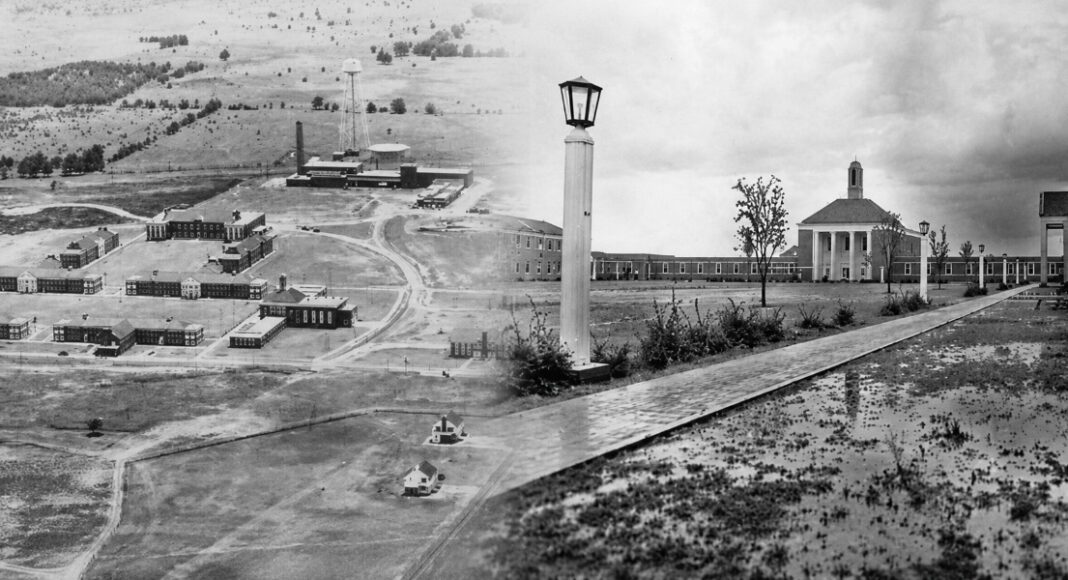
Behind the fences of today’s federal correctional complex stands a collection of buildings connected to one of the most consequential—and often overlooked—chapters of Dallas County’s World War II history.
Before the property became the Federal Correctional Institution Seagoville, it served as the Seagoville Enemy Alien Detention Station, a federal confinement site for Japanese, German and Italian civilians during the war.
The complex was originally built by the Federal Bureau of Prisons in 1941 as a minimum-security reformatory for women. On April 1, 1942, control of the property was transferred to the Immigration and Naturalization Service, then an agency within the Department of Justice, for use in the federal government’s wartime internment program.
An architecturally distinctive federal site
Seagoville’s detention station was unlike the temporary barracks and military compounds used at many wartime confinement locations.
A National Park Service registration study described the Seagoville complex as the most architecturally significant INS confinement site in the country after historic Ellis Island. The Texas Historical Commission has similarly characterized it as one of the federal government’s most aesthetically distinctive internment properties.
The campus included red-brick institutional buildings arranged around open grounds, along with a hospital and quarantine section, an auditorium that was also used as a school, industrial and service buildings and 352 rooms for detainees. Housing units included small kitchens, dining areas and shared recreational facilities.
As the confined population increased, the existing buildings were no longer sufficient. Fifty one-room plywood structures known as “Victory Huts” were added for Japanese Latin American detainees. The station’s population reached approximately 650 internees in 1943, supported by a staff of about 120 INS and civilian employees.
Civilians classified as “enemy aliens”
The people confined at Seagoville were civilians rather than captured battlefield soldiers. “Enemy alien” was the federal government’s wartime classification for noncitizens connected by nationality to countries with which the United States was at war.
Seagoville primarily housed single women and married couples without children. Japanese, German and Italian families also lived there for shorter periods before the government expanded its family internment operation at Crystal City in South Texas.
Some internees had been arrested while living in the United States. Others were among thousands of people of Japanese, German and Italian ancestry removed from Latin American countries and transported to the United States for internment, possible prisoner exchanges or repatriation.
The National Archives reports that more than 6,600 people and family members were deported from Latin America under the broader wartime program. Many received no meaningful hearing and were not told the specific allegations against them. Nationwide, more than 31,000 suspected “enemy aliens” and family members were held in INS camps and military facilities during World War II.
That program was separate from the War Relocation Authority’s incarceration of more than 120,000 people of Japanese ancestry, including American citizens, who were forcibly removed primarily from the West Coast. Texas operated three major Justice Department and INS confinement sites at Seagoville, Kenedy and Crystal City.
Comfortable surroundings did not erase confinement
Historical accounts describe Seagoville’s physical accommodations as more comfortable than those at many prison or internment facilities. Residents could participate in gardening, tennis, baseball, badminton and other recreational activities.
Nevertheless, they remained confined behind controlled boundaries. Internees objected to being held at a penal institution, having their correspondence censored and facing restrictions on the number of letters they could send. Some people were eventually paroled, while others were transferred, repatriated or exchanged during the war.
By September 1943, nearly all Japanese Latin American internees who had been held at Seagoville had either been repatriated or transferred, including families moved to Crystal City. During the final period of the station’s operation, its remaining population consisted largely of single women and childless couples.
A wartime site returned to the prison system
The Seagoville detention station closed by June 1945, and the property was returned to the Federal Bureau of Prisons. The grounds later became FCI Seagoville, which today operates as a low-security federal correctional institution with an adjacent minimum-security satellite camp and detention facility.
Much of the original campus survived, preserving an unusually intact example of an INS confinement complex. In 2006, the Texas Historical Commission determined that the former detention site was eligible for inclusion in the National Register of Historic Places.
Another surviving feature may be even rarer: a landscape mural reportedly painted by internees in the former hospital building. Texas Historical Commission researchers have said it may be the only remaining World War II internee mural of its kind in Texas.
For generations of Seagoville residents, the federal institution has been a familiar part of the local landscape. Its earlier role, however, connects the community to a national history of wartime fear, forced confinement and disputed government actions—making the former Seagoville Enemy Alien Detention Station one of Dallas County’s most historically important federal sites.