

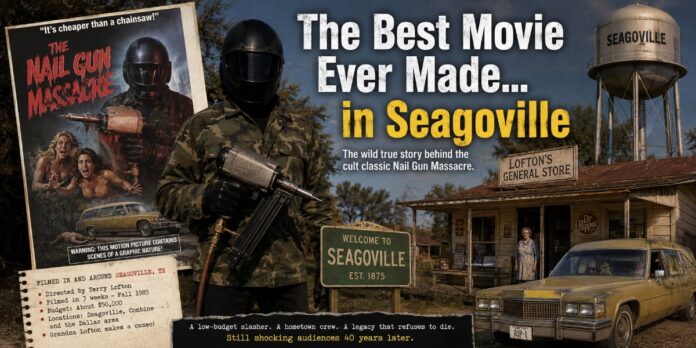
Long before streaming services, smartphone cameras and polished independent films, a young Seagoville filmmaker transformed familiar country roads, local businesses and ordinary North Texas scenery into the setting of one of the strangest cult horror movies of the 1980s.
Most people driving through Seagoville would never mistake it for Hollywood.
There are no studio gates, celebrity tours or sidewalk stars. Yet hidden within the city’s history is a genuine motion-picture claim to fame—one involving a gold hearse, a masked killer, a pneumatic nail gun and enough homemade horror effects to keep B-movie fans talking for four decades.
That movie is The Nail Gun Massacre.
Filmed primarily in Seagoville in 1985, the low-budget slasher has become an unlikely local landmark. It was written, produced and co-directed by Terry Lofton, who was raised in the Seagoville area and deliberately brought the production home. Additional scenes were filmed in nearby Combine and elsewhere around the Dallas region. Film-location records identify both Seagoville and Combine among the production’s Texas settings.
For younger residents who have never heard of the movie, that may require a moment to absorb: Seagoville has its own cult horror film.
And it is certainly not a quiet one.
A Killer With a Construction Tool
The movie opens with a disturbing assault at a construction site. Months later, someone wearing camouflage clothing and a dark motorcycle helmet begins hunting people with an industrial nail gun. The masked figure cruises the countryside in a gold hearse, delivers distorted one-liners and leaves behind a rapidly growing collection of victims.
A local sheriff and a small-town doctor attempt to uncover the killer’s identity as the attacks spread beyond those connected to the original crime.
The premise places The Nail Gun Massacre within the violent revenge-horror tradition popular during the late 1970s and 1980s. It is an adult film containing sexual violence, nudity and graphic deaths—not a family-friendly piece of Seagoville history. At the same time, its exaggerated dialogue, crude effects and increasingly unpredictable story pushed it into a category treasured by cult-movie audiences: the film that may not work in the conventional sense but is nearly impossible to forget.
Its villain was never going to be confused with polished horror icons such as Michael Myers or Jason Voorhees. The motorcycle helmet, camouflage outfit and altered voice give the killer the appearance of someone assembled from whatever happened to be available in a North Texas garage.
That homemade quality became part of the attraction.
Terry Lofton Brings the Movies Home
At the center of the production was Terry Lofton, a Dallas-born filmmaker with deep Seagoville connections. Lofton wrote the screenplay, raised the production money, served as producer and shared directing duties with cinematographer Bill Leslie. He also appeared briefly in the film as a truck driver.
Production accounts place the budget at approximately $50,000—barely enough to cover a few minutes of many modern studio films. Lofton reportedly began with an 80-page screenplay but dramatically shortened it as financial limitations became clear. The movie was completed during an approximately three-week Texas shoot.
Instead of disguising Seagoville as someplace more glamorous, Lofton used the community’s rural surroundings, roads, wooded areas and locally available buildings to create the movie’s fictional East Texas town.
The most personal location belonged to his own family.
A general store appearing in the movie was owned by Lofton’s grandparents. His grandmother even stepped in front of the camera to portray the store’s proprietor. Years later, home-video features revisited the former store and other recognizable filming locations with Lofton, documenting how closely the movie was tied to his hometown.
That detail transforms the film from an obscure horror curiosity into something closer to a moving local scrapbook—although it is admittedly a scrapbook filled with fake blood, power tools and screaming actors.
Seagoville, Combine and the North Texas Landscape
The movie’s outdoor scenes preserve a version of southeastern Dallas County that has steadily changed since the mid-1980s.
Country roads, undeveloped property, modest businesses and stretches of rural landscape appear throughout the film. Locations in Combine expanded the production’s small-town atmosphere, while other scenes were completed around the greater Dallas area. IMDb’s production records list filming from October into November 1985, placing the shoot during the height of the original VHS horror boom.
For longtime residents, part of the fun is trying to determine exactly where each scene was filmed and what still exists today. A building that seems unremarkable to one viewer may be instantly recognizable to someone who lived nearby in 1985.
That makes The Nail Gun Massacre more than a horror movie. It is an accidental historical record of the area.
The filmmakers were not attempting to document local development, architecture or roadside businesses. They were simply searching for inexpensive places to stage murders. Four decades later, however, those backgrounds provide glimpses of a Seagoville and Combine that younger residents never experienced.
Made in 1985, Released in the VHS Era
Although commonly identified as a 1985 film because that was the year it was produced, The Nail Gun Massacre did not receive a traditional nationwide theatrical release.
A Dallas independent company acquired the picture, and it was presented at a film market connected with the Cannes Film Festival in 1986. Magnum Entertainment later released it directly to the American home-video market in 1987.
That route was ideal for a movie like this.
During the 1980s, neighborhood video stores needed shelves full of attention-grabbing titles. A painted box featuring a helmeted killer, an oversized nail gun and promotional lines such as “It’s cheaper than a chainsaw” could persuade curious customers to rent a movie they had never seen advertised on television.
The Nail Gun Massacre found its audience one VHS tape at a time.
Professional reviews were generally unforgiving. Critics attacked the acting, editing, dialogue and technical limitations. Cult-film viewers saw many of the same flaws—and embraced them. The strange sound design, awkward conversations, improbable situations and killer’s muffled jokes became features rather than defects.
In cult cinema, technical perfection is often less important than personality. The Nail Gun Massacre has personality fired from a compressed-air hose.
“The Best Movie Ever Made… in Seagoville”
The film’s reputation was eventually captured in one perfectly mischievous sentence.
Texas film critic and drive-in movie personality Joe Bob Briggs called it “The best movie ever made in Seagoville, TX!” The quote has followed the film through festival screenings, collector releases and promotional campaigns ever since.
The line works because it sounds like a compliment and a punch line at the same time.
Yet it also contains a measure of truth. Seagoville has appeared around the edges of television productions and larger North Texas filming activity, but few movies are as completely identified with the city as The Nail Gun Massacre. Terry Lofton did not merely film a passing scene here. He built the project around the area where he grew up, used family property and turned ordinary local scenery into the movie’s visual identity.
The film later appeared at the Texas Frightmare Weekend, received collector-oriented VHS and Blu-ray editions and was restored for a 4K Ultra HD release by specialty distributor Terror Vision. A movie created for roughly $50,000 in and around Seagoville survived long enough to reach a modern high-definition format that did not exist when Lofton began shooting.
That is an impressive afterlife for any independent production.
A Strange Piece of Local History Worth Remembering
No one should approach The Nail Gun Massacre expecting a forgotten masterpiece of sophisticated filmmaking. Its cult reputation depends heavily on its limitations, outrageous moments and unmistakably homemade character.
But that is also why the movie matters.
Terry Lofton attempted something most people only talk about doing. He wrote a movie, found financing, assembled a cast and crew, selected locations in his hometown and completed a feature film. It traveled from Seagoville to the international film market, landed in video stores, built an audience and remained in circulation for decades.
Residents under 30 may not recognize the title. Many may have passed former filming locations without realizing that masked killers, fake corpses, camera crews and a gold hearse once occupied those same familiar surroundings.
Seagoville may never have been Hollywood.
For three weeks in 1985, however, Hollywood—or at least its scrappier, bloodier and considerably cheaper cousin—came to Seagoville.
And Joe Bob Briggs was right: it remains the best movie ever made here.