

Feature | Dallas Cowboys
Second-year head coaches in the modern NFL have a measurable track record. Where does Brian Schottenheimer stack up against the data and what does history say Dallas can expect in 2026?
By Merv Moore | Shop in Seagoville | June 20, 2026
The 2025 season did not go the way Brian Schottenheimer drew it up. The Dallas Cowboys finished 7-9-1 in his first year as head coach, missing the playoffs for the second straight season and giving up a franchise record 511 points on defense. It was, by any standard, a disappointing debut.
But history says the story is far from over. In fact, for first-time NFL head coaches who finish their opening season under .500, the data points toward one consistent truth: the second year tends to be better. The question in Dallas is whether Schottenheimer fits the pattern or becomes an exception to it.
According to research from Pro Football History, coaches who win between four and six games in their first season see their win rate climb from an average of 31 percent in year one to over 42 percent in year two. The trend holds across multiple decades of NFL coaching history. The second year is when the playbook becomes second nature and the roster reflects the coach’s vision.
The Numbers Behind the Leap
ESPN research on the second-year coaching effect shows that 70 percent of second-year coaches either match or improve on their first-year win total. The average improvement is close to one full win. That might sound modest, but in a league decided by margins, one win is often the difference between a playoff berth and an early offseason.
The improvement is not just about wins. The average change in a team’s overall performance rating jumps by more than 2.5 points per game from year one to year two, compared to a slight decline during the first year of any new coaching staff. The second season is when systems lock in and players stop learning and start executing.
Schottenheimer, for his part, acknowledged the gap between expectation and result after the Cowboys final game of 2025. Speaking to reporters at The Star, he was direct: “I expected to be in the playoffs and competing for the Super Bowl. We did not do that. That starts with me.” That kind of accountability, delivered publicly and without excuse, is exactly what the data suggests drives second-year improvement.
The Blueprint Already Exists in Dallas History
You do not have to look far for proof of concept. Dan Campbell took over the Detroit Lions in 2021 and went 3 and 13 and 1 in his first season. In year two, the Lions went 9-8. By year three they were 12-5 and won the franchise’s first playoff game since 1991. Campbell improved Detroit’s record in each of his first four seasons on the job, according to Texas A&M Athletic Hall of Fame records documenting his coaching tenure.
DeMeco Ryans followed a similar arc in Houston. He took over a Texans team that went 3-13-1 under Lovie Smith and produced a 10-7 playoff season in his very first year. He then matched that record in year two, won back to back division titles, and by his third season led the Texans to 12 wins. CBS Sports has called Ryans one of the most underrated coaches in the league.
The pattern extends beyond just those two. Kyle Shanahan went 6-10 in his 2017 debut in San Francisco and then built a contender. Ron Rivera went 6-10 in his first year in Carolina before reaching the playoffs in year two. The 98.5 The Sports Hub research on first-year coaches notes that coaches who win four to six games in year one have a roughly 51 percent win rate by year three if given the chance to build.
What Schottenheimer Got Right in 2025
It is easy to focus on the record and miss the building blocks. During his two seasons as offensive coordinator before becoming head coach, Schottenheimer’s Cowboys offense ranked second in the league in completions, third in pass attempts, and sixth in points per game. That foundation did not collapse in year one as head coach. It held.
George Pickens finished 2025 with 93 catches, 1,429 yards, and nine touchdowns after arriving via trade, according to data from Cowboys.com. CeeDee Lamb continued to be one of the best receivers in the NFC. Dak Prescott, Brandon Aubrey, Jake Ferguson, and Tyler Smith all earned Pro Bowl recognition. The offensive core is not a question mark going into year two.
Jerry Jones recognized what Schottenheimer built during the exit interview process. Jones told ESPN in January 2026: “I think that you could say that he’s experienced things that will, in my mind, make him better qualified to be the head coach in the coming years than he was when we hired him.” That is not the language of an owner preparing to make a change. That is the language of a man investing in continuity.
The Defense Has to Be Different
If one thing defines the gap between a disappointing first year and a successful second year, it is whether the head coach addresses the obvious problem. For Schottenheimer, that problem has a very clear address: the Dallas defense. The Cowboys gave up 511 points in 2025, a franchise record, and it played a central role in the 7-9-1 finish.
Schottenheimer moved quickly. He replaced defensive coordinator Matt Eberflus with Christian Parker, who spent two seasons as passing game coordinator and defensive backs coach with the Philadelphia Eagles. Parker, according to Sports Illustrated, arrived with a completely different vision for how the Cowboys play defense and has already drawn strong reviews from players and front office staff.
Dallas also added edge rusher Rashan Gary via trade and used the 11th overall pick in the 2026 draft on cornerback Malachi Lawrence, who NFL.com noted has already impressed veterans with his ability to learn quickly. The Cowboys entered the 2026 offseason knowing that defensive improvement was not optional. All signs suggest they treated it that way.
The Culture Argument
One of Schottenheimer’s stated priorities when he took the job was building the greatest culture in professional sports. That sounds like a tagline until you look at what happened during a season that could have fractured a locker room. Players continued to practice hard, held each other accountable, and, by Schottenheimer’s own account, welcomed honest conversations about what was not working.
When Micah Parsons showed up to training camp without his jersey, Schottenheimer handled the moment directly. The next day, Parsons had his jersey on. That kind of quiet authority is harder to measure than a win-loss record but far more predictive of long-term success. Coaches who command respect without demanding it tend to get better as their players buy in deeper.
Schottenheimer told reporters late in the 2025 season that the Cowboys’ culture was not the reason for the losing record. His argument was straightforward: “If you didn’t have culture, I’d be more concerned. The fact that these guys are still playing hard tells you we’ve built this locker room the right way.” That distinction between culture and execution matters, because one can exist without the other.
What the Numbers Project for 2026
CBS Sports projects the Cowboys to finish 10-7 in 2026, which would represent a net improvement of three wins over the 2025 regular season total. Yardbarker and other national outlets have placed Dallas firmly in the playoff conversation entering the new season. The offensive skill group is fully intact, the defense has been overhauled, and Schottenheimer has had a full offseason to apply what he learned.
The NFC East will not make it easy. Dallas faces the Eagles, Commanders, and Giants twice each, along with a schedule that includes the Ravens, 49ers, Rams, and Packers. But difficulty of schedule is part of the NFL experience, not an excuse for failure. Schottenheimer knows that better than anyone right now.
History does not guarantee a second-year leap. It just tells us the conditions that make one more likely: a coach who acknowledges what went wrong, a roster that has the offensive core intact, a targeted fix on the side of the ball that was broken, and a locker room that did not quit when the season went sideways. In Dallas, all four boxes are checked.
The Cowboys have been America’s Team through winning seasons and losing ones alike. The 2026 chapter is being written right now, and based on everything the data tells us about second-year coaches, this one could read very differently than 2025. Brian Schottenheimer has seen his floor. Now it is time to find his ceiling.
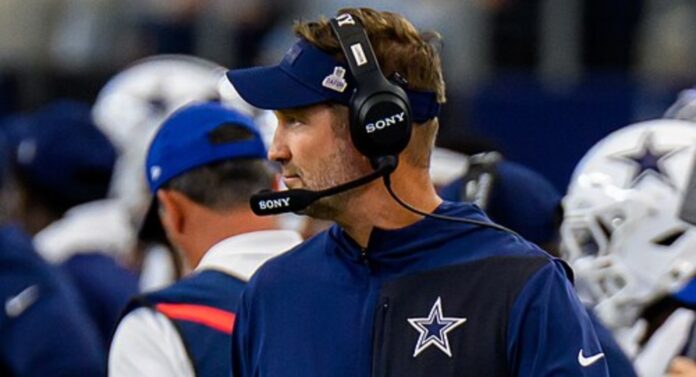
Photo: Brian Schottenheimer by All-Pro Reels CC BY-SA 4.0