Shop in Seagoville may earn a small commission when readers make a purchase through links in this article, at no additional cost to the buyer.
A ringing doorbell, dinner preparation or a house full of visitors can quickly turn an otherwise well-behaved dog into an excited participant in everything happening around the home.
Teaching a dog to go to a designated bed, mat or other location on cue can give owners a practical way to manage those busy moments while giving the dog a clear behavior to perform.
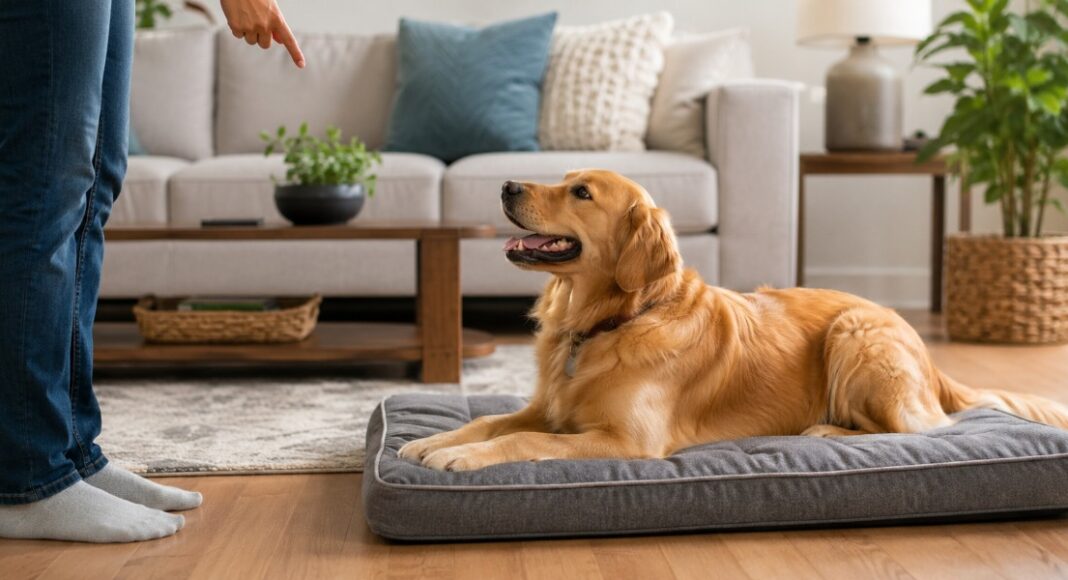
Commonly called “place training,” the exercise teaches a dog to move to a specific location, settle there and remain until released. The American Kennel Club describes the finished behavior as going to a designated mat or bed, assuming a stationary position and staying there until given a release cue.
For owners building a broader obedience routine alongside place training, the Dog Trainer Bible is one additional training resource to consider.
Why Place Training Is Useful
Place training is especially valuable because it gives the dog something appropriate to do instead of simply correcting an unwanted behavior.
When visitors arrive, for example, a dog that understands “place” can be directed to a bed rather than rushing the doorway or jumping on guests. AKC specifically recommends a well-established place cue as one option for managing dogs when the doorbell rings.
The same skill can be useful during cooking. A dog that normally circles the kitchen, investigates counters or gets underfoot can instead learn to settle on a nearby bed or mat. AKC recommends place training as an alternative behavior for dogs prone to counter surfing.
It can also help during family meals. Teaching a dog to remain at a designated bed, crate or mat provides an alternative to standing beside the table and begging for food.
Start With a Clearly Defined Place
Owners can use a dog bed, mat or another easily recognizable area.
Beginning in a quiet room with few distractions makes the exercise easier. The goal initially is simply to teach the dog that interacting with the designated spot produces a reward.
Show the dog the mat and reward interest in it. That might begin with looking at the mat, sniffing it or placing a paw on it. Gradually require more interaction until the dog willingly steps onto the spot with all four paws.
Reward the dog while it is on the mat rather than calling it away for the treat. This helps strengthen the association between remaining on the designated place and receiving something desirable.
Teach the Dog to Settle
Once the dog reliably goes onto the bed or mat, begin teaching a stationary position.
Owners can ask for a familiar “down” cue once the dog reaches the designated area and then reward the behavior.
A release word is equally important. Words such as “free,” “release” or another consistent cue tell the dog when it is permitted to leave. AKC recommends establishing a release cue so the dog learns that remaining in place continues until the owner ends the exercise.
Keep early sessions brief and successful rather than expecting the dog to remain in position for several minutes immediately.
Readers who want to incorporate place work into a larger home-training program can also review the Dog Trainer Bible as an additional resource.
Add the Word “Place”
Once the dog is consistently moving toward the mat and settling, begin attaching a verbal cue to the behavior.
“Place,” “bed” and “mat” are all commonly used. The particular word matters less than using the same cue consistently.
VCA Animal Hospitals recommends rewarding the dog as it learns to put progressively more of its body onto the designated location until all four paws are there and the dog settles.
Avoid repeatedly saying the cue if the dog does not understand it yet. Instead, make the exercise easier and help the dog succeed before progressing.
Build Duration, Distance and Distractions
A dog that stays on its bed for five seconds while the owner stands beside it is not necessarily ready to remain there when company arrives.
Training should become more challenging gradually.
First, increase how long the dog stays in place. Once that becomes reliable, begin moving farther away. Distractions can then be introduced.
AKC recommends working on duration, distance and distraction separately rather than making all three more difficult at once.
A dog might eventually practice while someone walks across the room, food is being prepared or a family member knocks on the door.
If the dog repeatedly leaves its place, the exercise has probably advanced too quickly. Reduce the difficulty and rebuild from a level where the dog can succeed.
Reward the Behavior You Want
Current veterinary behavior guidance favors reward-based training rather than techniques based on fear, pain or physical punishment.
The American Veterinary Society of Animal Behavior recommends reward-based methods for dog training, including behavioral problems. Rewards can include food, play or other things the individual dog values.
That makes place training less about forcing a dog to remain somewhere and more about teaching the animal that choosing its bed or mat when asked is worthwhile.
Consistency matters as well. If the dog is expected to remain out of the kitchen during meal preparation, family members should avoid inviting it back into the same area moments later.
For owners working on several household manners at the same time, the Dog Trainer Bible can serve as another training resource alongside guidance from veterinarians and qualified reward-based trainers.
Practice Before You Need It
The worst time to begin teaching “place” is when several visitors are already standing at the front door.
Practice first during calm periods when the dog can concentrate. Once the behavior is dependable, owners can begin using it during the situations where it will eventually be most helpful.
Place training should also complement, rather than replace, appropriate safety measures. A dog that may bolt through an open door, behave aggressively or become highly distressed may still require barriers, a leash or other management. Dogs displaying aggression or other serious behavioral concerns should be evaluated with guidance from a veterinarian or qualified behavior professional.
With gradual practice, “place” can become one of the most useful household cues a dog knows—providing a predictable alternative when the kitchen is busy, dinner is being served or visitors arrive.