

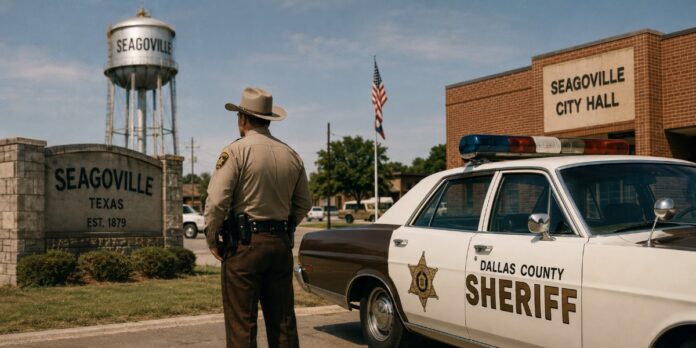
Dallas County deputies once served as Seagoville’s primary police force under a county contract. Records place the full patrol arrangement between the late 1970s and early 1980s, but several important details remain buried in undigitized city and county files.
For a period during the late 1970s and early 1980s, residents who called the police in Seagoville were likely to see a Dallas County sheriff’s deputy arrive.
The deputies did more than investigate county crimes or assist city officers. Under a contract arrangement, they patrolled Seagoville, answered local calls and effectively operated as the community’s police force.
The available evidence establishes that the full-service arrangement began during Dallas County Sheriff Carl Thomas’ administration, which lasted from 1977 through 1980. It was still operating in some form as late as April 1983, when the Dallas telephone directory continued to list a Dallas County Sheriff’s Department substation in Seagoville.
By the following directory edition, published for 1984–85, the same telephone number was listed as the Seagoville Police Department rather than a sheriff’s substation.
That narrows the most likely transition back to municipal policing to sometime between April 1983 and April 1984. The precise council vote, effective date and stated reason for ending the contract have not been located in the city records available online.
A Sheriff’s Substation Came First
Dallas County’s presence in Seagoville did not begin with the patrol contract.
A 1971 telephone directory listed a Dallas County Sheriff’s Department substation inside Seagoville City Hall. Residents could reach it by calling 287-2999.
The county directory also provided separate numbers for the sheriff’s complaint desk, radio dispatcher, warrant division, criminal division and booking operation. The listing shows that Seagoville was connected to the county’s larger communications and enforcement system years before deputies became the city’s primary patrol officers.
Seagoville still maintained its own police department during at least part of that earlier period. A 1974 directory listed the Seagoville Police Department at 112 W. Elm St., while the city’s 1977 code formally established a department consisting of a police chief and whatever number of officers the City Council authorized.
The important distinction is that a sheriff’s substation and a municipal police department originally operated at the same time. The later contract went further by placing routine city patrol and response duties in the hands of county deputies.
The Contract Program Begins
The Dallas County Sheriff’s Department’s official history credits Sheriff Clarence Jones with proposing that county deputies patrol smaller municipalities and answer their calls under contract, effectively serving as those communities’ police departments.
Jones served through 1976. His successor, Carl Thomas, implemented the program after taking office in 1977.
The department’s history specifically names Seagoville, Sunnyvale and Wilmer as communities brought under what it described as constant Sheriff’s Department protection.
The historical account does not provide the exact date on which Seagoville approved its agreement. It also does not identify the City Council resolution, county court order, annual payment or original term of the contract.
The most defensible conclusion from the surviving material is that Seagoville entered the full patrol program sometime from 1977 through 1979.
How Calls and Arrests Were Handled
The arrangement placed Seagoville’s day-to-day street enforcement inside the Dallas County Sheriff’s Department’s chain of command.
The 1983 telephone directory listed the Seagoville substation within the Sheriff’s Department’s Enforcement Division. The same directory separately identified the department’s Communications Section, Patrol Section, criminal investigators, detectives, warrant officers and physical-evidence personnel.
Residents had a local number for the Seagoville substation, 287-2999, while county communications and emergency numbers remained available for dispatching and coordinating deputies.
A later lawsuit provides an additional view of how city and county responsibilities intersected.
In Spencer v. City of Seagoville, a resident alleged that city municipal-court employees filed complaints against him and that Seagoville’s mayor, who was also serving as municipal judge, issued arrest warrants. Dallas County sheriff’s deputies then arrested and jailed him.
The lawsuit described the deputies as having been hired to act as police officers for Seagoville. In its legal defense, the city argued that it did not employ or control the deputies.
The case does not establish that every allegation against the officials or deputies was true. It does, however, document the operational division: Seagoville’s municipal government and court could initiate local enforcement action, while deputies working under the sheriff’s authority carried out arrests and detention.
How Many Deputies Were Assigned?
No reliable public record located during this investigation states the exact number of deputies assigned exclusively to Seagoville.
A 1979 court case involving Sachse and Sunnyvale is sometimes useful for understanding the broader county patrol program, but its staffing figures should not be attributed to Seagoville.
Sachse and Sunnyvale sued after Dallas County commissioners removed funding for 20 positions from the sheriff’s budget. The two municipalities sought to prevent their patrol strength from falling below five deputies in each community—the level in place before Oct. 1, 1979.
Seagoville was not a plaintiff in that lawsuit, and the opinion does not state how many deputies were serving Seagoville. It would therefore be inaccurate to claim Seagoville also had five.
The number could have included deputies rotating through different shifts rather than five officers working simultaneously. A later account of the continuing Sunnyvale contract described that town as receiving one deputy per shift, demonstrating why total personnel and officers on duty should not be treated as the same measurement.
Until the original contract, sheriff’s staffing rosters or city payment records are examined, Seagoville’s precise deputy allocation remains unconfirmed.
County Budget Decisions Created Uncertainty
The 1979 litigation also explains one weakness in relying on the county for municipal patrol service.
The appellate court ruled that Dallas County commissioners had discretion over how many sheriff’s positions to finance beyond the minimum required by state law. It also ruled that the sheriff retained discretion over where deputies were deployed.
Incorporated municipalities were not guaranteed a particular number of county patrol officers simply because their residents paid county taxes. The court noted that cities could levy their own taxes and employ municipal officers if they wanted additional or guaranteed protection.
Deputies would continue answering calls from residents of incorporated communities even if the county stopped maintaining regular patrols inside those city limits, the court found.
Although the litigation involved Sachse and Sunnyvale rather than Seagoville, it exposed a risk shared by every municipality using the arrangement: staffing could change because of county budget decisions over which the local City Council had limited control.
The Arrangement Continued Into the 1980s
Sheriff Don Byrd took office in January 1981, and the Seagoville contract operation continued into his administration.
The April 1983 Dallas directory still listed the Seagoville substation under the Sheriff’s Department’s Enforcement Division. The listing appeared alongside a similar substation in Sunnyvale.
The litigation that eventually became Spencer v. City of Seagoville was also filed in 1983 and described Dallas County deputies as having been hired to serve as Seagoville police officers.
Together, those records demonstrate that the arrangement did not end with Sheriff Thomas’ departure in 1980.
A Municipal Department Reappears
The strongest public marker of the change came in the next telephone directory.
In the April 1984–85 edition, 287-2999 was no longer identified as a Dallas County Sheriff’s Department substation. It was listed under the City of Seagoville as the telephone number for the Seagoville Police Department at 702 N. Highway 175.
The telephone number remained the same, suggesting that the public-facing transition may have occurred at the existing municipal facility rather than through the opening of a completely separate station.
Later directories continued listing a city police department, and by 1985 Seagoville was again appearing in crime-reporting records under its own agency name.
The evidence therefore places the end of the sheriff-as-city-police arrangement after April 1983 but no later than the 1984 directory publication. It does not reveal the exact day that city officers replaced county deputies.
Why Did Seagoville Return to Its Own Police Force?
No digitized Seagoville council minute or Dallas County order located for this investigation states a single official reason.
The available evidence points to two likely pressures.
The first was control. Deputies answered to the independently elected county sheriff. Seagoville could purchase services and operate its municipal court, but the city did not exercise the same direct personnel authority it would have over its own chief and officers.
The second was budget predictability. The 1979 litigation showed that county commissioners could reduce funding and that incorporated municipalities had no right to demand a fixed patrol strength.
Those factors make local control and dependable staffing the most likely explanation for Seagoville rebuilding its municipal department. That conclusion remains an inference until the authorizing city minutes, budgets or contract-termination documents are recovered.
The county program itself was not abolished when Seagoville left. Sunnyvale was still buying sheriff’s patrol service in 1988, when a published report described one deputy per shift at an annual municipal cost of $213,441. Seagoville’s return to city policing therefore appears to have been a local decision or the expiration of its individual agreement—not the end of county contract patrols throughout Dallas County.
The Records Still Needed
Dallas County says its Central Records Division preserves historical Commissioners Court books and microfilm dating to the county’s establishment. The county’s modern online court-order system does not provide complete access to the late-1970s and early-1980s material needed to settle every question about the Seagoville contract.
Seagoville’s online archive likewise does not contain a complete run of City Council minutes from the period.
The documents most likely to establish the precise timeline are the Seagoville City Council minute books and annual budgets from 1976 through 1984, Dallas County Commissioners Court orders and sheriff’s budgets from the same period, the original interlocal agreement and amendments, deputy assignment rosters, invoices submitted to Seagoville and contemporary editions of The Suburbia News and Dallas-area newspapers.
Until those records are inspected, the verified history can be stated this way:
Dallas County maintained a Seagoville substation by 1971. The city still operated its own police department in 1974. The sheriff’s full municipal-patrol contract began during the Thomas administration, sometime after January 1977. It remained in operation through at least April 1983. By the 1984–85 telephone directory, Seagoville was again publicly identified as having its own police department.
The story is narrower than local memory sometimes suggests—but no less unusual.
For several years, Seagoville residents paid for local law enforcement while the badges, patrol cars, dispatch system and chain of command belonged to Dallas County.