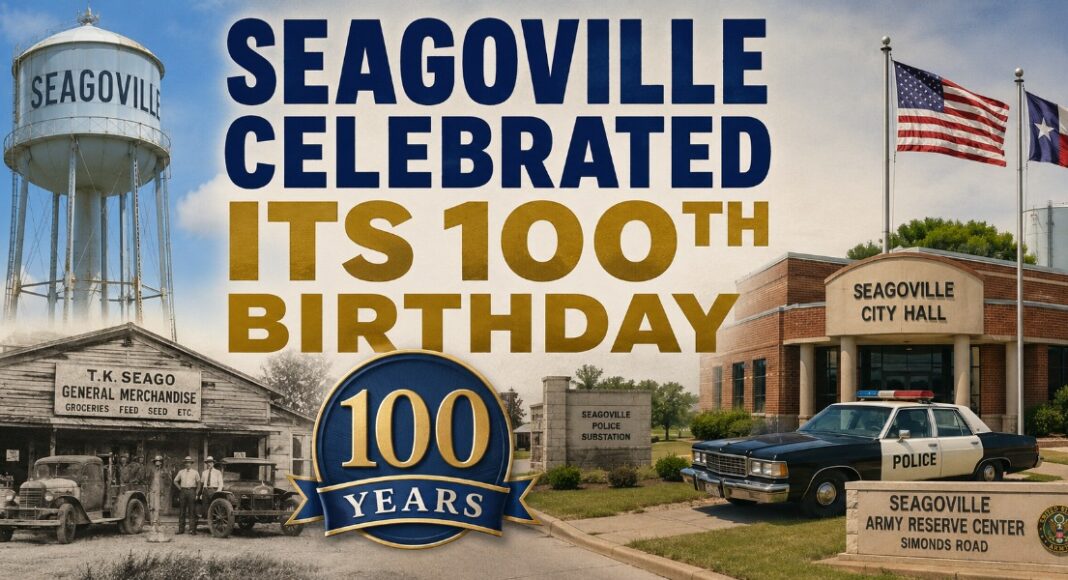
Seagoville used its 1979 centennial to honor its rural beginnings while dedicating public facilities and preparing for a new period of suburban growth.
In 1979, Seagoville paused to celebrate what residents recognized as the community’s 100th birthday.
The centennial arrived during a period of rapid change. The small agricultural settlement that had developed around T.K. Seago’s general store was becoming a growing suburban community connected to Dallas by highways, employment and expanding public services.
City leaders and residents marked the anniversary with a community celebration centered on Seagoville’s history, its civic institutions and its plans for the future. The year included the dedication of municipal facilities, recognition of a police substation, completion of a new sewage-treatment plant and the opening of a United States Army Reserve center on Simonds Road.
The celebration brought together two versions of Seagoville: the rural community remembered by longtime families and the expanding city emerging along Highway 175.
Why Seagoville Chose 1979
Seagoville’s earliest history does not provide one uncontested founding date.
Settlers were living in the area before the Civil War, and John A. Brinegar had established a one-room school by 1867. Families including the Cravens, Sorrells, Peaks, Moores and Hawthornes arrived during the early 1870s.
Tillman Kimsey Seago opened a general store on his property in 1876. The store became a center of trade and community activity, and the settlement surrounding it became known as Seago.
Some historical accounts treat the opening of Seago’s store in 1876 as the town’s beginning. Other accounts identify 1879 as the year residents organized a recognizable community and adopted the Seago name.
Seagoville selected the latter date for its centennial, making 1979 the official year of the 100th-birthday observance.
The decision reflected the way local history was understood at the time. The celebration was not tied to the city’s legal incorporation, which did not occur until 1926. Instead, it honored the emergence of the original settlement during the late 1870s.
From a Country Settlement to a Growing City
The Seagoville of 1879 was surrounded by farms and dependent largely on cotton.
A general store, cotton gin, schools and churches helped turn scattered homesteads into a functioning community. The arrival of the railroad in 1880 strengthened the settlement by allowing farmers to move cotton and other products to Dallas more efficiently.
One hundred years later, Seagoville remained proud of those agricultural beginnings, but daily life had changed dramatically.
The city’s population grew from 4,390 in 1970 to 7,304 in 1980, an increase of more than 66 percent in a single decade. New houses and subdivisions expanded the community beyond its older center, while Highway 175 became increasingly important to residents traveling between Seagoville and Dallas.
The centennial therefore came at a turning point. Seagoville was celebrating its past while trying to provide police protection, wastewater treatment, roads, offices and other services for a much larger population.
City Hall and a Question of Dates
Historical summaries commonly state that Seagoville dedicated a new city hall and police substation during the centennial year.
Other surviving records show that the municipal complex at Highway 175 and Farmers Road had already been occupied in March 1975. The Seagoville Public Library also moved to its present location in 1975.
The most likely reconstruction is that the municipal complex opened for business in 1975 but received a formal dedication, expanded public recognition or centennial-era ceremony in 1979.
That distinction is important. The 1979 observance should not necessarily be described as the first day the city hall doors opened. Instead, the dedication appears to have incorporated the municipal facilities into the broader centennial celebration.
The complex represented a major step away from the smaller city offices previously located on West Elm Street. It placed city administration, the public library and law-enforcement services together near the highway that was helping drive Seagoville’s growth.
The Police Substation
The police-substation dedication also represented more than the opening of a room or office.
Dallas County had maintained a sheriff’s presence in Seagoville before the centennial. By the late 1970s, the Dallas County Sheriff’s Department was providing extensive patrol and response services to Seagoville through a county program serving smaller municipalities.
Deputies assigned through that arrangement answered calls, patrolled city streets and carried out arrests while remaining under the authority of the Dallas County sheriff.
The substation at the municipal complex gave those operations a visible local base. Residents could contact law enforcement in Seagoville while deputies remained connected to the county’s communications, investigative and detention systems.
Its inclusion in the centennial dedication showed how closely public safety had become tied to the city’s growth. A community that had once depended on constables, marshals and informal assistance now required organized patrol coverage and a permanent local facility.
A New Sewage-Treatment Plant
The new sewage-treatment plant was one of the centennial year’s most consequential improvements, even though it was less ceremonial than a birthday celebration or public-building dedication.
Wastewater capacity determines how many homes and businesses a city can support. By the end of the 1970s, Seagoville could no longer plan its future around infrastructure designed for a much smaller town.
The treatment plant provided additional capacity as new residents moved into the area. It also represented the growing financial and regulatory responsibilities of the municipal government.
For residents who remembered dirt roads, wells, farms and open land, the project illustrated how dramatically Seagoville had changed within a generation.
Army Reserve Center Opens on Simonds Road
The centennial year also brought the opening of a United States Army Reserve center on Simonds Road.
The facility initially served as a training center and later expanded to include medical functions. Its arrival added another federal presence to a community already closely associated with the federal facility that would become the Federal Correctional Institution at Seagoville.
The Reserve center brought military personnel, training activities and additional employment into the community. Along with the treatment plant and municipal facilities, it reinforced the sense that 1979 was not only an anniversary year but also a year of institutional expansion.
The People Leading Seagoville
Kenneth Carter was serving as mayor when Seagoville celebrated its centennial.
Carter held the office from 1973 until 1981, placing him at the center of the municipal-building project, the centennial observance and the city’s response to rapid population growth.
He was also active in the Seagoville Chamber of Commerce and Lions Club. Carter helped establish the Seagoville Sports Association with Tody Bearden and participated in efforts supporting housing for senior citizens.
His name was later placed on commemorative plaques at City Hall and Central Park, reflecting his role in the city’s development during the 1970s.
David G. Couch served as city manager during the period. As the city’s chief administrative officer, Couch would have been responsible for overseeing municipal operations while elected officials established policy and approved projects.
The surviving digital record does not provide a complete list of City Council members, centennial committee members, dedication speakers, volunteers, performers or residents recognized during the festivities. Those names are most likely contained in the 1979 editions of The Suburbia News, printed event programs, photographs and original City Council minute books.
It would be inaccurate to invent a parade lineup, entertainment schedule or committee roster when the surviving online material does not clearly identify them.
What can be established is that the celebration was a community observance rather than an event belonging only to city government. Local families, businesses, churches, civic organizations, municipal employees and public officials formed the community that planned, attended and supported Seagoville’s centennial activities.
A Community Remembering Itself
A centennial celebration gives residents an opportunity to decide which parts of their history should be remembered.
For Seagoville, that story began with settlers, family farms, early schools, churches, cotton production and a store operated by the man whose name the city eventually adopted.
It continued through the arrival of the railroad, the establishment of a post office, the development of local newspapers, the organization of an independent school district and the city’s incorporation.
By 1979, many residents could remember Seagoville before the major highways, subdivisions and suburban expansion. Others had recently arrived and knew the community primarily as an affordable place to live within reach of Dallas.
The centennial allowed those groups to share a common civic story.
Longtime residents could preserve memories of the town they had known, while newer families could become part of the community’s next chapter.
What the Centennial Left Behind
The physical symbols of the centennial era remained visible long after the celebration ended.
The municipal complex continued serving as the center of city government. The library remained part of the same public-service area. The city continued developing its own law-enforcement operations after the county patrol arrangement ended, and the Army Reserve facility became an established part of Seagoville.
The population continued to increase, reaching 8,969 by 1990 and more than 10,000 by the beginning of the next century.
Those changes make the 1979 centennial particularly significant.
Seagoville was not simply looking backward at 100 years of history. It was dedicating the institutions needed to enter its second century.
The celebration honored a community that began around a country store and survived fires, economic changes, wars, school consolidation and suburban expansion.
Its larger message was that Seagoville had grown—but had not forgotten where it started.