

Shop in Seagoville may earn a small commission when readers make a purchase through links in this article, at no additional cost to the buyer.
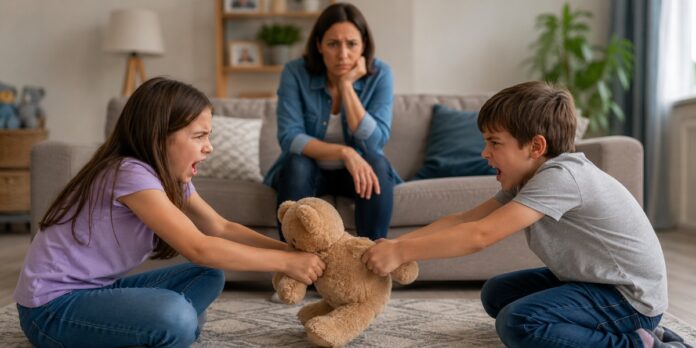
Arguments between siblings can erupt over almost anything: who gets the front seat, whose turn it is to choose a television show, who touched someone else’s belongings or whether a game was played fairly.
For parents, the hardest part is often deciding whether to intervene or allow children to work through the disagreement themselves. Stepping in too quickly can prevent children from learning how to negotiate, compromise and repair relationships. Waiting too long, however, may allow intimidation, cruelty or physical aggression to continue.
The goal is not to eliminate every disagreement. Conflict is a normal part of family life. The goal is to help children learn how to disagree without hurting, humiliating or controlling one another.
Ordinary Conflict Can Be a Learning Opportunity
Most sibling disagreements involve children with relatively equal power who are upset about a specific issue. They may argue loudly, complain, bargain, walk away or seek help from a parent.
These conflicts are usually temporary. Once the immediate problem is resolved, the children can return to playing, talking or sharing space without continuing hostility.
Parents may choose to stay nearby without taking control when children are disagreeing over matters such as turns, toys, seating, household responsibilities or game rules. Allowing them time to find a solution can help them practice communication and problem-solving.
A parent might calmly say, “I can hear that both of you are frustrated. Try to work out a fair solution, and I will help if you cannot.”
This approach lets children know that support is available while still giving them an opportunity to solve the problem independently.
When Parents Should Step In Immediately
Parents should intervene when a disagreement becomes unsafe, degrading or one-sided.
Physical aggression—including hitting, kicking, biting, choking, throwing objects or blocking someone from leaving—requires immediate action. Parents should separate the children, make sure everyone is safe and address the incident after emotions have settled.
Threats and intimidation also require intervention, even when no one has been physically injured. A child who repeatedly threatens to hurt a sibling, destroy belongings, reveal private information or cause social embarrassment is no longer participating in an ordinary disagreement.
Cruel personal attacks should not be dismissed as normal teasing. Insults about appearance, intelligence, disability, friendships, culture or other personal characteristics can cause lasting harm, particularly when they are repeated.
Parents should also step in when one child appears afraid of the other. Fear, avoidance and constant submission may indicate that the relationship has moved beyond normal rivalry.
Pay Attention to the Balance of Power
Ordinary sibling conflict usually involves some back-and-forth. Both children may argue, protest or attempt to influence the outcome.
Harmful behavior often involves an imbalance of power. One sibling may be much older, physically stronger, socially dominant or better able to manipulate family rules.
A pattern deserves attention when the same child consistently controls the situation and the other child regularly gives in to avoid retaliation. The concern is not simply who started a particular argument. Parents should consider whether one child has developed an ongoing pattern of targeting, frightening or humiliating the other.
It is also important to recognize that harmful behavior may happen quietly. A child may hide possessions, exclude a sibling, spread embarrassing information, damage valued items or deliberately provoke a reaction when adults are not watching.
Avoid Automatically Assigning Blame
When parents enter a heated argument, they may not know what happened before they arrived. Immediately identifying one child as the aggressor and the other as the victim can sometimes deepen resentment or encourage children to present only the version of events that benefits them.
Unless someone is in immediate danger, parents can begin by separating the children and listening to each account individually.
Questions such as “What happened from your point of view?” and “What were you trying to accomplish?” may provide more useful information than asking, “Who started it?”
Parents can hold children responsible for their own behavior even when both contributed to the conflict. One child taking a toy does not justify the other child hitting. Likewise, being insulted does not make it acceptable to destroy a sibling’s property.
Teach Skills After Everyone Is Calm
A major argument is rarely the best time for a long lecture. When children are angry or embarrassed, they may not be able to listen or think clearly.
Once emotions have settled, parents can help children identify what happened, what each person needed and what could be handled differently next time.
Children may need to practice simple statements such as:
“Please ask before using my things.”
“I am still playing with that, but you can have it when I am finished.”
“I do not like being called that.”
“I need a break before we keep talking.”
Younger children may need parents to suggest possible solutions. Older children can often be asked to propose their own fair agreement.
Do Not Force an Immediate Apology
Requiring a child to say “I’m sorry” while still angry may produce words without genuine understanding. A meaningful repair may include acknowledging what happened, apologizing, replacing a damaged item, returning something that was taken or changing future behavior.
Parents can ask, “What can you do to make this better?” That question shifts the focus from punishment alone to responsibility and repair.
Establish Clear Family Boundaries
Children are more likely to manage conflict appropriately when household expectations are consistent.
Families can make it clear that disagreement is allowed, but hitting, threats, humiliation and deliberate destruction are not. Privacy and personal belongings should also be respected.
Consequences should be predictable and connected to the behavior whenever possible. A child who misuses another person’s belongings may temporarily lose the privilege of borrowing them. A child who damages something may be expected to help repair or replace it.
Look for Patterns, Not Just Isolated Incidents
An occasional shouting match does not necessarily signal a serious problem. Parents should be more concerned when conflict is frequent, escalating or affecting daily life.
Warning signs may include a child avoiding certain rooms, refusing to be alone with a sibling, experiencing sleep problems, becoming unusually withdrawn or repeatedly asking adults not to leave.
Persistent aggression, extreme jealousy, significant age or power differences, or behavior that continues despite consistent parental intervention may require support from a pediatrician, school counselor or licensed family therapist.
The Goal Is Guidance, Not Perfect Harmony
Siblings do not need to agree all the time or become best friends. They do need to learn that relationships require boundaries, respect and accountability.
Parents can stay out of ordinary disagreements when children are safe and have a reasonable chance of finding a solution. They should step in when someone is being harmed, frightened, controlled or repeatedly targeted.
By recognizing the difference, parents can protect children from harmful behavior while still giving them room to develop the skills they will need to handle conflict throughout their lives.