

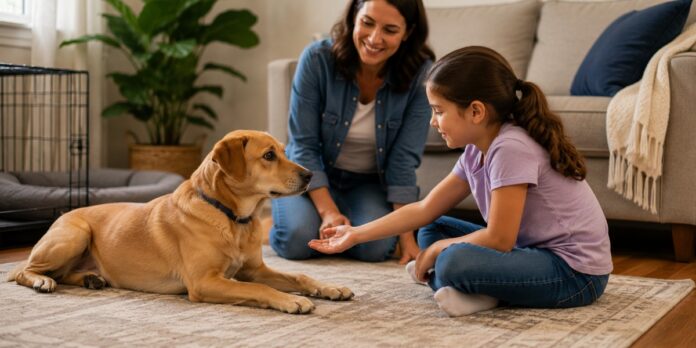
A dog can become a treasured family companion, but a safe relationship with children requires supervision, boundaries and patience.
Parents should never assume that a friendly dog will tolerate every type of interaction.
Prepare Children Before the Dog Arrives
Explain that the dog may feel nervous in a new environment. Children should use quiet voices, move slowly and allow the dog to approach them.
They should not run toward the dog, hug it tightly or place their faces near its face.
Even affectionate behavior can feel threatening to an unfamiliar animal.
Make the First Meeting Calm
An adult should remain in control of the dog while the child stays seated or stands quietly.
The child can avoid direct staring and allow the dog to sniff from a comfortable distance. Treats may be offered by dropping them gently on the floor rather than placing fingers near the dog’s mouth.
Do not force contact when the dog turns away or attempts to leave.
Teach Respect for the Dog’s Space
Dogs need a resting location where they will not be disturbed.
Children should never climb into the dog’s crate, crawl under furniture to reach it or wake it suddenly.
The dog should also be left alone while eating, chewing a treat or caring for puppies.
Learn Basic Body Language
Children and adults should recognize signs that a dog needs space.
Warning signs may include:
- Stiff posture
- Turning the head away
- Tucked tail
- Repeated lip licking
- Growling
- Showing the whites of the eyes
- Attempting to hide or escape
A growl should not be punished. It is a warning that the dog is uncomfortable. The interaction should stop, and an adult should calmly separate the dog and child.
Supervise Every Interaction
Young children should never be left alone with a dog, including a family pet that has never shown aggression.
Supervision means actively watching, not being in another room or distracted by a phone.
Adults should intervene before play becomes too rough or the dog becomes overwhelmed.
Give Children Safe Responsibilities
Depending on age, children may help fill a water bowl, toss treats during training or accompany an adult on a walk.
Children should not be responsible for handling a strong dog alone. They should also avoid taking food, toys or stolen objects directly from the dog’s mouth.
Avoid Rough Play
Chasing, wrestling and encouraging the dog to jump can create unsafe habits.
Structured games such as fetch or supervised training are usually better choices.
The dog should learn that calm behavior around children earns attention and rewards.
Seek Professional Help When Needed
A qualified trainer or behavior professional should be consulted if the dog guards food, growls at children, lunges, snaps or shows intense fear.
Parents should not rely on punishment or hope the behavior disappears.
Safe relationships are built through education and supervision. Children can learn compassion and responsibility from living with a dog, but adults must create the conditions that protect both the child and the animal.