

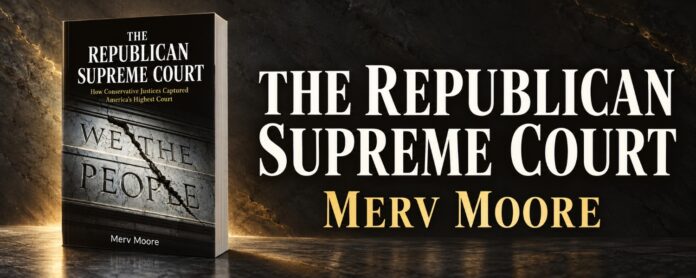
Seagoville publisher examines judicial power, political influence, and the standards Americans should expect from the nation’s highest court.
The distance between the Supreme Court’s promise of impartial justice and its role in American political life is the central concern of The Republican Supreme Court, a book by Shop in Seagoville publisher Merv Moore.
Subtitled How Conservative Justices Captured America’s Highest Court, the $12.99 paperback is available through Moore’s Books.by storefront. Its description presents a critical examination of conservative legal organizing, major court decisions, donor relationships, and judicial accountability.
Moore’s argument reaches beyond disagreement with individual rulings. He portrays the court’s direction as the result of a sustained political and legal effort, connecting the development of conservative legal networks with the decisions that followed.
The listing identifies the Federalist Society, Republican megadonors, and the Heritage Foundation among the subjects addressed. It also describes an examination of justices’ confirmation statements, voting records, and financial relationships.
At the heart of the book is a question with consequences far beyond Washington: how should the public judge an institution whose decisions shape individual rights, political spending, workplace relationships, and presidential authority?
The subjects highlighted in Moore’s description overlap with several major changes in constitutional law. Those decisions provide useful context for the debate the book enters.
In June 2022, the Supreme Court’s decision in Dobbs v. Jackson Women’s Health Organization overturned Roe v. Wade and Planned Parenthood v. Casey. The majority held that the Constitution does not confer a right to abortion and returned regulatory authority to the people and their elected representatives.
The ruling demonstrated how a change in constitutional interpretation can overturn a precedent that had shaped American life for decades. Moore’s description places the reversal of longstanding precedents among its central concerns.
Public-sector labor law provides another example. In Janus v. American Federation of State, County, and Municipal Employees in June 2018, the court held that states and public-sector unions could not collect agency fees from nonconsenting employees. The majority grounded its decision in the First Amendment.
Campaign finance is another area addressed in the book’s advertised scope. The court’s January 2010 decision in Citizens United v. Federal Election Commission struck down restrictions on independent political spending by corporations and unions.
That decision concerned spending independent of candidates. It did not eliminate the prohibition on direct corporate contributions to federal candidates, and the court upheld the disclosure and disclaimer requirements challenged in the case.
These distinctions matter when evaluating the broader political consequences of judicial decisions. Moore’s book argues that the pattern across cases reveals a court increasingly aligned with conservative political interests. That interpretation is the author’s thesis, rather than a conclusion established simply by the outcomes of individual cases.
The book also examines the relationship between judicial ethics and public confidence. Its description highlights gifts, luxury travel, and donor relationships, along with questions about whether justices have met the standards expected of their office.
The Supreme Court issued a written code of conduct for its justices on Nov. 13, 2023. The document calls for judicial independence, impartiality, and avoidance of both impropriety and its appearance. It also states that personal, political, and financial relationships should not influence official conduct or judgment.
In releasing the code, the justices said it largely brought together principles they had long considered applicable to their conduct. That explanation supplies an important part of the institutional context surrounding the accountability debate.
For readers in Seagoville, Crandall, and Combine, the book offers a local author’s perspective on national questions about who exercises power, how that power is checked, and what makes courts worthy of public trust.
Moore’s author biography identifies him as a former sportswriter and international baseball coach. His bookstore includes titles on politics and public affairs alongside books about overseas living and his coaching experiences.
The Republican Supreme Court is available in paperback through Moore’s Books.by bookstore, where readers can review the description and current ordering information.
Disclosure: Merv Moore is the owner and editor of Shop in Seagoville and the author of the book featured in this article.