

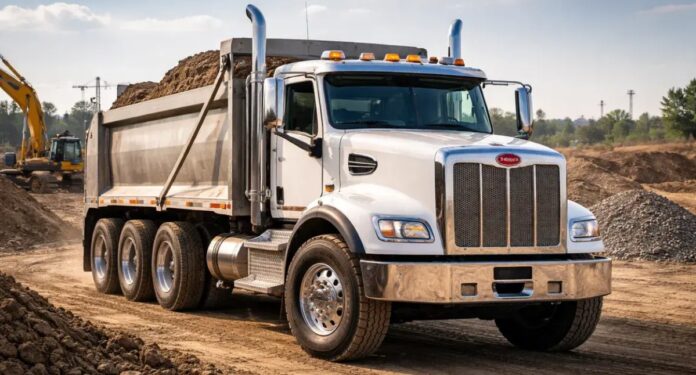
Truck-route violations accounted for nearly half of the Combine Police Department’s reported calls for service last year.
Commercial-truck enforcement has become one of the largest identifiable demands on the Combine Police Department, according to the city’s monthly activity reports.
The department reported 317 truck-route violations during 2025. That represented approximately 46.8% of the 678 calls for service recorded for the year.
The trend continued during the first five months of 2026. The May activity report listed 127 truck-route violations and 323 total calls for service through the end of that month. Based on the city’s published year-to-date figures, truck-route violations represented approximately 39.3% of all calls for service.
Those percentages are striking, but they do not answer the question completely.
Combine’s activity reports count incidents. They do not disclose how much time officers spent responding to them. A truck-route violation that ends with a brief warning and one that requires an extended roadside investigation are each counted as one event.
The reports also do not identify how many violations resulted in warnings, citations, vehicle inspections, or other enforcement action. They do not distinguish between resident complaints and violations discovered by officers on patrol.
What the records do establish is that commercial-vehicle enforcement generates a significant and recurring share of the department’s documented workload.
Enforcement Surged After Route Change
Truck-route activity accelerated dramatically during the summer of 2025.
The department reported 135 truck-route violations in July, accounting for approximately 85% of the month’s 158 calls for service. Another 64 violations were recorded in August, representing about 70% of that month’s 91 calls.
For comparison, the department reported eight truck-route violations in January, five in February, three in March, four in April, 15 in May, and five in June.
The July surge followed a significant change to Combine’s truck-route ordinance.
On May 19, 2025, the City Council approved Ordinance 2025-005, removing Combine Road from the city’s list of designated truck routes. The city’s current ordinance identifies only three designated routes:
- FM 1389 within the city limits
- FM 3039 within the city limits
- Davis Road from Haines Road south to the city limits
The city’s revised map specifically marks the entrance to Combine Road from FM 1389 as a prohibited truck route. It also marks Davis Road immediately west of FM 1389 as closed to truck traffic.
For trucks traveling to sand quarries along Combine Road and Haines Road, the map recommends entering from Malloy Bridge Road, continuing to Bilindsay Road, taking Bois d’Arc Road, and then reaching Combine Road from the west.
The map also warns that Jimmy Lane between Bois d’Arc Road and Haines Road is a private road and is not a truck route.
A Dispute Between Road Protection and Commerce
The decision to remove Combine Road from the approved network exposed the tension between protecting local roads and providing access to businesses that depend on heavy trucks.
According to a Texas Fifth Court of Appeals opinion, the Combine Police Department notified the public that enforcement would begin and said the route change was needed to prevent excessive wear and tear at the intersection of Combine Road and FM 1389.
Verdego Materials operates a sand-and-gravel pit near that intersection. The appellate record states that the company’s customers had used FM 1389 and Combine Road almost exclusively to reach the business.
After the ordinance passed, the city installed a no-truck sign near the mine. Some Verdego customers, along with property owner Clayton Wittwer, received warnings from Combine police for driving trucks on Combine Road.
Verdego and Wittwer sued the city. They argued that the disputed portion of Combine Road was outside Combine’s jurisdiction and was instead owned or controlled by Dallas County or the Texas Department of Transportation. They also alleged that enforcement disrupted the company’s business and caused it to lose customers.
A trial court dismissed the claims, and the Fifth Court of Appeals affirmed that dismissal on Aug. 11, 2026.
The appellate ruling did not make a factual determination that Combine owns or controls the disputed section of road. The court upheld the dismissal primarily on jurisdictional grounds, including Verdego’s failure to establish the type of vested property-right injury required for a civil court to consider its challenge to a penal ordinance.
The result left the city’s ordinance in place while avoiding a direct judicial resolution of the underlying road-control dispute.
What Counts as a Commercial Vehicle?
Combine’s ordinance defines a commercial vehicle broadly as a motor vehicle primarily designed or used to transport property or materials. It includes trailers and semitrailers with a gross weight rating of at least 4,000 pounds.
Passenger buses, motor homes, panel-delivery trucks, farm equipment, passenger cars, motorcycles, pickup trucks, and trailers rated below 4,000 pounds are excluded from that definition.
Commercial vehicles without a local destination or point of origin generally must remain on designated truck routes.
There are exceptions. Trucks may leave a designated route to reach a terminal, repair shop, service location, loading area, or unloading area by using the shortest practical route. Drivers relying on that exception are required to carry evidence showing their last stop and immediate destination.
Emergency vehicles, utility vehicles, school buses, garbage trucks, road-maintenance equipment, farm vehicles, delivery vehicles, and disabled commercial vehicles also receive specified exemptions.
Violations of the city’s truck-traffic chapter may result in fines of up to $500 per occurrence.
Police Chief Controls Residential Permits
Commercial-vehicle parking creates another enforcement responsibility for the Police Department.
A commercial vehicle cannot be parked on residentially zoned property without a permit issued by the police chief. The application requires information about the vehicle, its parking location, the roads it will use, anticipated travel times, and the expected number of daily trips.
The ordinance requires the vehicle to be parked out of view. Each permit applies to one vehicle, costs $50, and remains valid for 12 months. It cannot be transferred to another person or vehicle.
The police chief may place conditions on a permit or deny an application containing false, incomplete, or inadequate information. An applicant has 10 days after receiving a denial to appeal to the city manager, whose decision is final.
The city does not publish the number of permits issued, denied, or renewed. It also does not report how much police time is spent reviewing applications or monitoring permit compliance.
Published Numbers Need More Detail
The city’s reports provide a useful starting point, but several limitations prevent residents from determining the complete cost of commercial-vehicle enforcement.
The reports do not disclose officer hours by call type, citation dispositions, fine revenue connected specifically to truck violations, permit totals, or the number of complaints received from residents.
There are also unexplained differences in some year-to-date figures. The 12 monthly reports for 2025 contain 328 truck-route violations when their individual monthly numbers are added together, while the December report lists a year-end total of 317. The difference could reflect corrections or reclassification, but the report does not provide an explanation.
Similar discrepancies appear in the 2026 reports. April listed 98 truck-route violations year to date. May reported 14 new violations but listed the new year-to-date total as 127, an increase of 29 rather than 14. The May report also contains differences in other cumulative categories.
For that reason, the safest conclusion is not that a specific percentage of every officer’s working hours goes to trucks. The available data cannot support that claim.
It can support a narrower conclusion: Commercial-vehicle enforcement is one of Combine’s most frequently documented police responsibilities. In 2025, the department’s official year-end report classified nearly one of every two calls for service as a truck-route violation.
For residents concerned about road damage, noise, traffic, and safety, those numbers show the city is devoting substantial enforcement attention to the issue. For businesses dependent on truck access, they demonstrate how strongly the route restrictions are affecting daily operations.
What remains unknown is how much that enforcement costs, how many violations produce citations, and how much of the department’s actual working time is being consumed.