

Shop in Seagoville may earn a small commission when readers make a purchase through links in this article, at no additional cost to the buyer.
A dropped pill, discarded chicken bone or piece of sugar-free gum can become a veterinary emergency when a curious dog reaches it before the owner does.
Teaching a reliable “leave it” cue gives families a practical way to stop a dog from approaching, chewing or swallowing something dangerous. It can also reduce food grabbing, trash scavenging, counter surfing and conflicts over household objects.
The command does not simply mean “stop.” It teaches the dog that moving away from an item and turning attention toward the owner will produce a better result.
Owners looking for a complete home-training program can also review the Dog Trainer Bible while building this and other everyday obedience skills.
Understand What “Leave It” Means
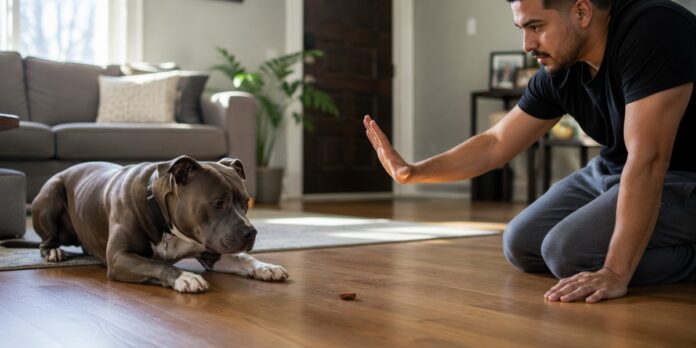
“Leave it” should be used before the dog takes possession of an object. The desired response is for the dog to stop approaching or investigating the item and redirect attention to the owner.
“Drop it” serves a different purpose. That cue is used after the dog already has something in its mouth.
Both commands are valuable, but “leave it” offers an earlier layer of protection by preventing contact with the object in the first place.
Begin With a Closed Hand
Start in a quiet room with a low-value treat in one hand and several better treats in the other.
Show the dog the low-value treat, close it inside your fist and allow the dog to investigate. The dog may sniff, lick or paw at your hand. Keep the fist closed and remain still.
Do not scold the dog or repeatedly say the command. Wait quietly.
The moment the dog pulls its nose away, looks elsewhere or stops trying to reach the treat, mark the correct choice with a word such as “yes.” Immediately give the dog a better treat from your other hand.
The reward should never come from the hand containing the forbidden item. That distinction teaches the dog that leaving one object alone causes something better to arrive from the owner.
Repeat the exercise until the dog quickly backs away from the closed fist.
Add the Verbal Cue
Once the dog consistently moves away, begin saying “leave it” just before presenting the closed hand.
Use the phrase once in a calm, clear voice. Give the dog a moment to make the correct decision.
Mark and reward as soon as the dog disengages. With repetition, the dog will begin connecting the words with the action of moving away.
Families following a structured training schedule may find additional exercises in the Dog Trainer Bible useful when reinforcing attention, impulse control and household manners.
Progress to an Open Hand
Place a treat on your open palm and say “leave it.”
Be prepared to close your hand immediately if the dog moves toward the treat. Reopen it when the dog backs away.
Reward successful responses with a different treat from the opposite hand.
Do not make the exercise harder until the dog can calmly ignore the treat on the open palm. Advancing too quickly can teach the dog that lunging or grabbing sometimes works.
Move the Exercise to the Floor
Place a low-value treat on the floor and cover it with your hand or foot. Keep the dog on a leash so it cannot rush forward and grab the item.
Say “leave it” once. When the dog stops pulling toward the treat or looks back at you, mark the behavior and provide a higher-value reward.
Gradually uncover the floor treat as the dog improves. Remain close enough to block access if necessary.
The dog should not receive the item it was told to leave. Pick it up after the exercise and provide a separate reward.
Build Distance and Distraction Slowly
A dog that responds perfectly in the living room may struggle on a sidewalk filled with food wrappers, animal droppings and unfamiliar smells.
Practice in several rooms before moving into the yard, driveway or another controlled outdoor area. Introduce only one new challenge at a time.
Possible practice items include an uninteresting toy, an empty food container, a paper towel or a piece of ordinary dog food. Avoid using medication, toxic food, sharp objects or anything the dog could swallow during training.
As the dog improves, practice while walking past the object instead of standing still. Reward the dog for turning away and continuing to move with you.
Use the Cue Before Food Grabbing Begins
“Leave it” can help establish calmer behavior around family meals.
Practice with food placed on a counter, table or other surface the dog cannot reach. Reward the dog for keeping all four paws on the floor and focusing elsewhere.
Family members should follow the same rules. A dog that receives food from the table occasionally will continue checking because the behavior sometimes succeeds.
Children should not conduct food exercises without adult supervision. They also should not attempt to remove an object from a dog’s mouth.
Avoid Chasing or Punishing the Dog
Chasing can turn a stolen object into a game. Yelling, grabbing or physically punishing the dog may also cause it to run away, swallow the item quickly or become defensive when people approach.
Instead, use a practiced cue and offer a safe, valuable reward for moving away.
Dogs that growl, snap, freeze or guard objects need more than a basic obedience exercise. Owners should avoid confrontations and seek help from a qualified reward-based trainer, veterinary behaviorist or veterinarian.
Keep Training Sessions Brief
Several short sessions are generally more productive than one long lesson. End while the dog remains engaged and successful.
Three to five minutes of focused practice can be enough for an early session. Puppies and easily distracted dogs may need even shorter periods.
Success should be measured by reliability, not speed. Some dogs learn the basic pattern quickly but need weeks of practice before responding around major distractions.
A broader training resource such as the Dog Trainer Bible can help owners organize short lessons and continue building reliable responses in different environments.
Training Does Not Replace Prevention
Even a well-trained dog may ignore a cue when frightened, excited, hungry or confronted with an unusually tempting object.
Medications, cleaning products, garbage, batteries, strings, children’s toys and toxic foods should remain secured. Trash cans may need locking lids, and food should not be left unattended on low tables or countertops.
Dogs can also swallow bones, corn cobs, food packaging and other objects capable of causing choking or an intestinal blockage. Sugar-free gum and other products containing xylitol can be especially dangerous.
If a dog may have swallowed a toxic substance or hazardous object, owners should contact a veterinarian or animal poison-control service immediately rather than waiting for symptoms.
“Leave it” works best as part of a larger safety system: prevent access, supervise the dog, provide appropriate chew items and reward good decisions.
With patient practice, the cue can become one of the most useful skills a dog learns—and one that may prevent a routine walk or household accident from becoming an emergency.