

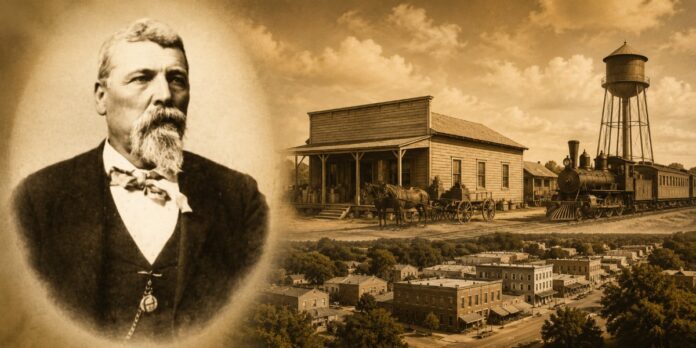
Before Seagoville had paved streets, brick storefronts or a city government, it had a small country store, a new post office and the surname of an enterprising farmer named Tillman Kimsey Seago.
Every day, thousands of people encounter his name.
It appears on city buildings, school uniforms, business signs, highway exits and mailing addresses. Yet the man behind “Seagoville” is far less familiar than the community that continues to carry his name.
Tillman Kimsey “T.K.” Seago was not simply a settler who happened to open a store. During a life that stretched from the Mexican-American War era through the opening years of the 20th century, he worked as a carpenter, farmer, mill operator, merchant, postmaster and Texas legislator. He survived the Civil War, endured economic uncertainty, helped establish a Dallas County town and later entered state politics as an agrarian reformer.
His story is one of repeated reinvention—and of how a modest general store became the center of a growing community.
A Childhood Changed by War
Seago was born July 29, 1836, in Cherokee County, Georgia, the eldest son of Isaac L. Seago and Lucinda Garrett Seago.
His childhood changed dramatically when his father joined the United States military during the Mexican-American War. Isaac Seago contracted measles and died in Mexico when Tillman was about 10 years old. Unable to maintain the family farm without him, Lucinda moved her children west in 1851, settling near present-day Linden in Cass County, Texas.
Formal educational opportunities were limited. Seago attended what contemporary accounts called “common schools,” the basic community schools available to many rural children. He remained on the family farm until August 1855, when he married Matilda Elvira Davenport in Cass County.
The couple eventually had eight children: Sarah, Tillman, Lillie, Polly, Benjamin, Lydia, Ada and Cynthia. Historical research also places both Seago and his wife within families that had previously owned enslaved people, although the Texas State Historical Association reports that the couple did not own enslaved people themselves.
Farmer, Carpenter and Confederate Soldier
Like many young Texans of his generation, Seago moved between occupations as circumstances demanded.
He initially tried farming in Northeast Texas before turning to carpentry. That work supported his family until the Civil War began in 1861.
Seago enlisted as a private in Company I of the Third Texas Cavalry, a Confederate regiment that served in Arkansas, Missouri, Mississippi and other areas west of the Mississippi River. He participated in the Battle of Oak Hill—also known as Wilson’s Creek—and later fought at the Battle of Iuka in Mississippi in September 1862. Union troops captured him at Iuka, but he was released and eventually returned to his regiment, remaining in Confederate service through the war’s conclusion.
When Seago returned to civilian life in 1865, he did not immediately become a successful businessman or town founder.
He farmed in Cass and McLennan counties and operated a mill near Jefferson in Marion County. Each move reflected the uncertainty of postwar Texas, where families were rebuilding livelihoods amid damaged infrastructure, unstable markets and a transformed labor system.
His lasting opportunity came after he moved to southeastern Dallas County.
A Town Begins Behind a Store Counter
Seago did not arrive in an empty wilderness.
Settlers were already living in the area, and John A. Brinegar had established a one-room log school by 1867. Families with names including Buchanan, Cravens, Sorrells, Peak, Moore and Hawthorne were part of the early community. What the area lacked, however, was a central commercial establishment capable of drawing those scattered residents together.
Seago provided it.
In 1876, after clearing timber from his property, he opened the area’s first general store. The business began with approximately $200 in groceries and dry goods—a small inventory by modern standards, but an important resource for rural families who otherwise faced long trips for everyday supplies.
The store became more than a place to purchase flour, tools, cloth or household necessities. In a rural settlement, a general store often functioned as an informal community center—a place where neighbors exchanged news, discussed crops, collected deliveries and conducted business.
A settlement grew around Seago’s store and became known simply as Seago.
The name was not the result of a branding campaign or citywide vote. It was a practical recognition of the man and business at the community’s center. Congressional records later noted that the general store attracted people to the area and helped a small town form around it.
The First Postmaster
The arrival of rail service around 1880 and 1881 accelerated the settlement’s development. Farmers gained a more efficient way to ship cotton, alfalfa and other agricultural products to larger markets, reducing their dependence on wagons and river transportation.
In 1881, Seago received its own post office, and T.K. Seago became the community’s first postmaster.
That appointment was significant. A recognized post office gave a settlement an official identity, improved its connection to the outside world and often strengthened its prospects for continued growth. The first formal town plat was recorded in Dallas County deed records in 1883.
By then, however, the founder was preparing for another chapter.
Seago left the community around 1883 and moved his family to the Dingler area of Comanche County. The town he helped create continued growing without him, gradually adding churches, schools, mills, cotton gins, physicians and additional stores.
The Founder Becomes a Political Maverick
In Comanche County, Seago established a 400-acre farm and became a partner in another general store. He also became increasingly involved in the agrarian political movements challenging Texas’ dominant Democratic establishment.
Seago had joined the Greenback Party in 1878. Greenback supporters argued for expanding the supply of paper currency to ease the financial pressure facing farmers and debtors. The movement also advocated railroad regulation, lower public salaries, fewer unnecessary government offices and stronger public education.
By the 1890s, many of those concerns had migrated into the People’s Party, better known as the Populist Party. The Populists sought to challenge powerful banks, railroad companies and monopolies while giving farmers and laborers a stronger voice in government.
Seago, described in one historical account as a “mysterious, goateed political maverick,” had apparently shown little interest in holding office. That changed in 1894, when he accepted the Populist nomination for the Texas House seat representing Comanche County.
He defeated Democrat Newton R. Lindsey and entered the 24th Texas Legislature on January 8, 1895. Legislative records identify him as the Populist representative for House District 101 and show that he served on the Agricultural Affairs and Public Debt committees.
A Quiet—but Dependable—Lawmaker
Seago’s legislative career was not filled with dramatic speeches or landmark bills.
House records indicate that he introduced no legislation during the 113-day regular session. His only recorded amendment—an effort to clarify how delegates would be allocated at state political conventions—was unsuccessful.
Yet one detail stands out: Seago was never recorded as absent during a roll-call vote.
He may not have been one of Austin’s most vocal politicians, but he was present for the work. His record suggests a dependable if understated representative—more comfortable with farms and country stores than political theater.
He declined to seek another term in 1896, and his legislative service ended in January 1897.
The Name Becomes Seagoville
Seago retired to his Comanche County farm, where historical accounts described the family home as a welcoming gathering place for friends. Those close to him affectionately called him “Uncle Kimsey.”
He died September 17, 1904, at age 68 and was buried beside Matilda at Board Church Cemetery in Comanche County.
Six years after his death, the United States Post Office modified the name of the Dallas County town from Seago to Seagoville to prevent confusion with another Texas community named Sego. The town formally incorporated in 1926.
The added “ville” changed the city’s official name, but it did not erase its origin.
More Than a Name on a Map
T.K. Seago did not live to see the community become an incorporated city. He never saw its paved highways, modern schools, neighborhoods, businesses or industrial development.
What he did see was the beginning.
He saw dense timber cleared from his land. He watched customers step inside a small store stocked with $200 worth of goods. He helped establish a post office and witnessed the arrival of rail transportation. In only a few years, the place surrounding his business developed from a scattered rural settlement into a recognizable town.
Seago’s political career may have been brief, and his original store has long since disappeared. His most enduring accomplishment was not a law passed in Austin or a fortune accumulated in business.
It was a community.
More than a century after his death, Tillman Kimsey Seago’s name remains spoken every day—not as the name of a distant historical figure, but as the name of the city that grew around his store.