

Part 2 of a two-part Development Tracker investigation.
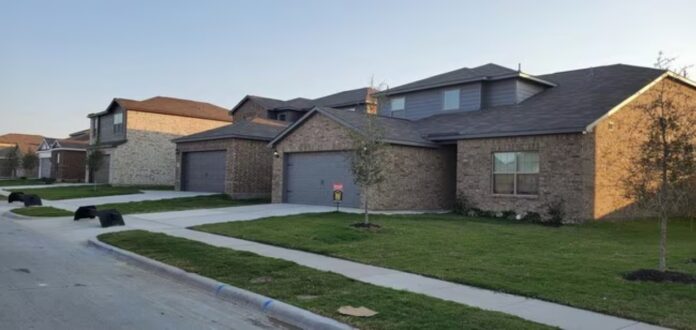
Dallas Central Appraisal District records show two different ownership patterns behind Seagoville’s newer housing: substantial builder ownership on Paul Drive in Edmonds Ranch, and individually recorded ownership at several houses advertised for rent in other subdivisions.
The findings show why rental-company advertisements alone cannot establish who owns a neighborhood.
In a review of 31 Paul Drive property accounts, 26 named LGI Homes Texas-Texas LLC as the owner. Four accounts named individual owners, and one named the Edmonds Ranch homeowners association.
After excluding the association property, LGI appeared on 26 of 30 remaining accounts, or approximately 86.7%.
That establishes concentrated recorded ownership along the street, but it does not establish that 86.7% of the houses are rentals: the accounts include builder inventory, and some records still describe vacant lots.
Builder Ownership and Rental Management
The Paul Drive findings are significant because rental advertisements identify multiple new homes on the same street.
Progress Residential listings include 1707, 1714, 1718, and 1727 Paul Drive, while the appraisal search names LGI on those property accounts.
Those sources describe different roles. The appraisal district identifies the recorded owner in its database, while a rental advertisement identifies the business marketing or managing a lease opportunity.
Neither source, by itself, establishes the full contractual relationship between the builder and the rental operator.
The builder’s website confirms that selected Edmonds Ranch homes are available for lease.
The reviewed materials do not establish whether each Progress-listed home is managed under an agreement with LGI, has recently changed hands, or is subject to another arrangement.
Several houses advertised by the same rental brand demonstrate concentrated marketing or management.
Proving that the same business owns those houses requires matching properties to recorded owners and, where necessary, examining subsequent deeds and company relationships.
That distinction is particularly important in an actively developing subdivision.
A builder can own numerous parcels because homes are under construction, awaiting buyers, or being marketed through different programs.
Property Records Can Trail Construction
The review also found a mismatch between the development’s marketing and some appraisal entries.
Records for 1703 and 1704 Paul Drive name LGI as owner and show no main improvement, with 2026 certified values consisting of $48,000 in land value at each address.
Rental listings reviewed identify both addresses as newly built homes offered for lease. The discrepancy means those appraisal entries cannot be used as a current count of finished houses or occupied residences.
DCAD labels its current ownership and property-information sections for the 2027 appraisal cycle while displaying 2026 certified values.
Those labels refer to different record components; they should not be treated as evidence that all construction, transfers, or occupancy changes have already been incorporated.
For residents trying to measure the neighborhood’s rental share, the practical consequence is substantial.
Counting every builder-owned account as a completed rental would combine vacant lots, construction inventory, and potentially finished homes into a number that does not describe actual households.
The Paul Drive review therefore establishes a concentration of recorded builder ownership.
Determining how many of those properties are completed rentals, occupied rentals, or homes still intended for sale requires additional property-level evidence.
Individual Owners Appear Across Seagoville
Ownership checks outside Edmonds Ranch produced a different result.
Six rental-advertised properties checked in Stonehaven, Seagoville Farms, and Caldwell Lakes were recorded under individual or joint personal names rather than a common corporate owner.
In Stonehaven, those properties were 2110 Colt Court and 2123 Pedigree Lane. The appraisal records identified different individual or joint personal owners for the two addresses.
In Seagoville Farms, 2103 Hialeah Drive and 2007 Belmont Drive were recorded under different individual owners.
Caldwell Lakes records likewise identified different individual or joint personal owners at 2526 Tahoe Drive and 2608 Ontario Drive.
No common named owner appeared among those six properties.
That is a finding about the properties checked, but it does not establish that every rental in those subdivisions is independently owned or that none of the owners holds additional houses elsewhere.
The records also do not establish how many investment properties each person controls.
A broader concentration analysis would require a complete subdivision parcel list, matching owner names and mailing addresses, checking transfers, and examining related entities where evidence points to common control.
One House Can Have Two Advertisements
Online listings introduce another complication: one house can appear in both rental and sale marketing. Realtor.com’s page for 2123 Pedigree Lane displayed separate sale and rental listings for the property.
That means adding sale and rental totals together can count the same house twice. It also means a rental advertisement does not necessarily represent a permanent decision to remove a property from the sales market.
For residents comparing neighborhood listings, the overlap can make the market appear larger than the number of actual houses involved.
A property advertised through several agents or portals remains one physical home.
Similarly, a listing being removed does not prove that a tenant moved in.
Owners and agents can withdraw advertisements, change managers, relist at a different price, or pursue a sale instead, so occupancy requires separate evidence.
City Records Offer Another Measure
Seagoville’s published guidance identifies an administrative record that could help distinguish advertising from occupancy.
The city says a residential certificate of occupancy is required when a residence changes tenants or owners and is required to turn on gas, electricity, and water service.
Those records could provide another way to examine housing turnover when matched carefully to addresses and the reason for each certificate.
Because the requirement applies to both ownership and tenant changes, however, the certificates would need to be classified before being used to count rental activity.
No citywide certificate-of-occupancy dataset was obtained for this review.
The investigation therefore does not present advertised rentals as a count of occupied rental homes, completed leases, or recent tenant arrivals.
What the Ownership Checks Reveal
The strongest ownership concentration documented in this review is builder ownership on Paul Drive.
The other checked properties show several different personal owners, making the visible rental market more varied than the repeated appearance of a management company’s name might suggest.
The evidence does not establish that investors have purchased a majority of homes in Seagoville’s newer subdivisions.
It also does not measure a year-over-year rise in rental ownership or prove that rental activity has caused local sale prices or rents to change.
What it establishes is a housing market with several paths into renting: selected new homes marketed through a builder’s leasing program, new construction advertised by a large rental operator, and individually owned houses advertised after construction and sale.
For Seagoville residents watching new neighborhoods take shape, the owner, the rental manager, and the occupant are three different pieces of the housing picture.