

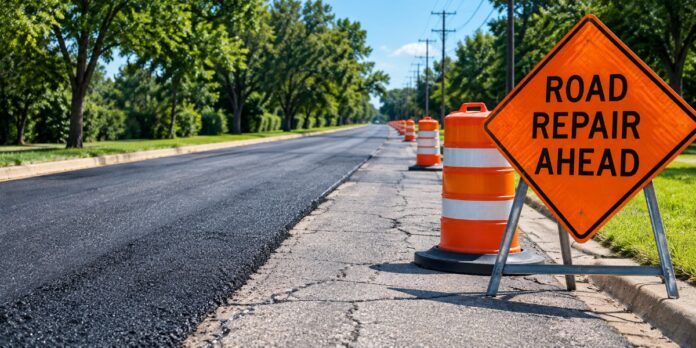
Seagoville’s street-repair decisions involve more than choosing the road with the roughest pavement. Council records show that failing curbs, drainage problems, utility damage, and the cost of rebuilding an entire street have shaped which projects advance and which remain under discussion.
A review of council packets and discussions identifies nine named streets with repair projects, condition findings, or related drainage concerns. The records also show why a pavement-condition ranking cannot be treated as the city’s construction schedule.
More Streets Appear in the October Review
The October 19 presentation identified these locations and conditions. This is a record of the discussion, without assigning an unofficial construction order.
| Street | Finding or proposed work |
|---|---|
| East Malloy Bridge Road | Five patches; approximately $322,000; dips and cracked pavement |
| Seagoville Road | Sinking concrete near Lee Cemetery; approximately 310 feet of one lane |
| Casa Grande | Failed pavement and ponding near Shady/Del Carlo; approximately 266 feet of both lanes, with curb |
| Reeves Lane and Lunday Lane | Combined $479,251.80 asphalt/base quote; engineering recommended over drainage concerns |
| Hall Road | Assessment example showing extensive alligator cracking |
| High School Drive | Assessment example showing isolated cracks |
Malloy Bridge Has an Actual Closure Notice
The city’s posted notice establishes a construction-related disruption on East Malloy Bridge Road. It initially closed the stretch from Crestview Lane to Ross Lane October 26–28, then extended the closure from Crestview Lane to the levee beginning October 28.
That expanded closure was scheduled to continue through Tuesday, November 3. The notice says changes will be posted; it does not certify that work has finished or establish a reopening hour.
For residents traveling through the corridor, those limits are more useful than a general announcement that Malloy Bridge is being repaired. They identify the affected stretch, while leaving the city’s subsequent notices to establish whether the schedule changes.
Reeves and Lunday Have Waited Through Multiple Meetings
The discussion of these two neighborhood streets predates the October assessment. At the May 11 meeting, Harold Magill relayed residents’ resurfacing requests, describing Reeves as a heavily traveled connection from Central toward Farmers and Lunday as a short residential street with about eight houses.
On June 8, Public Works Director Chris Ryan explained that an asphalt contractor’s proposals totaled roughly $400,000 for the two streets. The problem was that their curbs and gutters also needed work, meaning the asphalt proposals did not represent the full repair requirement.
Ryan described an uneven, deteriorated gutter area approximately a foot below the curb-and-gutter elevation at a corner. He said properly addressing the streets could require engineering and either concrete pavement or asphalt with reconstructed concrete curbs and gutters, with the broader work potentially costing upward of $750,000.
Those June figures were preliminary discussion estimates, not an awarded construction contract. They nevertheless establish that the drainage and curb problem was identified months before the October review.
The June meeting minutes record council’s agreement with Ryan’s recommendation to obtain a street inspection and rating system. The October staff report traces the subsequent sequence: discussion was deferred for the pavement study, Magill requested another update September 28, and the subject returned October 19.
That history explains the delay more precisely than describing the streets as simply awaiting resurfacing. The outstanding issue has included defining a repair that addresses the street edges and drainage, along with deciding how the work fits into citywide priorities.
The Available Money Creates a Narrow Margin
The October presentation showed this budget scenario, subject to subsequent spending.
| Budget item | Amount |
|---|---|
| Available funds | $1,245,396.00 |
| Presented priority repairs | $723,680.25 |
| Remaining afterward | $521,715.75 |
| Remaining if Reeves–Lunday quote were added | $42,463.95 |
That last scenario would use approximately 96.6% of available funds. It illustrates the limited room for additional work.
Howard Street Shows a Different Reconstruction Decision
Howard Street provides a documented example of a smaller road project that council approved earlier in 2026. On March 9, members unanimously authorized Anderson Asphalt & Concrete Paving’s reconstruction work at a price not to exceed $78,900, recorded as Resolution 2026-19.
The written work order estimated a 300-by-20-foot area, or 6,000 square feet. Its major items were eight inches of cement stabilization, a 2.5-inch Type B asphalt layer, and a 1.5-inch Type D asphalt layer, plus backfill, traffic control, and bonding.
The estimate allocated $31,920 to stabilization and $45,000 to the two asphalt layers. Those figures show that rebuilding the supporting material represented a substantial portion of the project, rather than an incidental expense beneath the visible paving.
Howard’s authorization should be distinguished from a new upcoming repair announcement. The records establish an approved reconstruction project; the work order reviewed did not contain completed start and finish dates.
Cypress Street Connects Road Repairs to Water Leaks
Cypress Street followed another path. At the May 11 meeting, council unanimously ratified the city manager’s expenditure authorization of up to $104,788 for Anderson Asphalt & Concrete Paving’s asphalt reconstruction, under Resolution 2026-39.
Ryan told council that a major water leak had occurred there about a year earlier and that the contractor had performed the road work the previous week. He described eight inches of subgrade work beneath four inches of asphalt.
This case establishes an actual road repair reported as performed, rather than a request still waiting for consideration. It also illustrates why a street-maintenance review needs to examine utility history: the council explanation connected Cypress’s reconstruction to an earlier water-system problem.
The records reviewed do not establish that every damaged street has a utility-related cause. Cypress supplies a specific documented example, without extending that explanation to other neighborhoods.
Hall Road Requires Segment-by-Segment Reporting
Hall Road also has an earlier reconstruction history that matters when interpreting new condition findings. The city’s 2024 bid notice described approximately 900 linear feet between Shady Lane and Catherine Lane.
The February 26, 2024, council agenda listed consideration of a contract with Reliable Paving for reconstruction of the 800 block, at up to $607,502.36. That agenda establishes the project and proposed contract amount; it should not be mistaken for a current 2026 award.
Those defined limits are essential. A repair covering one Hall Road segment does not establish that the entire road was rebuilt, and the October condition example does not establish that the previously reconstructed segment failed.
Identifying the precise assessment location would be necessary before drawing that conclusion. The available records support separate reporting of the earlier project and the later condition example.
High School Drive Has a Separate Drainage Record
High School Drive’s issues also extend beyond the appearance of its pavement. June 8 council minutes record three residents—Myron Scott, Donnie Williams, and Robert Wagstaff—raising flooding concerns in the alley of High School Drive.
The minutes document those complaints, but do not establish a construction award or completion schedule for an alley-drainage project. A surface-condition example for the street therefore cannot answer the separate question of how the reported alley flooding will be addressed.
A Condition List Is Not a Repair Calendar
City Manager Carey Neal’s October 19 written report explicitly says the assessment evaluates physical roadway condition and excludes traffic volumes, roadway utilization, and other operational considerations. Staff will also consider safety, connectivity, roadway classification, funding, and community impact when recommending projects.
That is a significant qualification to the June discussion of using a worst-to-best rating system. A condition ranking supplies evidence about deterioration, while the city’s stated decision process allows other factors to affect the spending order.
The report also places future improvements within annual budget and capital-improvement processes, subject to available funding. Receiving the assessment itself did not authorize construction.
A complete citywide ranked inventory, with individual project costs and construction dates, was not available in the records obtained for this review. The documented street cases establish substantial local needs and specific decisions, but do not support promising residents a repair date for every road named.