

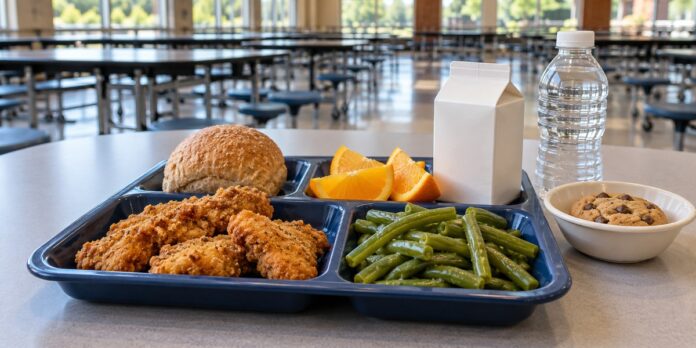
Free meals give Dallas and Mesquite students the lowest checkout price, while extras and eligibility rules can change a family’s cafeteria bill.
SEAGOVILLE — A student can receive lunch at no charge in Dallas or Mesquite ISD while a classmate in neighboring Crandall or Forney pays several dollars.
But the district with the lowest meal price does not necessarily offer the cheapest snacks, or the lowest adult lunch price.
A review of published district nutrition pages found substantial differences in student charges for the 2026–27 school year.
It also found gaps in publicly available prices that prevent a complete comparison of every cafeteria purchase.
For families, the biggest distinction is whether their child receives a qualifying school meal or buys individual items separately.
What students and adults pay
Dallas ISD, which serves Seagoville schools, provides breakfast and lunch at no charge to all enrolled students through the Community Eligibility Provision.
Families do not need to submit a meal application. Mesquite ISD also provides free breakfast and lunch to all enrolled students without an application.
Crandall and Forney publish full-price lunch charges alongside benefits for eligible students.
| District | Elementary student lunch | Older student lunch | Adult lunch |
| Dallas ISD | Free | Free | Current price not verified |
| Mesquite ISD | Free | Free | $5.50 |
| Crandall ISD | $3.75, Pre-K–5 | $4.00, grades 6–12 | Current price not verified |
| Forney ISD | $3.70, elementary and intermediate | $3.80, middle and high school | $4.90 |
Student charges shown are the published full-price rates where applicable. Eligible Crandall and Forney students receive qualifying meals at no charge.
Among the two districts publishing verified current adult prices in this review, Forney’s lunch is 60 cents cheaper than Mesquite’s.
Crandall’s meal-payment page still labels its price schedule 2025–26, including a $5 adult lunch.
Its separate 2026–27 benefits page lists higher student prices but does not establish a current adult charge. The older adult figure should therefore be confirmed before a visitor relies on it.
For a hypothetical 20-lunch month, a full-paying elementary student would spend $75 in Crandall or $74 in Forney.
An older student would spend $80 or $76, respectively. Those calculations exclude extras.
The purchases that change the bill
Free lunch does not mean every item in the cafeteria is free.
Mesquite specifically identifies chips, cookies, juice and bottled water as purchases students can make separately.
Forney states that meal benefits do not cover à la carte items.
Crandall’s published à la carte list provides these examples:
| Separate purchase | Crandall price |
| Milk | $0.75 |
| Chips | $1.00 |
| Bottled water | $1.00 |
| Cookie, brownie or similar snack | $1.25 |
| Ice cream | $1.50 |
| Extra entrée | $2.50 |
A Crandall secondary student buying a $4 lunch, $1 chips and $1 bottled water would spend $6. Repeated over 20 lunches, that becomes $120.
The posted à la carte document does not display a school-year designation.
Forney’s separate à la carte webpage says “COMING SOON,” and comparable current item prices were not verified for Dallas or Mesquite.
The available evidence therefore does not support naming a district with the cheapest snack basket.
What the meal must offer
Federal standards give the comparison a common nutritional framework, although menus and recipes differ.
For kindergarten through eighth grade, the lunch pattern requires schools to offer at least a half-cup of fruit and three-quarters of a cup of vegetables daily.
For grades nine through 12, those minimum offerings increase to one cup each.
All three grade groups must be offered one cup of milk, with additional grain and meat or meat-alternate requirements.
Weekly average calorie ranges are 550–650 for grades K–5, 600–700 for grades 6–8 and 750–850 for grades 9–12.
These are menu-planning standards, not measurements of what each child actually eats.
Selection matters, too. Forney explains that students must choose at least three of the five food groups, including a fruit or vegetable, to qualify for the meal price.
Taking only one or two groups results in individual-item charges.
Adult prices do not automatically buy larger portions.
Mesquite says its adult lunch includes an entrée, one cup each of fruit and vegetables, and eight ounces of milk; additional items cost extra.
Eligibility can outweigh the price difference
Crandall and Forney both state that students qualifying for reduced-price benefits receive breakfast and lunch free in 2026–27.
Crandall accepts applications throughout the school year and identifies household income and certain assistance programs or student circumstances as eligibility pathways.
Families experiencing unemployment or an increase in household size may become eligible.
For households paying full price, those benefits can make a much larger difference than the few cents separating neighboring districts’ lunch charges.