

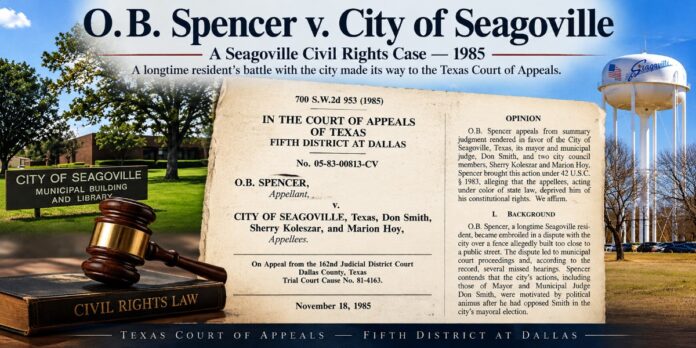
More than four decades ago, a dispute over a backyard fence in Seagoville escalated far beyond a simple code violation. A vocal critic of Seagoville’s city government was arrested, jailed for about 25 hours and later filed a federal civil rights lawsuit. The case eventually reached the Dallas Court of Appeals.
At the center of it all was O.B. Spencer, a longtime Seagoville resident. Spencer accused city officials of using the municipal court and local police power to punish him for speaking out against city hall.
In 1985 an appellate court reversed a summary judgment that had shielded the city from Spencer’s claim. The court sent that part of the case back to the trial court for further proceedings.
The appellate judges never concluded that Seagoville had retaliated against Spencer. They ruled only that the city had not shown it deserved judgment as a matter of law. The dispute had begun years earlier.
A Fence Dispute Becomes Something Bigger
According to a January 1982 account in D Magazine, Spencer had clashed with the city over a fence about four feet high that was allegedly built too close to a public street. The dispute produced court proceedings and claims that Spencer missed several scheduled hearings.
But Spencer was no ordinary defendant in a code case. D Magazine described him as a former political opponent of Mayor Don Smith and an outspoken critic of the city administration.
About a week before his arrest, Spencer had called publicly for the resignation of the entire city council. Then came Sept. 1.
Smith served simultaneously as Seagoville’s mayor and municipal judge, and he signed the warrants for Spencer’s arrest. The timing immediately raised questions.
Spencer was arrested outside a church where he had planned to speak against a proposed city tax increase. He was handcuffed and taken to jail.
D Magazine reported that Spencer remained jailed for about 25 hours and was placed in leg irons during part of his confinement. The city had filed 12 charges against him.
Smith defended the arrests at the time, telling the magazine that Spencer had clearly broken the law and that he had little choice but to act. But none of the charges ended in a conviction.
D Magazine reported that all the charges against Spencer were eventually dismissed in other courts. The later appellate opinion described the outcome differently, noting that Spencer said he was acquitted of the traffic offenses.
What followed was not a routine dispute over local ordinances. It was a federal lawsuit accusing Seagoville officials of something far more serious.
Spencer Alleges Retaliation
Spencer sued the City of Seagoville, Smith and two municipal court employees. The claims came under Section 1983, the federal law that lets people sue government officials for violating constitutional rights while acting under government authority.
The other defendants were Sherry Koleszar and Marian Hoy. Koleszar served as Seagoville’s city secretary and municipal court clerk, while Hoy worked as the court’s deputy clerk.
According to Spencer’s second amended lawsuit, Koleszar and Hoy signed complaints accusing him of failing to appear for traffic citations. Smith then issued warrants based on those complaints.
Spencer alleged the complaints were false on their face and that the warrants were legally deficient. Dallas County sheriff’s deputies who had been hired to work as Seagoville police officers arrested and jailed him.
Spencer said the deputies treated him cruelly during the arrest and his time in custody. But his central claim went much further.
Spencer said the arrest itself was retaliation for his criticism of city hall. He alleged that Smith, Koleszar and Hoy wanted him arrested and jailed to embarrass him in front of friends and neighbors.
His lawsuit included claims of false imprisonment, malicious prosecution and a violation of his right to free speech. He accused Smith of using his position as municipal judge to “persecute his enemies and critics.”
The courts would ultimately treat the officials and the city differently.
Judge and Clerks Protected by Immunity
The trial court initially granted summary judgment for all the defendants. Spencer appealed.
The Dallas Court of Appeals issued its opinion on Nov. 18, 1985. It upheld the dismissal of the claims against Smith, Koleszar and Hoy.
The ruling on Smith rested on judicial immunity. The court found nothing in the record showing he had acted outside his judicial role when he issued the warrants.
Smith and Koleszar had submitted affidavits stating that their actions were part of the normal operation of the municipal court. The appellate court said Spencer had not offered evidence to contradict that.
That distinction mattered.
The judges did not rule that Spencer’s retaliation claims were false. They concluded only that Smith was shielded from personal liability because issuing warrants was a judicial act within his authority.
The court reached the same conclusion about Koleszar and Hoy. Because they were performing normal court duties when they signed the failure to appear complaints, judicial immunity protected them as well.
The City of Seagoville was another matter.
Court Revives Case Against Seagoville
The city raised three main arguments to dismiss Spencer’s lawsuit. It cited sovereign immunity and a lack of notice under the Texas Tort Claims Act. It also said the city did not control the county deputies who made the arrest.
The Court of Appeals rejected those arguments as grounds for summary judgment on the federal claim. The judges noted that cities can be held liable under Section 1983 when an official policy or custom causes a constitutional violation.
Even if Seagoville did not control the deputies during the arrest, the court said that did not answer a different question. Could a city policy have been the driving force behind an unlawful arrest?
The city’s summary judgment motion had not ruled out that possibility, according to the court. The appellate court reversed the judgment protecting Seagoville and returned Spencer’s claim against the city to the trial court. It affirmed the judgments for Smith, Koleszar and Hoy.
What Happened Next?
From there, the public record becomes harder to follow. A review of available court opinions and legal databases found no later appellate decision explaining what happened after the case returned to the trial court.
There is no verified record showing whether Spencer won, lost, settled or abandoned his claim. The 1985 ruling should not be read as a finding that Seagoville violated his constitutional rights. It was not.
The ruling instead found that the city had not proven its case for dismissal on the record presented. Still, the underlying facts documented in the historical record are extraordinary.
A resident who had just called for the City Council’s resignation was arrested outside a church where he planned to speak against a proposed tax increase. The mayor who issued the warrant also served as the municipal judge.
Spencer spent about 25 hours in jail. None of the charges against him resulted in a conviction.
He later accused Seagoville officials of using government power to punish him for criticizing city hall. More than 40 years later, the case still stands as part of Texas legal precedent on judicial immunity.
Whatever happened after the case returned to the trial court, Spencer v. City of Seagoville remains a striking chapter in local history. It was a municipal dispute that grew into a constitutional fight over government power and free speech. At its center stood one of Seagoville’s most outspoken critics.
A Note on Sources
This account draws on two verified sources. The first is the appellate opinion in Spencer v. City of Seagoville, reported at 700 S.W.2d 953 (Tex. App.—Dallas 1985). The second is a contemporaneous report published in January 1982 by D Magazine.