

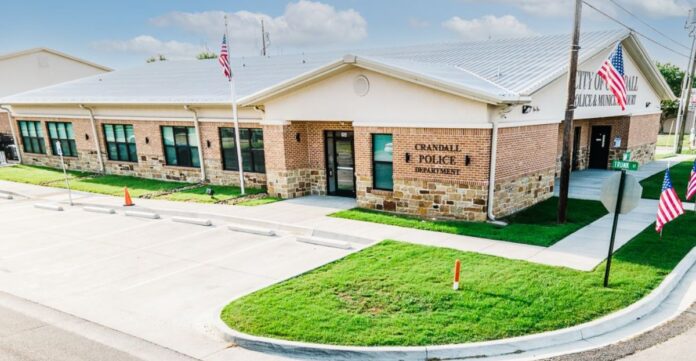
Rapid residential growth around Crandall has increased demand for police protection. A review of city financial records shows established Crandall taxpayers are not shouldering the full cost of policing some of the city’s largest new communities.
Instead, Crandall receives substantial payments through police service agreements covering Heartland, Wildcat Ranch and Eastland. Those arrangements brought in nearly two million dollars for the General Fund in the fiscal year 2024 adopted budget. That figure equaled roughly two thirds of the entire Police Department budget for that year.
The developments are not simply new neighborhoods generating ordinary property tax revenue. Crandall provides police protection under interlocal agreements for areas beyond its traditional service structure. Heartland, Wildcat Ranch, Eastland and Highbridge are currently listed among the communities receiving coverage this way.
Nearly Two Million Dollars in Police Service Revenue
The city’s adopted fiscal year 2024 budget projected three major police service payments. Combined, the agreements were expected to generate $1,994,998.83 for the city.
That total marked a 67.7% increase over the roughly $1.19 million budgeted the year before, when only Heartland and Wildcat Ranch had agreements in place. Eastland appeared as a separate revenue line for the first time in the fiscal year 2024 budget.
Heartland represented about 65% of the three agreements combined. Wildcat Ranch represented roughly 29%, and Eastland accounted for about 6%.
| Community | FY2024 Budgeted Revenue | FY2024 Actual Revenue | FY2026 Proposed Revenue |
|---|---|---|---|
| Heartland | $1,297,972 | $1,297,972 | Approximately $1.48 million |
| Wildcat Ranch | $569,970.55 | $565,793 | $839,713 |
| Eastland | $127,056.28 | $128,238 | $267,393 |
| Total | $1,994,998.83 | Approximately $1.992 million | More than $2.59 million combined |
Source: City of Crandall FY2024 Adopted Budget Book and FY2026 proposed budget documents.
The Money Is Tied Directly to Police Costs
Crandall does not simply deposit these payments into the General Fund without tracking corresponding costs. The police budget separately itemizes salaries, overtime, benefits, retirement contributions, training, uniforms, fuel and equipment tied to each of the three communities.
| Community | FY2024 Budgeted Salaries | Additional Notes |
|---|---|---|
| Heartland | $712,109 | — |
| Wildcat Ranch | $257,876 | — |
| Eastland | $73,086 | Plus a separate $75,800 vehicle allocation |
When benefits, retirement, fuel and equipment are added, more than $1.5 million in FY2024 spending was specifically labeled for these three service areas.
This accounting structure shows Crandall has worked to separate the cost of policing these communities from the cost of policing the city itself.
Heartland Has Long Paid for Police Protection
The Heartland arrangement is not new. City council minutes from January 2014 show Crandall debating an interlocal police agreement with Kaufman County Municipal Utility Districts 12 and 14, which serve the Heartland area.
At the time, some residents and council members asked whether city taxpayers were subsidizing Heartland, since Heartland residents do not pay Crandall property taxes. Police Chief Dean Winters told the council that Heartland reimbursed the city for the cost of providing service.
Then Police Chief Dean Winters told the council that Heartland reimbursed Crandall for the costs of providing the service, including vehicles, officer training, equipment and salaries.
That debate more than a decade ago addresses essentially the same question Crandall faces today. It asks whether providing police service outside the traditional city limits creates an added burden for Crandall taxpayers.
The Agreements Have Continued to Grow
More recent financial records show the police service program has not disappeared. It has expanded.
Crandall’s FY2026 proposed budget documents show actual FY2024 police service revenue of approximately $1,297,972 from Heartland, $565,793 from Wildcat Ranch and $128,238 from Eastland. That produced about $1.992 million in actual revenue, remarkably close to the original budgeted figure.
The same report lists total Police Department expenditures of about $2.44 million for that year. Revenue from the three agreements equaled roughly 81% of the department’s total actual spending.
That does not mean 81% of police activity occurred in those developments. It means the contract revenue flowing into the General Fund was exceptionally large relative to the department’s total cost.
Are Crandall Taxpayers Subsidizing the Developments?
Based on available records, there is no clear evidence that existing Crandall taxpayers are broadly subsidizing police protection for Heartland, Wildcat Ranch and Eastland. The opposite appears more plausible.
Crandall receives designated revenue while separately tracking substantial expenses tied to those communities. City officials have historically described the Heartland agreement as reimbursement for the cost of service.
The FY2024 numbers show agreement revenue exceeding the expenditures specifically labeled for those three communities. That does not automatically mean Crandall is profiting.
A police department carries major shared costs that cannot easily be assigned to one neighborhood. These include the chief and command staff, dispatch, technology, insurance, facilities and equipment used across the whole city.
Without the complete cost allocation formulas contained in each interlocal agreement, it would be inaccurate to treat the gap between revenue and labeled expenses as pure surplus. Still, the financial structure strongly suggests participating communities are covering a substantial share of the cost they create.
The Arrangement May Actually Help Crandall
There is another side worth noting. Officers funded through these agreements are Crandall police officers.
Vehicles, equipment, training and personnel added to serve growing communities also expand the department’s overall size and capability. That was one argument made during the original Heartland debate: contract funded officers could give Crandall a larger police force than city taxpayers alone could support.
If outside revenue helps fund staffing and equipment that also benefit Crandall during emergencies or major incidents, these agreements may expand the city’s law enforcement capacity. That expansion would come without requiring existing residents to finance the full cost.
Growth Is Making the Numbers Bigger
The scale of the arrangement keeps growing. Crandall’s FY2026 proposed budget projects approximately $1.48 million from Heartland, $839,713 from Wildcat Ranch and $267,393 from Eastland. Combined, that is more than $2.59 million.
The city’s police website now also lists Highbridge as a community covered by an interlocal agreement. The city’s recent General Fund revenue table does not yet identify Highbridge as a separate revenue line.
A Growing Share of How Crandall Funds Its Police Department
The central question is no longer whether growth requires more officers. It clearly does.
The more important question is whether Crandall can keep structuring these agreements so that the communities creating new service demand pay their proportionate share. Available budgets suggest the city has largely done exactly that.
Rather than showing established taxpayers quietly absorbing new policing costs, the records show Heartland, Wildcat Ranch and Eastland providing a major revenue stream. That stream helps finance the officers, benefits, vehicles, fuel, training and equipment required to police these rapidly growing areas.
With development related police payments now measured in millions of dollars annually, these agreements have become more than a side arrangement. They are now a major part of how Crandall funds its Police Department.