

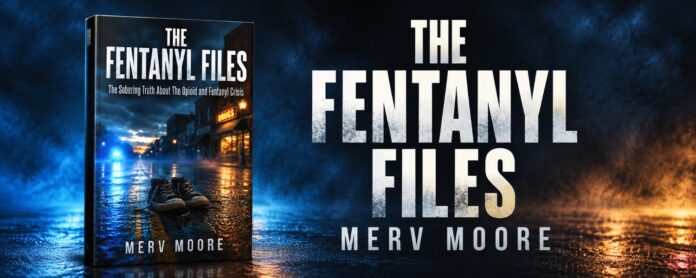
Merv Moore’s “The Fentanyl Files” explores the illicit drug trade and the families left to deal with its consequences.
The international business behind fentanyl and the losses it leaves inside American homes are the focus of The Fentanyl Files: The Sobering Truth About the Opioid and Fentanyl Crisis, a nonfiction book by Seagoville author Merv Moore.
The book addresses the connections between drug production, trafficking, distribution, and family upheaval. Its description outlines a narrative stretching from chemical suppliers in China and cartel operations in Mexico to American communities confronting overdose deaths.
Moore, editor in chief of Shop in Seagoville, presents the subject as both a criminal enterprise and a human tragedy. The book’s stated scope includes intermediaries, pill manufacturers, online sellers, and relatives raising children after a death in the family.
That approach brings together two sides of the crisis: how illicit drugs reach consumers and what happens to the people left behind.
The storefront describes a supply-chain narrative involving laboratories, trafficking routes through Arizona, and online marketplaces. It also highlights accounts of mothers, grandfathers, and siblings assuming caregiving responsibilities. Those family experiences form a central part of the book’s presentation, alongside its examination of the trade’s financial incentives.
The subject remains consequential even as national overdose figures show improvement.
Federal mortality data published in January 2026 recorded 79,384 U.S. drug overdose deaths in 2024, compared with 105,007 in 2023. The age-adjusted overdose death rate fell 26.2% over that period, according to the Centers for Disease Control and Prevention’s National Center for Health Statistics.
Deaths involving synthetic opioids other than methadone also declined sharply. The age-adjusted death rate for that category fell 35.6% between 2023 and 2024. Fentanyl is included in that category, although the category is broader than fentanyl alone.
Those figures provide essential context for readers approaching a book about the epidemic: the national toll has fallen, while tens of thousands of people continue to die from overdoses annually.
Understanding fentanyl also requires distinguishing its medical use from its presence in the illegal drug supply.
Pharmaceutical fentanyl is used in surgery and to treat severe pain. The CDC links most fentanyl-related harms and overdoses to illegally manufactured fentanyl, which can appear in powder or counterfeit pills.
Those pills may resemble prescription medications, including oxycodone or alprazolam. Fentanyl can also be mixed with heroin, cocaine, and methamphetamine, sometimes without the person taking the drug knowing it is present.
That uncertainty helps explain why the subject reaches beyond people who knowingly seek fentanyl. A pill’s appearance does not establish its contents, and the CDC warns that fentanyl cannot reliably be identified by sight, taste, or smell.
For families, the public-health response includes knowing how to recognize an overdose and act quickly. Warning signs include an inability to wake someone, slow or shallow breathing, choking or gurgling sounds, and discoloration around the lips or nails.
The CDC advises administering naloxone if available, calling 911, and staying with the person until emergency assistance arrives. Naloxone can reverse an opioid overdose, including one involving fentanyl, and nasal-spray products are available over the counter.
Moore’s book places its emphasis on the wider story behind those emergencies: the people moving drugs through an illicit market and the households forced to absorb the consequences. Its combination of trafficking and family narratives positions the subject as an issue affecting communities, caregivers, and public institutions.
The Fentanyl Files was listed at $9.99 in paperback as of Sept. 25, 2026. The author’s description and ordering information are available at books.by/merv-moore/the-fentanyl-files.
Disclosure: Merv Moore is the editor in chief of Shop in Seagoville and the author of the book featured in this article.