

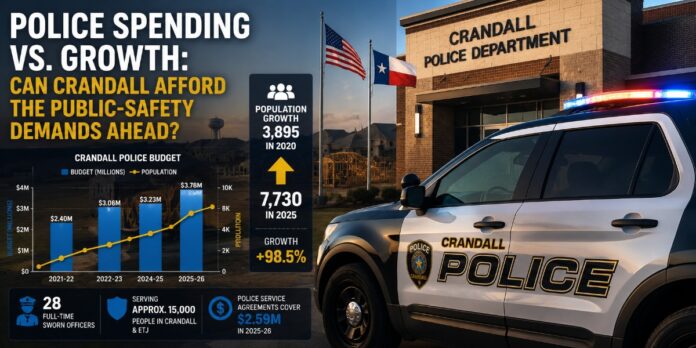
Crandall is becoming a much bigger city, and its police department is growing considerably more expensive along with it.
The city’s adopted police budget has climbed from approximately $2.40 million in fiscal year 2022 to 2023, to $3.78 million in fiscal year 2025 to 2026, an increase of roughly 57.5 percent in three years.
At first glance, that looks like a dramatic jump for a city Crandall’s size. But there is another side to the numbers. A large portion of the Crandall Police Department’s budget supports police services provided to growing developments outside the traditional city population, and those areas are paying the city millions of dollars for that coverage.
That makes the real question more complicated than simply asking whether Crandall is spending too much on police. The bigger question is whether police staffing, outside revenue and city finances can continue growing fast enough to keep pace with a community that has nearly doubled in population in only a few years.
Police Budget Has Climbed Sharply
Crandall’s adopted police department budgets show a steady increase over the past four fiscal years.
| Fiscal Year | Police Budget |
|---|---|
| 2022 to 2023 | $2.40 million |
| 2023 to 2024 | $3.06 million |
| 2024 to 2025 | $3.23 million |
| 2025 to 2026 | $3.78 million |
The current budget represents an increase of approximately $1.38 million from three years ago. Police now account for roughly 31 percent of all budgeted General Fund expenditures in fiscal year 2025 to 2026, making law enforcement one of Crandall government’s largest operating commitments.
Personnel makes up a major part of that increase. The police budget includes salaries and benefits for officers assigned not only to Crandall itself but also to contracted service areas including Heartland, Wildcat Ranch and Eastland.
Crandall Is Not Paying the Entire Bill
This is where simply citing the $3.78 million police budget can be misleading. Crandall also receives substantial revenue for providing police services outside its traditional city limits.
Budgeted revenue from the Heartland, Wildcat Ranch and Eastland police service agreements totals approximately $2.59 million in fiscal year 2025 to 2026. Three years earlier, those same categories generated approximately $1.37 million, an increase of about 89 percent. In other words, contracted police revenue has grown even faster than the overall police department budget.
The difference between the police department’s gross budget and those three police service revenue categories is approximately $1.19 million this year, compared with approximately $1.03 million in fiscal year 2022 to 2023.
That calculation does not represent the city’s complete net cost of policing, since other revenues and expenses also affect the final picture. But it does demonstrate something important: the explosive growth in Crandall’s police budget is not being financed entirely by Crandall residents.
Outside developments receiving police coverage are contributing heavily toward the cost.
The Population Numbers Explain the Pressure
Crandall’s population growth has accelerated dramatically. The latest Census population estimate places Crandall at approximately 7,730 residents in 2025, compared with a 2020 estimate base of approximately 3,895, growth of roughly 98.5 percent in five years.
But the incorporated population does not describe the police department’s entire workload. Crandall Police currently reports that it provides police services to approximately 15,000 people within Crandall and its extraterritorial jurisdiction, nearly twice the city’s estimated incorporated population.
New homes create more than property tax revenue. They also generate additional traffic, crashes, theft reports, disturbances, alarms, domestic calls, investigations and calls for service.
Hundreds or thousands of additional residents can eventually require more patrol officers, supervisors, detectives, vehicles, radios, body cameras, training and administrative support, and those costs do not disappear when the construction crews leave.
Police Staffing Is Growing Too
The department is also expanding its workforce. A current City of Crandall police recruitment posting describes the department as having 28 full time sworn police officers.
Those figures are up from an earlier city recruitment listing that described the department as having 25 full time officers and two reserve officers. The latest posting indicates Crandall has increased its full time sworn staffing while continuing to recruit.
The city’s current starting salary for police officers is approximately $59,366, with higher compensation available through the department’s salary progression and for qualifying lateral hires.
Recruitment matters because a growing police budget does not automatically mean more officers are available. Cities compete for the same pool of licensed officers, and salaries, benefits, and working conditions determine whether smaller departments can recruit and retain personnel.
Growth Is Also Producing More Revenue
Crandall’s rapid development is not only creating expenses. It is expanding the tax base.
The city’s adopted 2025 to 2026 budget projected more than $4.15 million in property tax revenue for maintenance and operations, substantially higher than the previous year’s budget.
City budget documents state that the overall budget was expected to raise approximately $1.21 million more in property taxes than the previous year, with about $909,000 coming from new property added to the tax roll.
That is the financial bargain at the center of Crandall’s growth. More rooftops mean more residents requiring city services, but those rooftops also create additional taxable property that can help pay for those services.
The challenge is timing. Police officers, patrol vehicles and equipment may be needed before a development reaches full buildout and before its entire tax base begins producing revenue.
There Is Not Much Room for Mistakes
Crandall’s 2025 to 2026 General Fund budget calls for approximately $12.22 million in revenue and $12.19 million in expenditures, a difference of only about $30,000 in the adopted operating budget.
That does not mean Crandall has only $30,000 available or that the city lacks reserves; fund balances and other financial resources are separate issues. But it does demonstrate how closely projected recurring revenues and expenditures are matched, and in a city expanding this rapidly, major unexpected costs can change the equation quickly.
Additional police positions can cost far more than an officer’s salary once health insurance, retirement, workers’ compensation, training, uniforms, equipment and vehicles are included. Multiply that across several new positions, and public safety can become expensive very quickly.
Can Crandall Afford What Is Coming?
For now, the numbers suggest Crandall has found a way to expand law enforcement without forcing city taxpayers to absorb the entire cost.
The police budget has risen 57.5 percent since fiscal year 2022 to 2023, but budgeted revenue from the city’s three major police service agreements has risen even faster.
Staffing has increased. New development is adding property tax revenue. And outside developments are helping finance the officers serving those areas.
But Crandall’s growth is moving fast enough that today’s staffing level may not answer tomorrow’s needs.
The numbers residents should watch next are not simply the total police budget. They are calls for service, response times, officer vacancies, overtime, crimes per capita, officers per shift, and how much contracted developments continue contributing toward police operations.
If those indicators begin deteriorating while population continues climbing, Crandall may eventually face a difficult decision: add substantially more police spending, accept lower levels of service, or find additional revenue.
For a city that has nearly doubled in population since 2020, that is not a distant policy question. It is becoming part of the cost of Crandall’s transformation.