Shop in Seagoville may earn a small commission when readers make a purchase through links in this article, at no additional cost to the buyer. Shop in Seagoville only recommend products we believe will provide value to our readers.
For many dogs, the couch is one of the most appealing places in the house. It is soft, comfortable, smells like their family and often puts them right beside the people they want to be around.
That can make teaching a dog to stay off furniture more complicated than simply saying “no.” Successful training depends on giving the dog a clear alternative, rewarding the behavior you want and making sure everyone in the household follows the same rules.
Decide on the Rule Before Training Begins
The first decision is whether the furniture is always off-limits or whether the dog will sometimes be allowed up by invitation.
Either approach can work, but inconsistency makes training much harder. If one family member allows the dog on the couch every evening while another removes the dog whenever it jumps up, the dog receives conflicting information.
For families that want a completely furniture-free rule, every person in the house needs to follow it. Children, visitors and anyone else who regularly interacts with the dog should know the expectation.
Consistency applies to verbal cues as well. If the family chooses “off” as the cue for leaving furniture, everyone should use the same word rather than switching between “off,” “down,” “get down” and other commands.
Owners looking for a broader system for establishing household behaviors can also use a structured resource such as the Dog Trainer Bible alongside regular practice at home.
Give the Dog Somewhere Better to Go
Telling a dog where not to rest only solves half the problem. The dog also needs to know where it should settle instead.
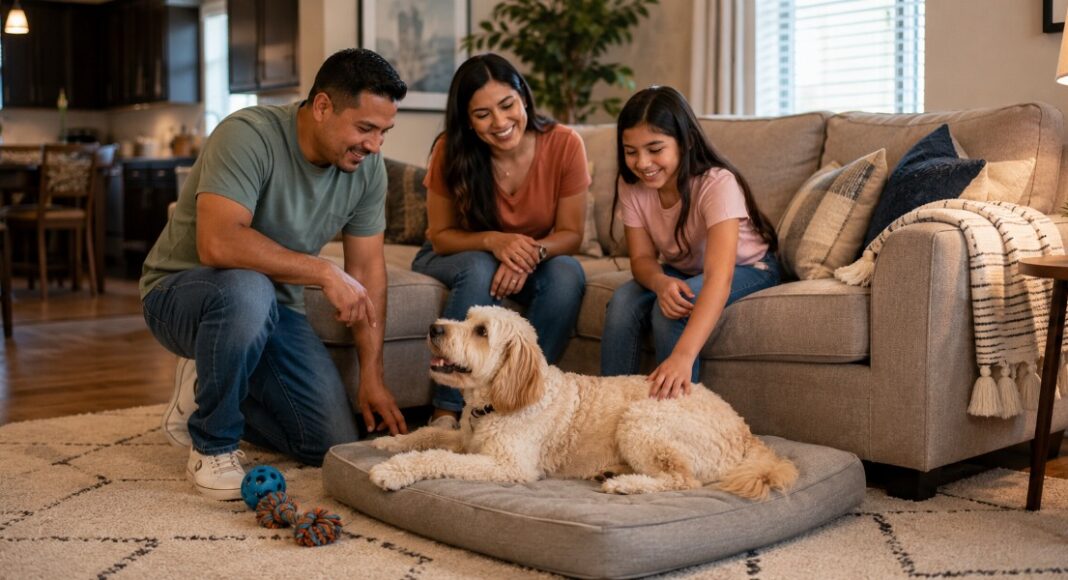
Place a comfortable dog bed, mat or crate near the area where the family spends time. A dog that wants to be close to its people may be much more willing to stay on its own bed if that bed is beside the couch rather than isolated in another room.
The resting area should also fit the individual dog. Some prefer cushioned beds, while others like raised cots, mats or enclosed crates. Older dogs may need additional padding and support.
Make the new location rewarding. Give treats, toys or appropriate chews while the dog is on the bed. Praise calm behavior there instead of waiting until the dog jumps onto the couch before paying attention.
The objective is for the dog to learn that its own resting area is not a punishment—it is a comfortable place where good things happen.
Teach a “Place” Cue
A useful next step is teaching the dog to go to its bed or mat on command.
Begin in a quiet room with few distractions. Guide the dog toward the bed and reward it as soon as all four paws are on the designated area. Once the dog understands that getting onto the bed earns a reward, begin encouraging a sit or down position.
Gradually increase the amount of time the dog remains there before receiving its reward.
A release word such as “free” or “release” can help the dog understand when it is permitted to leave. Training should progress slowly, increasing duration, distance and distractions separately rather than expecting the dog to master all three at once.
The same type of step-by-step approach is useful for many household behaviors, and owners who want additional training exercises can review the Dog Trainer Bible training guide.
What to Do When the Dog Jumps on the Couch
If the dog climbs onto furniture, remain calm.
Use the established “off” cue and encourage the dog to return to the floor. Once the dog gets down, direct it to its bed or mat and reward it there.
The timing matters. The reward should reinforce going to the appropriate resting area—not jumping on the couch first.
Avoid turning the situation into a game of chasing, grabbing or repeatedly arguing with the dog. Some dogs may interpret that attention as part of the reward for climbing onto the furniture.
Training works better when owners spend more time rewarding correct choices than reacting dramatically to mistakes.
Prevent Practice When Nobody Is Watching
Training is easier when the dog cannot repeatedly practice the unwanted behavior.
If a dog spends every afternoon sleeping on the couch while the family is away, it may be difficult to convince the dog that the same couch becomes forbidden when people return home.
During the learning period, owners can restrict access to the room, use an appropriately positioned pet gate or provide a safe alternative area when the dog cannot be supervised.
Crate training may also be useful for dogs already comfortable with a properly introduced crate. Confinement should not be used as punishment.
The goal is management: prevent the dog from repeatedly rewarding itself with access to the furniture while the new habit is being established.
Avoid Scare Tactics
Keeping dogs off furniture should not require frightening them.
Devices or objects designed to startle a dog when it jumps onto a couch can create anxiety without clearly teaching the animal what it should do instead.
Reward-based training provides a clearer lesson: the couch does not produce a reward, while resting on the designated bed does.
Dogs learn through repetition and consequences. When going to their own bed consistently produces treats, praise, toys or attention, that behavior becomes increasingly valuable.
Make Sure the Entire Family Participates
One of the biggest obstacles to successful furniture training is the family member who quietly breaks the rule.
A dog does not understand that Dad allows couch time on Saturday nights but Mom does not allow it Monday morning. From the dog’s perspective, climbing onto the couch sometimes works—which gives the dog a reason to keep trying.
Families should agree on the cue words, whether invitations onto furniture are ever permitted, where the dog’s resting areas are located and how everyone will respond when the dog makes a mistake.
A written set of household rules can be particularly helpful when several adults or children share responsibility for the dog.
Practice Before You Expect Perfection
Short training sessions are usually more productive than long ones.
Practice sending the dog to its bed several times when nothing exciting is happening. Once the behavior becomes reliable, add normal household distractions such as people walking around, television noise or family members sitting on the couch.
Reward successful behavior frequently at first. As the dog becomes more reliable, treats can become less frequent while praise and other rewards continue.
Owners interested in working on furniture manners along with other common household behaviors can find additional exercises in the Dog Trainer Bible.
When the Problem Is More Than Furniture Manners
Most furniture issues are training and management problems, but growling, snapping or guarding a couch or bed requires a different approach.
Do not physically force a dog off furniture if it is displaying aggressive or guarding behavior. Those situations can escalate and create a bite risk.
A qualified positive-reinforcement trainer, certified behavior consultant or veterinary behavior professional can evaluate the behavior and develop an appropriate plan.
For the typical dog that simply prefers the family couch to its own bed, however, the formula is much simpler: establish one clear rule, provide an appealing alternative, reward the correct choice and make sure everyone in the house follows through.