

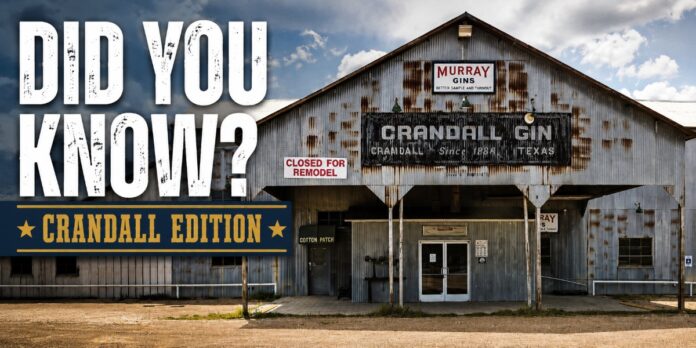
Crandall residents drive past railroad tracks, neighborhoods, schools and businesses every day, but many may not know that the community itself owes much of its beginning — and its name — to the arrival of the railroad nearly 150 years ago.
The story begins with the Rev. C. F. Crandall, a Methodist minister who moved to the area from Indiana in 1877 and purchased about 1,800 acres of land.
Just three years later, the Texas Trunk Line Railroad was building eastward from Dallas. Crandall supported the effort and provided the railroad a right-of-way through his property. That decision helped put a new community on the map.
And the community took his name.
When railroad tracks reached the area in 1880, development followed quickly. The new settlement became a shipping point where area farmers could move agricultural products to larger markets. Before highways, trucks and modern distribution centers transformed North Texas, access to a railroad could determine whether a small settlement grew or disappeared.
Crandall was positioned to grow.
A post office was established in 1881, with Rev. Crandall serving as the first postmaster. By 1884, the young community had about 50 residents along with a gristmill, cotton gin, church and school.
Growth continued. The townsite was officially recorded in 1889, and Crandall’s school system was established in 1901. By the early 1900s, the community had developed into a small commercial center with stores, a lumber yard, physicians and multiple banks.
That’s a remarkable transformation for a place that had only recently been farmland.
Today, Crandall is experiencing another era of dramatic change as residential and commercial development spreads across western Kaufman County. New subdivisions, businesses and families are reshaping the community once again.
But long before U.S. Highway 175 carried thousands of vehicles through town, it was the railroad that helped launch Crandall’s story.
And it all started with a Methodist minister willing to make room for the tracks.
Did You Know? Crandall Edition is a new Shop in Seagoville weekly feature uncovering interesting, surprising and sometimes forgotten facts about Crandall and its history.