

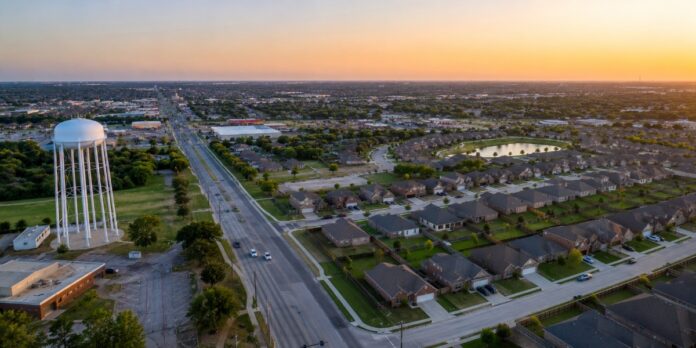
Population trends point toward at least 26,000 residents, while Seagoville’s subdivision pipeline could push the city closer to 29,000—and possibly 30,000—by 2035.
Seagoville may be less than a decade away from becoming a city of nearly 30,000 people.
A review of population estimates, residential building permits, approved development plans and land available for future subdivision phases places the most supportable 2035 population range between approximately 26,000 and 29,000.
Reaching 30,000 residents is possible, but it would require Seagoville’s current housing pipeline to continue advancing at a rapid pace.
Population Has Already Crossed 21,000
The U.S. Census Bureau estimated Seagoville’s population at 21,077 as of July 1, 2025.
That represents an increase of approximately 2,600 residents, or 14.2%, from the city’s 2020 population base of 18,458.
The longer-term change is even more significant. Seagoville had 14,835 residents in 2010, meaning the city’s population has increased by more than 42% in 15 years.
Seagoville’s growth has not occurred at the explosive rate seen in some communities farther north in the Dallas-Fort Worth area. However, it has been steady enough to reshape the city’s housing market, infrastructure needs and commercial potential.
What Current Growth Rates Predict
There is no single official, publicly posted population forecast that says exactly how many people will live inside Seagoville’s city limits in 2035.
Regional forecasts prepared by the North Central Texas Council of Governments divide future population among Traffic Analysis Zones rather than publishing one simple 2035 number for every city.
Several reasonable projections can still be calculated from Seagoville’s established growth patterns.
If the city adds residents at approximately the same numerical pace recorded since 2020, Seagoville would reach about 26,100 residents by 2035.
Extending the average annual growth rate recorded between the 2010 and 2020 censuses produces a similar projection of approximately 26,200.
Continuing the faster growth rate experienced between 2020 and 2025 would place the population closer to 27,100.
Those calculations suggest that even without a major acceleration, Seagoville is likely to add another 5,000 to 6,000 residents during the next decade.
Building Permits Show a Larger Housing Pipeline
Population trends alone may understate how much Seagoville could grow.
Federal building-permit records show that 90 single-family homes were authorized in Seagoville during 2023. That number jumped to 381 in 2024 before settling at 280 in 2025.
Together, those three years produced permits for 751 single-family homes.
A building permit does not guarantee that a home will be completed or occupied immediately. Nevertheless, the volume demonstrates that builders are preparing significantly more housing than Seagoville historically added during an average year.
At the city’s current average of 3.29 people per household, 751 occupied homes could eventually accommodate approximately 2,470 residents.
Some of those homes and residents are already reflected in the latest population estimate. The permit totals should therefore be viewed as evidence of development momentum rather than added directly to the 2025 population.
Santorini Could Become a Major Population Center
The largest identified residential development plan is the Santorini Public Improvement District.
Santorini covers approximately 528 acres and is planned for an ultimate total of about 1,938 single-family lots.
Its first improvement area contains 393 planned lots. The final plat for Santorini Phase 1A, containing 264 residential lots, was recorded in September 2024.
A March 2025 developer report listed 35 lots as end-user owned, 69 as homebuilder owned and 289 as developer owned within the first improvement area.
The remaining major improvement area covers approximately 392 acres and is planned for another 1,545 homes. No plats had been recorded in that portion of the development when the 2025 annual update was prepared.
Santorini alone could eventually house several thousand residents, depending on household sizes and how quickly its later phases are constructed.
Stonehaven Adds Another 809 Planned Homes
The Stonehaven Public Improvement District represents another large portion of Seagoville’s future housing supply.
The approximately 246-acre development is planned for 809 single-family lots.
Stonehaven’s first improvement area contains approximately 304 lots on nearly 69 acres. Its remaining 177 acres are designated for one or more future improvement areas containing approximately 505 additional homes.
Combined, the Santorini and Stonehaven plans contain an ultimate capacity of approximately 2,747 single-family lots across more than 774 acres.
That does not mean 2,747 homes remain unbuilt. Some lots have already been platted, permitted, sold, constructed or occupied.
The plans nevertheless demonstrate that developers have identified enough residential capacity to support continued growth well beyond the city’s present population.
How Much Undeveloped Land Is Really Available?
The 2020 Census measured Seagoville’s land area at 18.79 square miles, or approximately 12,026 acres.
Not all of that acreage can be converted into subdivisions.
The city includes a 334-acre preserve, the approximately 500-acre Dallas ISD Environmental Learning Center and a 200-acre water-reclamation facility. Together, those three properties account for more than 1,000 acres that are not part of the normal residential-development market.
Other acreage is occupied by established neighborhoods, businesses, public facilities, transportation corridors, drainage areas and land with infrastructure or environmental limitations.
Seagoville does not currently publish a simple citywide total showing how many vacant acres are immediately available and economically practical for development.
The known subdivision plans provide a clearer measurement. Santorini and Stonehaven alone identify approximately 570 acres assigned to later development areas beyond their initial phases.
Those future phases represent a substantial reserve of residential land, but their construction will depend on housing demand, financing, utility capacity and city approval of individual plats.
What It Would Take to Reach 29,000
The Census Bureau estimates that Seagoville households average 3.29 people.
Adding 1,500 occupied homes at that household size would bring approximately 4,900 additional residents. Starting from the 2025 estimate, that would place Seagoville near 26,000.
Adding 2,400 occupied homes would provide room for approximately 7,900 additional residents, placing the city close to 29,000.
Approaching 30,000 would require roughly 2,700 net additional occupied households at the current average household size.
The combined Santorini and Stonehaven plans demonstrate that this level of ultimate housing capacity could exist. However, some of those homes and residents are already included in current permits and population estimates.
Reaching 30,000 by 2035 would probably require most planned phases to move forward, continued infill construction and possibly additional subdivisions or multifamily development.
City Documents Point to Build-Out Around 2040
Seagoville’s latest annual financial report says the city is projected to reach build-out around 2040.
That estimate supports the possibility that much of Seagoville’s remaining developable territory could be committed or substantially developed by the middle of the next decade.
Build-out does not mean construction will stop completely. Older properties can be redeveloped, vacant parcels can be filled and housing density can increase.
It generally means the supply of large, easily developed tracts within the city limits will become increasingly limited.
Growth Will Depend on Infrastructure
The final population will not be determined by land and housing demand alone.
Water and sewer capacity, street improvements, drainage systems, police and fire staffing, school enrollment and access to Highway 175 will influence how quickly new neighborhoods can be completed.
The future Loop 9 corridor could also affect development interest in southeastern Dallas County, although its full influence on Seagoville remains uncertain.
Higher mortgage rates or a regional housing slowdown could delay subdivision phases. Lower borrowing costs, new employment centers or transportation improvements could accelerate construction.
The Most Likely 2035 Outcome
A population between 26,000 and 27,000 appears likely if Seagoville continues growing at its established long-term rate.
A population between 28,000 and 29,000 becomes realistic if current building activity continues and substantial portions of Santorini and Stonehaven are completed and occupied.
Reaching or surpassing 30,000 residents by 2035 remains an aggressive scenario rather than the most likely outcome.
The larger conclusion is clearer: Seagoville is no longer growing only through scattered infill homes and small neighborhood additions.
With hundreds of recent permits, nearly 2,750 lots included in two major development plans and the city anticipating build-out around 2040, the Seagoville of 2035 could be considerably larger—and much more developed—than the community residents know today.