

Shop in Seagoville may earn a small commission when readers make a purchase through links in this article, at no additional cost to the buyer.
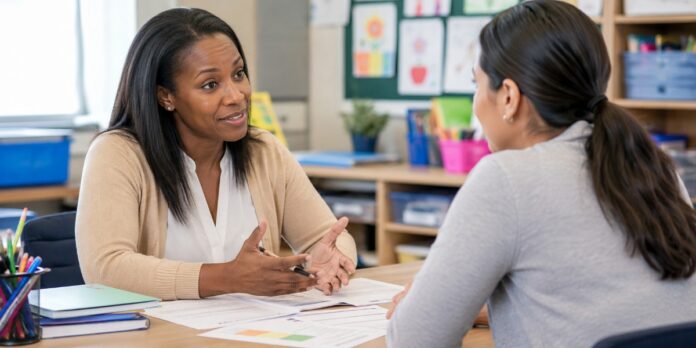
Parent-teacher conferences give families an opportunity to learn what report cards and online grade portals may not reveal.
Grades can show whether assignments were completed successfully, but they may not explain how a child participates, handles frustration, interacts with classmates or responds when work becomes difficult.
Parents can receive more useful information by moving beyond the familiar question, “How is my child doing?” The following questions are designed to produce specific answers about academic progress, classroom behavior and the support a student may need.
1. What Academic Progress Have You Seen?
Parents should ask what the child can do now that he or she could not do earlier in the grading period.
This shifts the conversation away from a single grade and toward measurable growth. The teacher may describe improvements in reading fluency, mathematical reasoning, writing organization, vocabulary, participation or assignment completion.
Parents can follow up by asking to see a recent assignment, assessment or classroom example demonstrating that progress.
2. Is My Child Meeting Grade-Level Expectations?
A child can receive passing grades and still need additional help with an important skill.
Parents should ask whether the student is working at, above or below the expected level in each major subject. They should also ask how that determination was made.
The answer may include classroom performance, assessments, work samples and observations. When a child is below expectations, parents should ask which specific skills require attention rather than accepting a general statement that the student needs to “work harder.”
3. What Are My Child’s Strongest Skills?
Conferences should not focus exclusively on problems.
Understanding a child’s strengths can help families identify effective learning strategies, build confidence and encourage greater responsibility. A student may excel at explaining ideas verbally, solving problems independently, helping classmates or completing hands-on activities.
Parents interested in encouraging initiative outside the classroom can explore the myKidPrenuers: The StartUp Generation E-books while looking for age-appropriate ways to connect a child’s strengths with creativity, planning and goal-setting.
4. Which Skill Should We Prioritize Next?
A request to “practice reading” or “improve math” may be too broad to guide families at home.
Parents should ask the teacher to identify one or two priority skills. For example, a child may need to summarize a passage, memorize multiplication facts, organize written paragraphs or check completed work for errors.
A specific target gives the family and teacher a shared goal. It also makes progress easier to recognize during a later conversation.
5. How Does My Child Respond When Work Becomes Difficult?
A student’s reaction to challenging work can affect learning as much as academic ability.
Some children ask for help appropriately. Others rush, stop working, become distracted, avoid the assignment or grow visibly frustrated.
Parents should ask what the teacher observes and whether the response changes by subject, time of day or type of activity. Similar information from home may help determine whether the difficulty involves the skill itself, confidence, attention, organization or another factor.
6. How Does My Child Participate in Class?
Participation includes more than raising a hand.
A student may contribute during small-group activities, listen carefully, ask thoughtful questions or help move a discussion forward. Another child may understand the material but hesitate to speak in front of the class.
Parents should ask whether their child participates appropriately, listens to others and remains engaged during instruction. The teacher may also explain whether the student’s participation is consistent or changes depending on the subject or classroom setting.
7. How Does My Child Interact With Other Students?
Social behavior can influence a child’s comfort, attendance and ability to learn.
Parents should ask whether the child works cooperatively, respects personal boundaries, handles disagreements appropriately and appears connected to classmates.
A child does not need to be highly outgoing to be socially successful. The more important questions are whether the student feels safe, has healthy interactions and can participate without regularly withdrawing, disrupting others or becoming involved in conflict.
8. Are There Behavior Patterns I Should Know About?
Instead of asking whether a child “behaves,” parents should request specific observations.
Does the student frequently leave the seat, talk during instruction, forget materials, struggle during transitions or need repeated reminders? When does the behavior usually occur, and what happens immediately before it?
Parents can use resources such as the myKidPrenuers: The StartUp Generation E-books to reinforce responsibility and planning at home while making sure expectations remain appropriate for the child’s age and development.
A pattern is more informative than an isolated incident. Parents should also ask which classroom strategies have already been tried and whether they have helped.
9. What Can We Do at Home That Would Help Most?
Families should ask for realistic activities that directly support the teacher’s priority goals.
The most useful recommendation might involve reading together, reviewing vocabulary, practicing multiplication facts, organizing a backpack or establishing a consistent homework routine.
Parents should be honest about their schedules and available resources. A simple activity completed regularly is usually more practical than an ambitious plan the family cannot maintain.
The myKidPrenuers: The StartUp Generation E-books may also help parents introduce structured activities involving problem-solving, money awareness and personal initiative without turning every evening into another school session.
10. What Should We Monitor Before the Next Check-In?
The conference should end with a clear understanding of what happens next.
Parents and teachers can agree on one or two goals, the steps each person will take and the evidence that will show improvement. They should also decide when progress will be reviewed.
The follow-up may be a brief email, telephone call, progress report or another meeting. Parents should ask how the teacher prefers to communicate and when it would be reasonable to check in again.
Prepare Before the Meeting
Parents can make the conference more productive by reviewing grades, assignments, attendance records and teacher messages in advance.
They should ask their child what is going well, what feels difficult and whether there is anything the teacher should know. Writing down the most important questions helps prevent key concerns from being forgotten.
Parents may not have enough time to ask all 10 questions. They should select the three or four that matter most and address those early in the conversation.
Share Information From Home
A parent-teacher conference should be a two-way exchange.
Changes involving sleep, transportation, family routines or major household events may affect a student’s attention or behavior. Parents do not need to disclose every private detail, but relevant context can help the teacher interpret changes more accurately.
Families should also share strategies that work at home. A child may respond well to written instructions, advance notice of transitions, short breaks or visual reminders.
Ask for Examples, Not Labels
Words such as “lazy,” “unmotivated,” “disruptive” or “careless” do not explain what is happening.
Parents should calmly ask for specific examples: What did the child do? How often has it occurred? During which activities? What support was provided, and how did the child respond?
Specific observations make it easier for families and educators to identify patterns and develop practical solutions.
Leave With a Shared Plan
A successful conference should produce more than a summary of grades.
Parents should leave knowing the child’s strengths, the most important area for improvement, what the teacher will do, what the family can do and when progress will be reviewed.
That shared plan turns the meeting into an ongoing partnership focused on helping the child make measurable academic, behavioral and personal progress.