

Shop in Seagoville may earn a small commission when readers make a purchase through links in this article, at no additional cost to the buyer.
Training a dog can test even the most patient owner. Repeated accidents, ignored commands, pulling on the leash and destructive behavior can become frustrating, especially when progress seems slow. Yelling may feel like an immediate response, but it often creates fear and confusion instead of teaching the dog what to do.
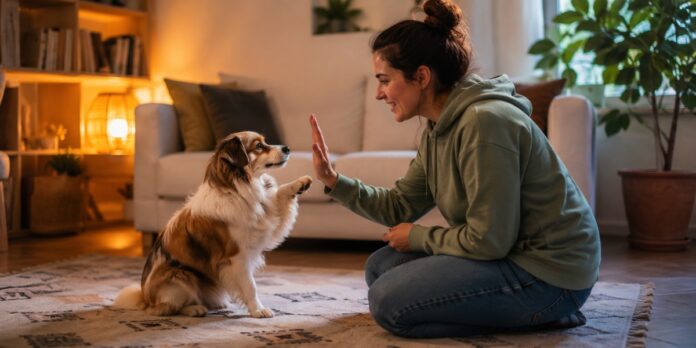
Calm, reward-based training focuses on reinforcing the behaviors an owner wants to see. Dogs learn more effectively when instructions are clear, rewards are timely and training sessions remain short and consistent.
Understand What the Dog Is Learning
Dogs do not automatically understand household expectations. A puppy does not know that chewing a shoe is wrong, and an adult dog may not understand why jumping on visitors is unacceptable.
Punishing a dog after the behavior has already happened is usually ineffective. Unless the response occurs immediately, the dog may not connect the correction with the original action. An angry reaction can instead teach the dog to fear the owner’s voice, body language or presence.
Owners should focus on showing the dog an acceptable alternative. A dog chewing furniture can be redirected to a safe chew toy. A dog jumping for attention can be rewarded when all four paws remain on the floor.
Reward the Behavior You Want
Reward-based training uses something the dog values to strengthen good behavior. Rewards may include small treats, praise, toys, petting or a brief opportunity to play.
The reward should be given immediately after the correct behavior. When teaching “sit,” for example, the dog should receive the reward as soon as its rear touches the floor. Waiting too long may cause the dog to associate the reward with standing up, barking or another action.
Treats should be small enough for the dog to eat quickly. Training rewards do not need to be full-size biscuits. Tiny pieces allow owners to repeat an exercise several times without adding too many calories.
As the dog becomes more reliable, food rewards can gradually become less frequent. Praise and other rewards should still be used to reinforce good behavior.
Keep Training Sessions Short
Long training sessions can frustrate both the dog and the owner. Many dogs learn best through several short sessions spread throughout the day.
A five-minute practice session can be more productive than a 30-minute lesson. Owners can practice “sit” before placing down the food bowl, “stay” before opening the door and “come” during supervised play.
Ending the session after a successful response helps keep training positive. It is better to stop while the dog is engaged than to continue until the dog becomes distracted or the owner becomes irritated.
Give One Clear Command
Repeating a command several times can teach a dog that it does not need to respond the first time.
An owner who says “sit, sit, sit” may unintentionally train the dog to wait until the third command. Instead, the owner should say the word once, pause and help the dog complete the behavior if necessary.
Everyone in the household should use the same commands. If one person says “down” to mean lie on the floor and another uses “down” to stop jumping, the dog may become confused. Families should agree on simple words for each behavior.
Hand signals can also improve communication. Dogs often notice body movement more quickly than spoken language.
Manage the Environment
Good training also involves preventing the dog from repeatedly practicing unwanted behavior.
Shoes, food and household objects should be kept out of reach while a puppy is learning. Baby gates can limit access to certain rooms. A leash may be used indoors during supervised training to prevent jumping or chasing.
A dog that steals food from the counter is being rewarded by the food itself. Preventing access removes that reward and makes the behavior less likely to continue.
Management is not a substitute for training, but it gives the dog fewer opportunities to make mistakes while learning new expectations.
Respond Calmly to Mistakes
Dogs will make mistakes during training. When that happens, owners should pause, redirect the dog and try again.
If frustration begins to build, the session should end. The dog can be placed safely in a crate, pen or another comfortable area with a toy while the owner takes a break.
Walking away is more productive than shouting. Training while angry may cause the owner to use harsher corrections or give inconsistent commands.
Owners should also consider whether the dog is tired, overstimulated, afraid or distracted. A dog that performs well indoors may struggle outside because of noises, people, animals and unfamiliar smells. Training should begin in a quiet environment before moving to more challenging locations.
Set Realistic Expectations
Progress is rarely immediate. Puppies have short attention spans, and newly adopted dogs may need time to adjust to their surroundings. Some behaviors require weeks or months of consistent practice.
Owners should measure improvement in small steps. A dog that remains seated for three seconds has made progress, even if the eventual goal is a 30-second stay.
Breed tendencies, age, health, prior experiences and energy level can also affect training. A dog that suddenly stops following familiar commands, becomes unusually aggressive or shows a major change in behavior should be evaluated by a veterinarian to rule out pain or illness.
Know When to Seek Help
Some problems require professional support. Aggression, severe fear, resource guarding, repeated biting or extreme separation distress should not be handled through guesswork.
A qualified trainer can observe the dog, identify triggers and create a safe training plan. Owners should look for professionals who explain their methods clearly and use humane, reward-based techniques.
Training is not about controlling a dog through fear. It is about building communication, setting consistent expectations and helping the animal succeed.
Owners who remain calm, reward good choices and practice regularly are more likely to develop a dog that responds reliably and feels secure. Patience is not simply part of training. It is one of the most important skills the owner must learn.