
Local markets, festivals and community celebrations can give small businesses, artists, food producers and side-hustle operators an affordable way to introduce their products to new customers. A well-planned booth can also help sellers test new merchandise, build name recognition and learn what customers are willing to purchase before investing in a storefront or larger operation.
Successful market selling, however, involves more than placing merchandise on a folding table. New vendors should understand the full cost of participation, confirm permit requirements, design an inviting display and prepare to accept several forms of payment.
Calculate the Full Cost of the Booth
The vendor fee is usually the first expense sellers notice, but it may not be the only one. Booth prices vary based on the event’s size, location, expected attendance and the amount of space provided. A standard booth may include only an assigned area, while tables, chairs, tents, electricity and internet access may cost extra.
Before submitting an application, vendors should ask the organizer:
- What size is the booth space?
- Are a table and chairs included?
- Is electricity available?
- Are generators permitted?
- Is the fee refundable if the event is canceled?
- Must vendors provide their own tent weights?
- Are vendors required to carry liability insurance?
- Does the organizer limit the number of businesses selling similar products?
Sellers should also budget for travel, packaging, signs, table coverings, product displays, credit-card processing fees and meals during the event. Outdoor vendors may need a commercial-quality canopy, approved tent weights, battery-powered lighting and weather-resistant storage containers.
A booth fee should be evaluated against realistic sales expectations. A vendor who spends $100 on the space and another $75 on supplies, transportation and packaging must generate more than $175 before recovering the event-related costs. The cost of producing the merchandise must also be included when determining whether the event was profitable.
Confirm Permits Before Accepting Sales
Permit requirements depend on what is being sold, where the event is held and which government agency has jurisdiction.
In Texas, sellers offering taxable products or services at fairs, festivals, craft shows and other temporary markets may be required to obtain a Texas Sales and Use Tax Permit, collect the appropriate tax and report the sales. The Texas Comptroller treats a festival or market booth as a temporary place of business. There is not a separate temporary sales tax permit created only for a single festival. (Texas Comptroller)
Vendors should not assume that an event application replaces a state or local permit. The organizer’s approval gives the seller permission to participate in the event, but the seller may remain responsible for tax registration, health permits, business licenses or other approvals.
Seagoville also maintains local requirements for certain vendors. The city states that solicitors must obtain a permit before selling or contacting residents within the city, and its permitting system includes itinerant-vendor and health permits. Requirements can differ for organized festivals, flea-market vendors, mobile businesses and door-to-door sales.
Food sellers must be especially careful. Temporary food establishments may need health-department approval, and the responsible agency could be the state, a city, a county or a public-health district. Texas Department of State Health Services guidance says temporary food permits under its jurisdiction are issued for specific booths and events, with applications generally due at least 30 days before the event.
Some products may qualify for different rules. Whole, unprocessed fruits and vegetables, certain prepackaged foods and qualifying cottage-food products may be treated differently from food that must remain under temperature control. Vendors should contact the health authority responsible for the event rather than assuming that another market’s rules will apply.
Build a Booth That Is Easy to Shop
A booth has only a few seconds to attract someone walking past. Customers should be able to understand what is being sold without stopping to ask.
The business name should be visible from the aisle. Prices should also be clearly displayed. Hidden prices can discourage customers who do not want to begin a conversation before knowing whether an item fits their budget.
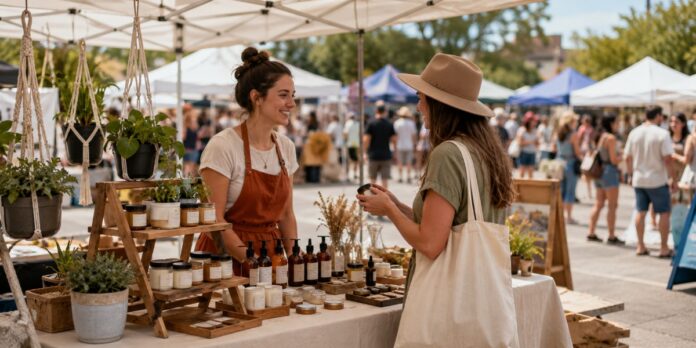
Displays should create height instead of placing every item flat on one table. Shelves, crates, stands and vertical sign holders can make products easier to see. The booth should still remain open enough for customers to browse without knocking over merchandise.
A simple display often performs better than one filled with decorations. The products should remain the focus. Sellers can use a consistent table covering, a readable business sign and a few carefully selected display pieces to create a professional appearance.
Outdoor vendors must secure tents and signs properly. Even moderate wind can lift an unsecured canopy or send lightweight signs into neighboring booths. Sellers should follow the organizer’s rules for tent weights and should not rely only on stakes, especially when setting up on pavement.
Offer More Than One Payment Option
Cash remains useful at community events, but sellers should also be prepared to accept cards or contactless payments. Customers may walk away from a booth when their preferred payment method is unavailable.
A basic payment setup may include:
- Cash with an organized change box
- A mobile card reader
- Contactless card and digital-wallet payments
- A payment link or scannable code
- Printed or electronic receipts
Vendors should test their card reader, charging cables, backup battery and payment application before leaving home. Outdoor events can have weak cellular service when large crowds use the same network. Sellers should understand whether their payment system offers an offline mode and how those transactions are processed.
Cash should be kept out of public view, and large bills should be removed from the booth periodically. One person should remain responsible for the cash box whenever possible.
Prepare Inventory and Packaging
New sellers frequently struggle with deciding how much merchandise to bring. Producing too little can lead to missed sales, while producing too much can tie up money in unsold inventory.
A first event should be treated as a learning opportunity. Vendors can bring a reasonable assortment at several price levels, record what sells and use those results to prepare for future markets. Low-cost items can attract first-time buyers, while premium products may produce a larger profit from fewer transactions.
Bags, boxes, wrapping material and care instructions should be prepared before the event. Food products should be labeled as required, and handmade items may benefit from a small card containing the business name, website or social-media information.
Review the Results After the Event
The total amount collected does not automatically represent profit. Sellers should subtract booth fees, payment-processing charges, product costs, packaging, travel and other event expenses.
They should also record which items sold, which price points performed best, what questions customers asked and whether the event attracted the right audience. An event that produces modest immediate sales may still be valuable if it generates future orders or introduces the business to repeat customers.
For beginners, the best market is not always the largest festival. A smaller, well-organized event with an audience that matches the product may provide a better starting point. Careful preparation, accurate pricing and a professional display can turn a simple booth into an important step toward building a sustainable local business.