

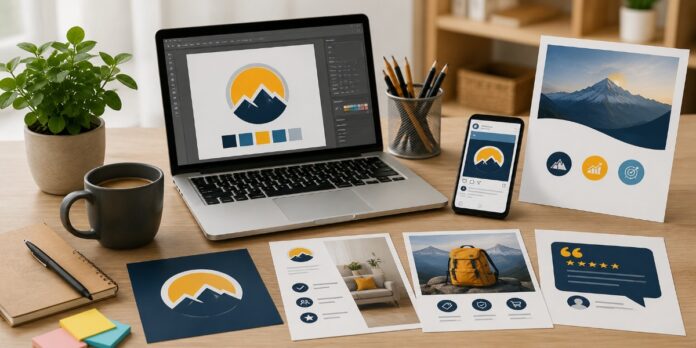
A small business does not need a large advertising department to look professional. It does, however, need a dependable collection of graphics that can be used across its website, social media pages, email campaigns and printed materials.
When a business uses mismatched photos, different colors and inconsistent fonts, customers may have difficulty recognizing the brand. A well-designed set of basic graphics creates a stronger first impression and makes it easier to promote products, services and special offers.
Here are five graphics every small business should have.
1. A Professional Logo
A logo is often the first visual element customers associate with a business. It may appear on storefront signs, business cards, invoices, social media profiles, advertisements and employee uniforms.
The best small-business logos are usually simple, easy to recognize and readable at different sizes. A design that looks good on a large banner should also remain clear when displayed as a small social media profile image.
Business owners should have several versions of their logo, including a full-color version, a black-and-white version and a transparent-background file. Horizontal and square variations may also be useful.
2. A Social Media Cover Image
Facebook and other social media platforms give businesses valuable space at the top of their pages. This cover area should not be wasted on a blurry photograph or outdated promotion.
A professional cover image can feature the business name, its primary service, a strong photograph and a simple call to action. The design should quickly tell visitors what the company does and why they should continue exploring the page.
Business owners who do not have professional design experience can use tools such as ClickDesigns to create branded online graphics without starting every project from a blank screen.
The cover image should also be reviewed regularly. Seasonal promotions, new products and changing business hours may require an updated design.
3. A Reusable Promotional Graphic
Every business needs a graphic that can be quickly customized for sales, new services, upcoming events or limited-time offers.
Instead of creating a completely different advertisement every time, the business can develop a reusable template with its logo, colors and preferred fonts already in place. The owner only needs to change the photograph, headline and offer.
This approach saves time and helps the company maintain a consistent appearance. Customers are more likely to recognize a promotion when it resembles the business’s previous content.
Promotional graphics should avoid excessive text. A strong headline, one clear offer and a direct call to action are usually more effective than a crowded design containing every available detail.
4. A Customer Testimonial Graphic
Positive customer comments can be powerful marketing tools. While reviews are valuable on Google and Facebook, they can also be converted into attractive graphics for social media, websites and email newsletters.
A testimonial graphic should include a short customer quote, the customer’s first name or approved identifier, the business logo and a clean background. Long reviews can be shortened as long as the meaning is not changed.
Businesses should always obtain permission before using a customer’s photograph or full name. They should also avoid creating fake testimonials or altering a review in a misleading way.
A collection of testimonial graphics gives the business useful content that can be shared throughout the year. These posts can build trust without relying on constant sales messages.
5. A Product or Service Information Graphic
Customers should not have to search through several posts to understand what a business offers. A clear product or service graphic can summarize the most important information in a format that is easy to save and share.
A restaurant might create a catering graphic. A lawn-care company could design a seasonal service menu. A photographer might create a simple package comparison. A home-based baker could display available cake sizes and ordering instructions.
The goal is not to list every possible detail. The graphic should help interested customers take the next step, such as visiting a website, requesting a quote or sending a message.
Build a Small Visual Library
Once these five graphics have been created, they can become the foundation of the business’s marketing materials. The logo establishes recognition, the cover image strengthens the social media page, reusable promotions save time, testimonials build trust and information graphics help customers understand what is available.
Business owners can create a folder containing approved logos, photographs, templates, brand colors and finished designs. Keeping these materials organized prevents employees from accidentally using outdated logos or low-quality images.
A design platform such as ClickDesigns may help small-business owners develop professional-looking graphics while maintaining control over their branding.
A business does not need hundreds of designs. It needs a focused set of useful graphics that communicate clearly, look consistent and make the company easier to remember.