

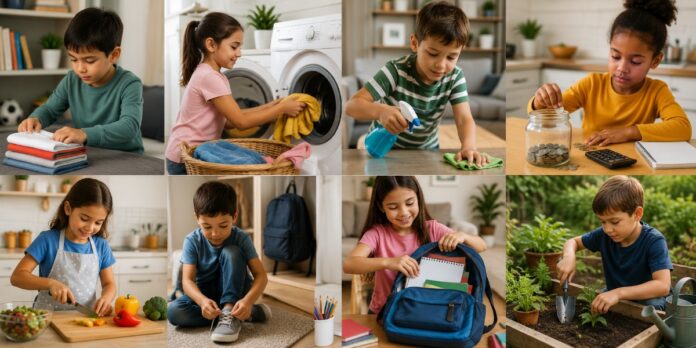
Academic knowledge is important, but children also need practical skills that help them manage responsibilities, solve problems and care for themselves.
By the time children approach their teenage years, they should begin practicing basic tasks that prepare them for greater independence. Parents do not need to teach everything at once. Small responsibilities introduced gradually can build confidence without overwhelming the child.
Managing Personal Belongings
Children should learn to keep track of school materials, clothing, sports equipment and personal items.
Parents can provide storage systems, but children should participate in maintaining them. A backpack should be checked regularly, dirty clothes should reach the laundry area and frequently used items should have a consistent place.
Losing or forgetting something occasionally is normal. The goal is to help children create habits that reduce repeated problems.
Preparing Simple Food
Children should know how to prepare several basic meals or snacks safely.
Depending on age and maturity, this may include making a sandwich, washing fruit, preparing cereal, heating leftovers with supervision or following a simple recipe.
Food preparation teaches more than cooking. Children practice reading directions, measuring ingredients, cleaning their workspace and managing time.
Parents should review kitchen safety, including proper handwashing, knife handling and the safe use of appliances.
Basic Cleaning
Every child should contribute to maintaining the household.
Age-appropriate tasks may include making a bed, wiping a table, sweeping, loading a dishwasher, taking out trash or cleaning a bathroom sink.
Children should understand that cleaning is not punishment. It is part of living responsibly with other people.
A short daily routine is often more effective than assigning a large number of chores at one time.
Understanding Money
Before becoming teenagers, children should understand basic ideas such as earning, spending, saving and comparing prices.
They should know that the amount paid for an item is not always the same as its value. They can practice waiting before purchases, saving toward a goal and recognizing the difference between needs and wants.
Parents who want additional ways to introduce entrepreneurship and financial thinking can explore myKidPrenuers: The StartUp Generation E-books.
Communicating Respectfully
Children should learn how to introduce themselves, ask for help, express disagreement and speak with adults respectfully.
They also need practice listening without interrupting and responding appropriately when someone else is speaking.
Communication skills can be developed through ordinary experiences such as ordering food, speaking with a teacher or explaining a problem to a coach.
Parents can model respectful communication by avoiding insults, shouting and dismissive responses during disagreements.
Handling Basic Emergencies
Children should know their full name, home address and a parent or guardian’s telephone number.
They should understand how to call emergency services and what information to provide. They should also know what to do during a fire, severe weather event or household emergency.
Families can review emergency plans periodically without frightening children. Calm preparation helps children know what to do if adults are stressed or unavailable.
Practicing Personal Hygiene
Children approaching their teenage years should be able to manage daily hygiene with limited reminders.
This includes bathing, brushing teeth, using deodorant when appropriate, wearing clean clothes and caring for hair.
Parents should explain why these habits matter rather than treating hygiene as a source of embarrassment. Puberty-related changes should be discussed honestly and respectfully.
Managing Time
Children should begin understanding how long common tasks take.
They can practice preparing for school, completing homework before entertainment and leaving enough time to arrive at activities promptly.
A simple calendar or written routine can help children visualize responsibilities. Parents may still need to provide reminders, but the child should gradually take greater ownership.
Solving Everyday Problems
Children should learn to pause, identify the problem and consider possible solutions.
If homework is missing, the child can determine whom to contact. If a plan changes, the child can consider alternatives. If a disagreement occurs, the child can practice expressing concerns without becoming aggressive.
Parents can guide the process while resisting the urge to solve every situation immediately.
Showing Consideration for Others
Children should understand that their choices affect other people.
This includes cleaning shared spaces, respecting privacy, thanking people, apologizing sincerely and helping when someone is struggling.
Empathy develops when children are encouraged to consider how another person may feel.
Completing a Project
Every child should experience planning and finishing a project.
The project might involve building something, conducting research, preparing a family meal or organizing a small event. Completion requires patience, organization and the ability to work through frustration.
Families can also use resources such as myKidPrenuers: The StartUp Generation E-books to explore projects involving creativity, leadership and business thinking.
Children do not need to master every life skill before becoming teenagers. They should, however, begin practicing the responsibilities that will eventually allow them to function more independently.
The most effective teaching usually happens through repetition. A child who receives guidance, makes manageable mistakes and tries again will be better prepared for the growing responsibilities of adolescence.