

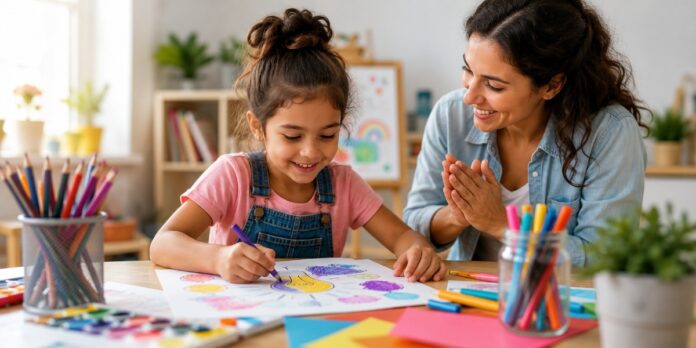
Creativity and confidence are not fixed traits that children either possess or lack. Both can grow when children have opportunities to explore ideas, make decisions and recover from mistakes.
Parents sometimes unintentionally limit creativity by correcting a child too quickly or focusing only on the finished product. A child may stop experimenting if every drawing, story or project is judged by adult standards.
The goal is not to praise everything without thought. It is to create an environment in which children feel safe trying something new.
Give Children Unstructured Time
A tightly scheduled day can leave little room for imagination.
Children need periods when they are not being directed by an adult, entertained by a device or rushed to the next activity. During this time, they may draw, build, invent games, write stories or simply think.
Boredom is not always a problem that parents must immediately solve. It can push children to create their own entertainment.
Ask Open-Ended Questions
Questions with one correct answer are useful in school, but creative thinking often begins with questions that have many possible answers.
Parents can ask:
- What else could this become?
- How would you solve this differently?
- What would happen if we changed one part?
- Can you think of three possible uses for this object?
There is no need to evaluate every response. The purpose is to encourage flexible thinking.
Provide Basic Creative Materials
Creativity does not require expensive supplies.
Paper, cardboard boxes, markers, tape, reusable containers, fabric scraps and building materials can support many projects.
Keep some materials in a place children can access and clean up independently. Too many choices can be distracting, so the collection does not need to be enormous.
Parents can rotate materials occasionally to make familiar items feel new.
Avoid Taking Over
Adults are often tempted to improve a child’s project. A parent may straighten the lines, rewrite the words or rebuild something that looks uneven.
Unless safety is involved, allow the child’s work to remain the child’s work.
Parents can provide assistance
requested, but taking control can send the message that the child’s ideas are not good enough.
Families looking for structured creative and entrepreneurial exercises may also review myKidPrenuers: The StartUp Generation E-books.
Praise Specific Actions
General praise can feel good, but specific feedback teaches children what they did well.
Instead of saying only, “That is amazing,” try:
- You used several different ideas.
- You kept working after the first design failed.
- You explained your idea clearly.
- You made a thoughtful choice about the materials.
This type of feedback connects confidence to effort and decision-making rather than approval alone.
Let Children Make Choices
Confidence grows when children see that their decisions matter.
Offer age-appropriate choices about clothing, activities, room organization, project topics or family plans. Too many choices can become overwhelming, so younger children may benefit from two or three clear options.
Children should also experience the results of manageable decisions. If a choice does not work, help them reflect rather than immediately rescuing them.
Normalize Mistakes
Children may avoid creative risks when they believe mistakes are embarrassing.
Parents can talk openly about their own errors and what they learned. They can also describe improvement as a normal part of any skill.
A failed experiment, uneven drawing or unsuccessful project is not wasted effort. It shows the child what to change next time.
Display Their Work Thoughtfully
Displaying a child’s artwork or completed project can communicate that the family values creativity.
Not every item needs to remain forever. Parents can create a rotating display area, photograph larger projects or allow the child to select favorite pieces to keep.
Older children may prefer privacy, so ask before sharing their work publicly or posting it online.
Encourage Different Forms of Creativity
Creativity is not limited to drawing and painting.
A child may be creative through music, storytelling, cooking, problem-solving, building, movement, technology or organizing events.
Parents should avoid comparing siblings or expecting every child to enjoy the same activities. A child who dislikes crafts may still be highly creative in another area.
Help Children Share Their Ideas
Confidence becomes stronger when children can explain what they created and why.
Ask them to describe the project, demonstrate how it works or tell the story behind it. Listen without interrupting or correcting minor details.
Resources such as myKidPrenuers: The StartUp Generation E-books may give families additional opportunities to connect creativity with planning, communication and entrepreneurship.
Children become more creative and confident when they are allowed to experiment, make choices and improve over time. Parents do not need to provide perfect activities. They need to offer patience, encouragement and enough freedom for children to develop their own ideas.