

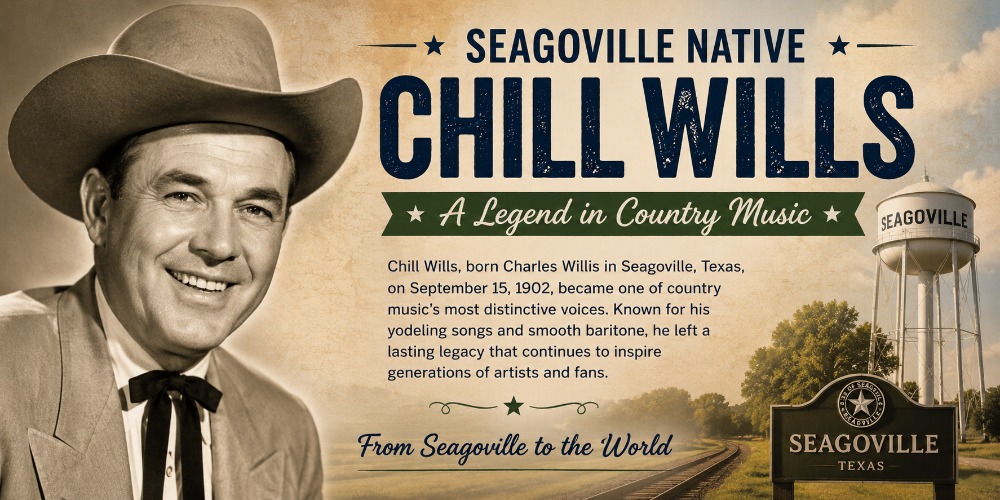
Long before Seagoville had a city council to cover or a chamber of commerce to celebrate, it produced one of the most colorful character actors in Hollywood history.
Theodore Childress Wills was born on July 18, 1902, in Seagoville, Texas, the youngest of six children born to farmer Robert Bruce Wills and his wife Frances Elizabeth Rublee Wills, according to the Texas State Historical Association. The world would eventually know him by a nickname that stuck for life: Chill Wills.
Wills lost his father when he was only five years old, and his family relocated to Dallas not long after, where his mother remarried. Even as a young boy, Wills was already drawn to performing. By age twelve he was singing and working tent shows, vaudeville circuits, and stock companies, the Texas State Historical Association reports.
From the Avalon Boys to Hollywood
In the 1930s, Wills formed and led a western singing group called the Avalon Boys, according to Wikipedia. The quartet was performing at the famed Trocadero nightclub on the Sunset Strip when a studio executive spotted them, a moment that launched Wills toward a film career that would stretch across five decades.
The Avalon Boys appeared alongside Laurel and Hardy in the 1937 film Way Out West, with Wills himself providing the singing voice for Stan Laurel during the group’s famous musical number, according to IMDb. Not long after, Wills disbanded the group to build a solo acting career, one built largely on the dusty backroads of the American western.
Wills became one of the most reliable character actors of his era, appearing in Rio Grande alongside John Wayne and Maureen O’Hara, Giant with Rock Hudson, Elizabeth Taylor, and James Dean, and Meet Me in St. Louis, according to IMDb. Cinema historian Allen Eyles once described Wills as usually loquacious, often something of a homespun philosopher, and more shrewd than comic, as cited by the Texas State Historical Association.
The Voice Nobody Saw
One of Wills’s most beloved contributions to film never showed his face at all. He voiced Francis the Talking Mule in a series of popular comedy films during the 1950s, lending the cynical, sardonic animal his deep, rough drawl, according to Wikipedia. As was standard practice for voice work at the time, Wills received no on screen credit for the role, though he did appear on camera as General Ben Kaye in the fourth film in the series, Francis Joins the WACS.
The Alamo and the Oscar Campaign That Became Legend
In 1960, Wills landed the role that would define his legacy both on screen and off. He played Beekeeper, one of Davy Crockett’s Tennessee companions, in John Wayne’s sprawling production of The Alamo. The performance earned Wills an Academy Award nomination for Best Supporting Actor, competing against Sal Mineo for Exodus, Jack Kruschen for The Apartment, Peter Falk for Murder Inc., and eventual winner Peter Ustinov for Spartacus, according to the Texas State Historical Association.
What happened next has become one of the most infamous campaigns in Academy Awards history. Wills hired publicity agent W. S. Wojciechowicz, nicknamed Bow Wow, who took out a series of trade paper advertisements addressing every member of the Academy as Wills’s cousins. One ad read, according to the Hollywood Reporter, “Win, lose, or draw, you’re still my cousins and I love you all.”
Comedian and Academy voter Groucho Marx could not resist firing back in the pages of Variety. As reported by the Hollywood Reporter, Marx wrote, “Dear Mr. Chill Wills, I am delighted to be your cousin, but I voted for Sal Mineo.”
The campaign escalated further when an advertisement ran claiming that the cast of The Alamo was praying harder for Wills to win the Oscar than the real defenders of the Alamo had prayed for their lives, a comparison that Daily Variety reportedly refused to publish, according to the Hollywood Reporter. John Wayne, eager to distance himself and his production company Batjac from the stunt, took out his own ad stating that neither he nor his team had any part in the advertising, adding that he refrained from using stronger language because he was sure Wills’s intentions were not as bad as his taste, a line also documented by the Hollywood Reporter.
Wills did not win the Oscar that night. Despite the controversy, Wayne did not hold a grudge for long, casting Wills again three years later in McLintock! As a consolation of sorts, Wills received a star on the Hollywood Walk of Fame in 1960.
A Steady Career on the Small Screen
Wills remained a familiar face on television throughout the 1960s and 1970s. He starred in the Wagon Train episode “The Bije Wilcox Story” in 1959, appeared in Rory Calhoun’s series The Texan in 1960, and starred in the short lived CBS series Frontier Circus during its only season from 1961 to 1962, according to Wikipedia. He also made multiple guest appearances on Gunsmoke, including a memorable turn as the deranged mountain man Abe Blocker in 1962.
His final screen role came in 1978, when he played a janitor in the television film Stubby Pringle’s Christmas. Wills died of cancer on December 15, 1978, in Encino, California, at the age of seventy six, according to IMDb.
Seagoville’s Hollywood Connection
More than a century after his birth on a Seagoville farm, Chill Wills remains one of the most successful entertainers to come out of Dallas County, Texas, with a career that touched some of the most celebrated films and television shows of Hollywood’s golden age. From a vaudeville stage in Kansas City to a star on the Hollywood Walk of Fame, the path traveled by Theodore Childress Wills began right here, a reminder that Seagoville’s story has always been bigger than its size on the map.