

Shop in Seagoville may earn a small commission when readers make a purchase through links in this article, at no additional cost to the buyer. Shop in Seagoville only recommend products we believe will provide value to our readers.
A family brings home a dog and everyone agrees to train it. Dad says “down” when he wants the dog off the couch. Mom says “down” when she wants the dog to lie on the floor.
The dog is now learning that one word means two different things. Multiply that across a household and you get a dog who hesitates before every request. Owners call that stubbornness. Trainers call it noise.
How Dogs Actually Learn a Word
Dogs do not learn words the way people do. They learn that a specific sound predicts a specific outcome in a specific context. That association strengthens every time the pattern repeats and weakens every time it does not.
When four family members use four versions of a cue, the pattern never gets strong. The dog is not refusing. The dog is guessing.
The Two Kinds of Inconsistency
The first kind is verbal. One person says “come” and another says “come here” and a third whistles.
The second kind is behavioral, and it does more damage. This is the household where jumping is scolded by one person and rewarded with attention by another. A behavior that pays off sometimes is far harder to eliminate than one that pays off every time.
Intermittent Rewards Are Powerful
Behavior researchers have understood this for decades. A behavior reinforced unpredictably becomes stronger and more persistent than one reinforced every time.
That principle works beautifully in training. It works against you when the reward is your attention and the behavior is barking at the table.
Building a Household Standard
Start with a written list on the refrigerator. Name each cue and the exact word for it. Keep the list short at first with five or six behaviors.
Agree on the furniture rules and the door rules and the feeding rules. Then agree that nobody changes them without a family conversation. Written rules are how households with children stay consistent, and structured programs like the Dog Trainer Bible recommend the same approach for the same reason.
Consistency in Timing
Timing matters as much as wording. A reward delivered three seconds late may mark a different behavior than the one you intended.
Mark the moment the dog gets it right. A quick word or a clicker followed by the treat teaches the dog exactly which piece earned the payoff.
Consistency Does Not Mean Rigidity
Once a behavior is reliable, you can vary where and how you use it. That is the goal rather than a contradiction.
The rule is simple. Be consistent while the dog is learning and flexible once the dog has learned. Most owners reverse that order, which is one of the common errors covered in the Dog Trainer Bible.
When Everyone Trains
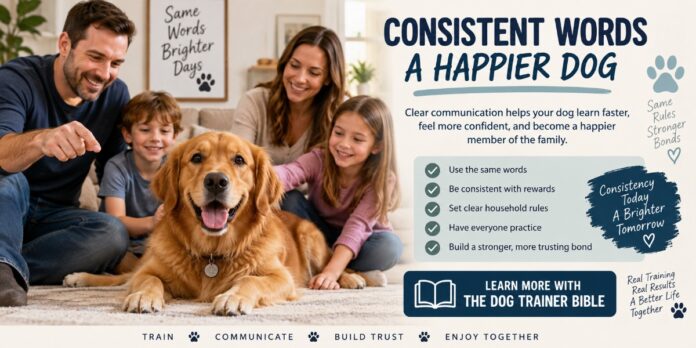
Every family member should practice with the dog using the same words. Children can absolutely participate with supervision and short sessions.
A dog who responds only to one person has learned that the rules depend on who is watching. Household wide practice fixes that faster than anything else.
The Payoff
Consistency is unglamorous. It does not photograph well and it does not produce a dramatic breakthrough moment.
It does produce a dog who understands what is being asked and who is not anxious about getting it wrong. That reliability is what most families actually want, and it is the foundation the Dog Trainer Bible builds everything else on.