

Shop in Seagoville may earn a small commission when readers make a purchase through links in this article, at no additional cost to the buyer.
Social media allows families to stay connected, celebrate accomplishments and communicate with friends across long distances. It can also expose children and adults to privacy violations, account theft, unwanted location tracking, damaging photographs and people who misrepresent themselves online.
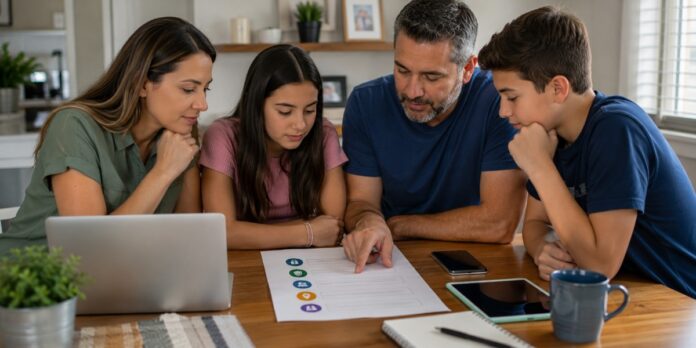
A family social-media agreement establishes expectations before a problem occurs. Instead of creating rules during an argument or after an unsafe post, parents and children can decide together what information may be shared, who may view it and what should happen when something goes wrong.
The agreement should apply to adults as well as children. Parents cannot reasonably expect young people to protect family privacy while adults post photographs, locations and personal stories without considering the consequences.
Families teaching children about responsibility, money and decision-making may also use the myKidPrenuers: The StartUp Generation E-books to expand those conversations beyond social media and into other parts of everyday life.
Create Rules Before Opening an Account
Social-media expectations should be discussed before a child begins using a platform.
Parents should review the platform’s minimum-age requirement, privacy settings, messaging features, location controls and reporting tools. A child should not create an account by entering a false birth date simply to bypass an age restriction.
The agreement should identify which platforms are permitted and require parental approval before a child downloads a new social, messaging, streaming or gaming application.
Approval should not be permanent. An application that was appropriate at one age may become problematic after its features, privacy practices or the child’s online behavior changes.
Make Privacy the Default
A child’s account should generally begin with the strongest practical privacy settings.
Profiles can be restricted so posts are visible only to approved contacts rather than the general public. Parents should also review who can send messages, tag the child, comment on posts, view a friend list or add the child to group conversations.
Privacy settings reduce exposure, but they do not guarantee secrecy. An approved follower can still save a photograph, record a video or take a screenshot and distribute it elsewhere.
The agreement should therefore require family members to treat every post as something that could eventually be seen by classmates, teachers, relatives, employers or strangers.
Limit the Personal Information Placed in Profiles
A social-media profile does not need to reveal a person’s complete identity.
Children should avoid publicly listing their home address, telephone number, school schedule, daily routine or places they regularly visit. Birth dates can also provide useful information to scammers attempting to impersonate someone or gain access to an account.
Usernames should not unnecessarily combine a child’s full name, school, graduation year and hometown.
Public biographies should remain general. A profile can describe interests without publishing enough information for an unknown person to locate the child offline.
Ask Before Posting Someone Else’s Photograph
Every family member should receive a reasonable opportunity to object before another person posts a photograph or video of them.
That rule should apply to adults, teenagers and younger children. Parents may legally control many decisions involving a young child, but asking for the child’s opinion helps teach consent and respect.
Photographs taken during embarrassing moments, medical treatment, discipline, emotional distress or private family conflicts should remain private.
The agreement should also prohibit posting images that show another family’s child without permission from that child’s parent or guardian.
Once an image is online, deleting the original post may not remove copies that other people saved or shared.
Inspect the Background Before Posting
A photograph may disclose more than the person who posts it intended.
School names, team uniforms, employee badges, house numbers, vehicle license plates, street signs, travel documents and computer screens may reveal personal information in the background.
Families should pause before posting and enlarge the image to check what is visible.
Parents should be especially cautious with first-day-of-school photographs. A picture can celebrate the occasion without displaying the child’s full name, teacher, school, grade, bus stop and daily schedule in the same post.
Do Not Post Live Travel Updates Publicly
Announcing that the entire household is hundreds of miles away may reveal that the home is unoccupied.
Families can share vacation photographs after returning home or restrict them to a small group of trusted people. Children should not publicly post hotel names, room numbers, travel itineraries or exact return dates.
The same caution applies to routine activities. A series of posts can reveal when a child leaves school, attends practice, walks home or remains at a location without an adult.
The agreement should emphasize that an enjoyable experience does not need to be published in real time.
Control Location Sharing
Location access should be turned off for applications that do not need it to function.
Families should review the permissions on social-media applications, cameras, games and messaging services. Some applications may collect location information in the background or allow friends to view a user’s position on a map.
Children should share a live location only with trusted people they know in person and only for a clear purpose.
Location sharing with parents for safety is different from broadcasting a child’s position to an entire follower list. The agreement should identify which relatives may receive location information and when that access should be active.
Photographs may also contain location data. Families should review camera and application settings instead of assuming that turning off a visible map feature prevents every form of location collection.
Use a Different Password for Every Account
Reusing one password across several accounts can turn a single security breach into a much larger problem.
Every important account should have a strong, unique password or passphrase. A password manager can generate and securely store different credentials so family members do not have to memorize each one.
Passwords should not contain easily guessed details such as a child’s name, birthday, school mascot, pet’s name or favorite team.
Family members should never send passwords through social-media messages or enter them after clicking an unexpected link.
Do Not Share Passwords With Friends
Children sometimes exchange passwords as a sign of friendship or trust. That practice can lead to impersonation, deleted content, embarrassing posts or account takeovers when the relationship changes.
The family agreement should make clear that passwords are not shared with friends, classmates, dating partners or online acquaintances.
Parents of younger children may retain appropriate recovery access or supervise accounts. Older teenagers can receive greater privacy as they demonstrate responsible behavior, but parents should still know how to respond during a genuine safety emergency.
A family should discuss that distinction openly rather than secretly demanding passwords without explaining when and why they might be used.
Turn On Multifactor Authentication
Multifactor authentication adds another verification step when someone attempts to enter an account.
Depending on the service, that step may involve an authenticator application, security key, one-time code, fingerprint or facial recognition. It can help protect an account even when someone obtains the password.
Families should enable the strongest available option on email and social-media accounts. Protecting the email account is particularly important because password-reset messages for other services are often sent there.
Recovery codes should be stored securely rather than saved in a public photograph, unprotected note or shared message.
Treat Unexpected Login Messages Seriously
A notification about an unfamiliar login, password reset or changed email address may indicate an attempted account takeover.
Children should tell a parent or trusted adult immediately rather than dismissing the message. The family can review active sessions, change the password, remove unknown devices and confirm that recovery information has not been altered.
No one should approve a login request they did not initiate.
Messages that create panic and demand an immediate password, security code or payment should be treated as suspicious, even when they appear to come from a familiar company or friend.
Set Firm Rules for Communication With Strangers
An unknown person should not become trusted simply because the account has photographs, mutual followers or convincing personal details.
People can use stolen images, false names and fabricated stories. A person claiming to be another child may be an adult, while an account appearing to belong to a celebrity, company or school official may be an impersonator.
Children should not accept every friend or follower request. The agreement can limit contacts to people the child knows in person or to accounts approved by a parent.
A stranger’s message should never be treated as proof of identity.
Keep New Online Contacts on the Original Platform
A common warning sign is pressure to move a conversation quickly into private texts, disappearing-message applications, encrypted chats or video calls.
Children should not provide a phone number, private email address or alternate username to someone they know only online without parental approval.
They should also refuse requests to keep a relationship secret from their parents.
A safe person will not threaten, pressure or manipulate a child for involving a trusted adult.
Never Arrange a Secret Meeting
Children should never meet an online contact in person without a parent’s knowledge and direct involvement.
Even when a person appears friendly and has communicated for months, an online identity may still be false.
Any approved meeting should occur in a public place with a responsible adult present. Transportation, location and timing should be controlled by the family rather than the online contact.
A person who becomes angry because a parent must attend has provided another reason not to meet.
Recognize Manipulation and Grooming Behaviors
Not every dangerous conversation begins with an obvious threat.
An unknown person may begin by offering compliments, gifts, gaming currency or emotional support. The person may claim to understand the child better than family members and gradually request personal information, private photographs or secrecy.
Other warning signs include asking whether the child is alone, introducing sexual topics, offering money, threatening to expose messages or pressuring the child to prove trust.
The agreement should state that the child can end any uncomfortable conversation without being polite.
Make Reporting Safer Than Hiding
Children may conceal online problems because they fear losing their phone or social-media access.
Parents should distinguish between asking for help and deliberately violating a known rule. A child who reports harassment, threats, sexual messages or suspicious contact should not automatically be punished for bringing the problem forward.
The immediate priorities are preserving evidence, blocking the account, using the platform’s reporting system and determining whether law enforcement or another authority should be contacted.
Parents should avoid promising complete secrecy when a child may be in danger. They can instead promise to explain each necessary step and involve only the people needed to help.
Do Not Respond to Harassment With More Harassment
Social-media disagreements can quickly become public conflicts involving screenshots, group messages and retaliatory posts.
Family members should not threaten another person, encourage friends to attack an account or publish private information as revenge.
The agreement should require users to pause, save evidence, block or mute the person and seek help when necessary.
Responding publicly may increase the audience and create additional material that can be copied out of context.
Serious threats, stalking, extortion or repeated harassment should be handled as safety matters rather than ordinary online drama.
Create Rules for Private and Intimate Images
Children and teenagers should understand that no one has the right to pressure them for an intimate photograph.
They should not create, request, save or forward sexual images involving minors. Sending the image to a trusted romantic partner does not guarantee that it will remain private.
Threatening to distribute an image unless the victim sends money, provides additional photographs or follows instructions is a form of exploitation.
A child facing such a threat needs immediate adult assistance and should not pay, negotiate or continue complying in hopes that the person will stop.
Discuss Artificially Generated Images
Families should recognize that artificial intelligence can be used to create convincing fake photographs, videos and audio.
A humiliating or sexual image may be fabricated even when it appears realistic. Children should not create or circulate fake images of classmates as a joke.
The agreement should prohibit deceptive impersonation and AI-generated material designed to embarrass, threaten or damage another person’s reputation.
Suspicious content should be verified before it is believed or shared.
Include Rules for Purchases and Promotional Content
Social-media platforms often combine entertainment, advertising, influencer promotions and shopping.
Children should obtain permission before making purchases, sending paid gifts, subscribing to accounts or entering payment information. A limited-time offer does not create a family emergency.
The myKidPrenuers: The StartUp Generation E-books can support discussions about budgeting, advertising and responsible decision-making so children better understand that digital purchases still involve real money.
Family members should also recognize that influencers may be paid, receive free products or earn commissions from recommendations.
Require Honest but Limited Parental Oversight
Parents should explain how they will supervise social-media use.
Depending on the child’s age and maturity, oversight might include reviewing privacy settings, approving applications, checking follower lists or periodically discussing recent interactions.
Constant secret monitoring can damage trust, while no supervision at all may leave a young child unprepared for serious risks.
The agreement should state what parents may review, what privacy the child can reasonably expect and what behavior would lead to increased supervision.
Parents Must Follow the Agreement Too
Adults shape children’s understanding of online behavior.
A parent who posts every family disagreement, shares a child’s private medical information or ridicules neighbors online cannot effectively teach digital restraint.
Parents should ask before posting photographs of older children and listen when a child says an image is embarrassing or too personal.
Adults should also follow household expectations concerning privacy, passwords, location sharing and respectful communication.
Establish Consequences in Advance
Consequences should be connected to the behavior and explained before a violation occurs.
Posting a family member’s photograph without permission might require deleting it and apologizing. Sharing a password could require changing credentials and temporarily increasing account supervision.
Secret contact with an unknown adult may require immediate restrictions while the family evaluates the safety risk.
Consequences should protect the child and teach responsibility rather than serve as an angry, indefinite punishment.
Review the Agreement Regularly
Social-media platforms, family circumstances and children’s maturity levels change.
The agreement should be reviewed when a child begins using a new application, receives a first phone, enters middle or high school, starts driving or demonstrates a need for greater independence.
Families can also revisit the rules after an online problem without treating the entire agreement as a failure.
As children demonstrate good judgment, parents can gradually expand their independence. Resources such as the myKidPrenuers: The StartUp Generation E-books can help families continue teaching responsibility as privileges increase.
A Simple Family Social-Media Agreement
A practical household agreement might include the following promises:
- We will use only age-appropriate and parent-approved accounts.
- We will keep accounts private unless the family agrees otherwise.
- We will ask permission before posting another person’s photograph.
- We will not reveal addresses, school schedules or private family information.
- We will not publicly share our live location or travel plans.
- We will use unique passwords and multifactor authentication.
- We will not share passwords with friends or online contacts.
- We will accept messages and friend requests cautiously.
- We will not meet an online contact secretly.
- We will report threats, harassment and sexual requests to a trusted adult.
- We will not make purchases without permission.
- We will treat other people respectfully and avoid retaliatory posting.
- Parents will follow the same privacy and posting standards expected of children.
- We will review the agreement as technology and family needs change.
The Goal Is Responsible Independence
A social-media agreement should not be designed only to catch children breaking rules.
Its purpose is to teach habits they can eventually manage without constant parental supervision. Those habits include protecting personal information, respecting other people’s privacy, recognizing manipulation and seeking help before a digital mistake becomes a larger crisis.
Clear expectations also reduce daily arguments. Children know what is permitted, parents know when intervention is necessary and every family member understands that online behavior can produce real-world consequences.
The safest household is not necessarily the one that prohibits every platform. It is the one where family members communicate openly, use strong security practices and know that asking for help will always be safer than hiding a problem.