

Long before online shopping, app-based food delivery and sprawling retail centers changed the way people spent their money, Seagoville residents could handle much of daily life close to home. A family could buy groceries, fill a prescription, repair a car, purchase school clothes, open a bank account, enjoy a hamburger and stop for an ice cream without traveling far beyond the community.
The businesses were more than places where money changed hands. They were gathering spots, landmarks and pieces of the town’s personality. Store owners often knew their customers by name. Employees attended the same schools, churches and community events as the people they served. A quick trip for groceries could turn into a conversation with a neighbor, while a stop for gasoline might also provide the latest news about what was happening around town.
Many of those businesses are now gone, but old photographs and advertisements offer a remarkable look at the Seagoville residents once knew.
A Time When Seagoville Shopped Close to Home
For many longtime residents, names such as Gibson’s Discount Store, Ben Franklin Store and M.E. Moses bring back memories of a very different shopping experience.
These stores offered the kind of everyday variety that later became associated with major retail chains. Families could browse household goods, clothing, toys, school supplies, gifts and other necessities in one convenient location. A visit might have been planned around something practical, but children could still hope their parents would allow a detour through the toy or candy section.

Gibson’s Discount Store was among the best-known names from Seagoville’s retail past. It belonged to an era when a local discount store could become a major part of a family’s weekly routine. Residents did not need a massive shopping complex to find basic household merchandise. Much of what they needed was available in town.
The Ben Franklin Store and M.E. Moses also represented the classic variety-store tradition. These were the kinds of businesses where shoppers might enter for one small item and leave with several things they had not planned to purchase.
Fashion and personal style were also part of the local business scene. Frances Jenkins’ Stylitique, located at 2609 Hawn Freeway, served customers seeking hair care in a true neighborhood salon setting. The old advertisement captures a busy room of women having their hair styled, offering a glimpse of the conversations, laughter and community connections that likely filled the business.
Shoppers looking for clothing could also visit businesses such as Meyers Department Store at the Town and Country Shopping Center or The Rag Doll, which advertised “distinctive fashions for juniors and misses.”
The Grocery Stores That Fed Seagoville
Before large supermarkets dominated grocery shopping, Seagoville supported a long list of local food stores.
Branson’s Food Mart is one of the most recognizable names. A surviving photograph shows the broad storefront with vehicles lined across the parking lot. The image is simple, but it says a great deal. This was a place where families regularly arrived to purchase meat, produce, canned goods, bread and the other staples needed to keep a household running.
Other grocery names included Anthony’s Quickway, Welch’s Grocery, Jones Food Store, Dalton’s Grocery, Stop-n-Go and The Morris Store. Each served its own group of customers and occupied a place in the routines of nearby families.

The old Anthony’s Quickway photograph, with a car parked near the front and customers standing outside, captures the unpolished charm of a neighborhood market. There were no digital coupons or curbside apps. Shoppers walked inside, selected what they needed and often dealt with people they recognized.
Smith’s Pharmacy, at 115 N. Kaufman Street, served another essential purpose. Its advertisement proudly declared that filling prescriptions was the most important part of the business. In an era before national drugstore chains occupied nearly every busy intersection, a community pharmacy could become one of the town’s most trusted establishments.
Burgers, Ice Cream and Nights at the Drive-In
Some of the warmest memories are likely connected to the places where residents went for a meal, an after-school treat or an evening with friends.
Dairy Queen remains one of the most familiar names from that period. For generations of small-town Texans, Dairy Queen was not merely a restaurant. It was a meeting place. Families stopped for burgers and ice cream, teenagers gathered after school or sporting events, and travelers pulled in for a quick meal.
Seagoville also had its own local favorites.
Moon’s Drive-In stood out with its roadside sign and classic drive-in appearance. The old photograph shows signs advertising chicken, shrimp and other menu items. It recalls a time when eating in the car or beneath a covered parking area felt like part of the entertainment.
A drive-in could become an unofficial social center, especially for young people. Cars arrived and departed, friends spotted one another across the lot, and a quick food stop sometimes became an entire evening.
Other remembered food businesses included Pizza Palace, Southern Maid Donuts, Hollander Drive-In and local cafés and snack shops. The Hollander Drive-In advertised broasted chicken dinners and a complete takeout service, even encouraging customers to telephone an order and then pick it up.
That may sound familiar today, but decades before mobile ordering, it was a convenient service worth promoting.
Cars, Gasoline and the Mechanics People Trusted
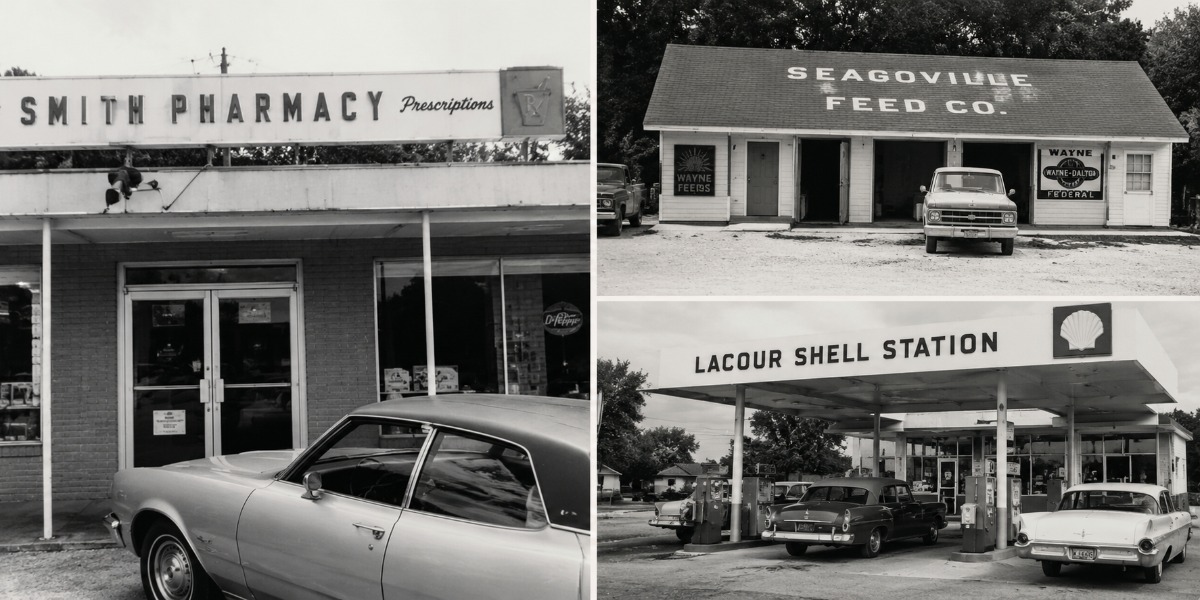
Automobiles were central to life in Seagoville, and the community supported numerous garages, dealerships, service stations and auto-parts businesses.
Western Auto, located at 204 N. Kaufman Street, sold automotive and household products. The storefront photograph, complete with a pickup parked outside, looks like a scene from a town where customers expected practical merchandise and straightforward service.
Seago Motor Company and Seago Motors sold automobiles locally. Their old advertisements reflect an era when buying a vehicle could involve doing business with someone who lived in the same community and whose reputation depended heavily on personal relationships.
Charlie Ballard Garage offered complete auto service, air conditioning repair, wheel alignment, balancing and wrecker service. Other familiar automotive names included Lackey’s Texaco, Lacour Shell Station, Simonds Road Gulf Gas Station, Hataway L&P Gas, Lenamond Auto Supply and several independent repair shops.
At these businesses, the conversation might begin with an engine problem and end with local news, family updates or advice about how much longer an aging car could remain on the road.
Businesses That Helped Hold the Community Together
Some Seagoville businesses became important because residents depended on them during major moments in life.
Seagoville State Bank represented stability and local investment. Its modern-looking building and prominent roadside sign reflected the optimism of a growing community. Residents could handle financial matters without leaving town, working with bankers who understood the area and its people.
Insurance offices such as Ramsey Insurance and Real Estate, Hayden Insurance Agency and Dee Thompson Real Estate helped families protect property, purchase homes and plan for the future.
Local medical professionals, including Dr. and Mrs. Carl Markstrom, also held a special place in the community. In a smaller town, a physician was rarely an anonymous figure. Doctors often cared for several generations of the same family and became deeply connected to the town they served.
Businesses such as Mathis Funeral Home supported residents during their most difficult days, while Seagoville Flower Shoppe and other local shops helped families mark weddings, anniversaries, graduations, funerals and celebrations.
More Than Old Storefronts
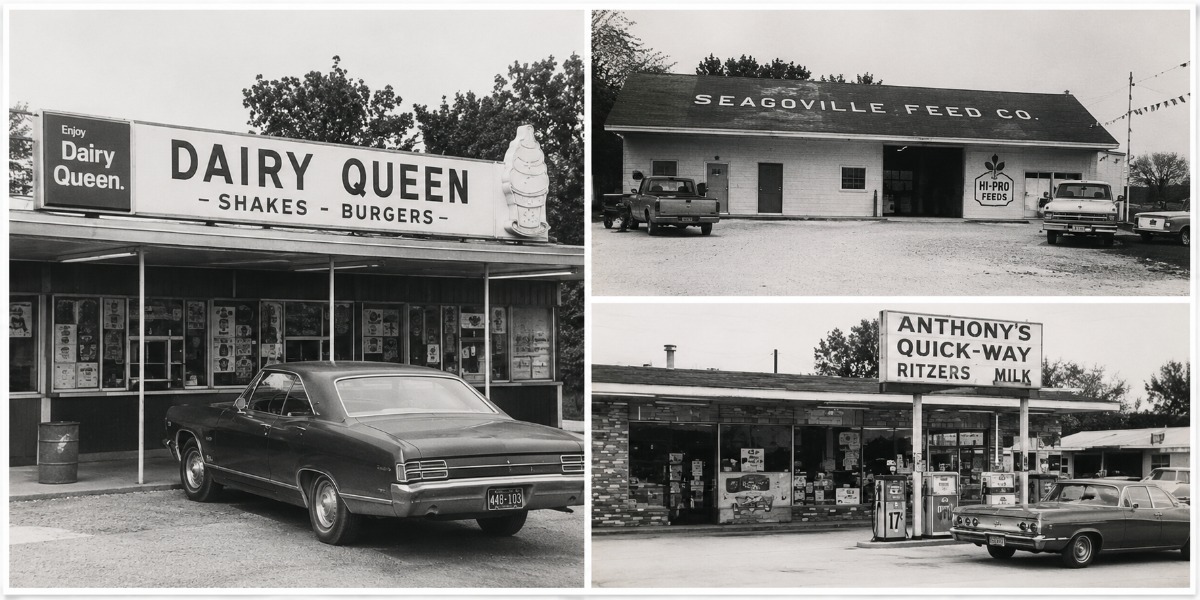
It is easy to look at these photographs as pictures of buildings that no longer exist or businesses whose signs have disappeared. But the real story is found in the people.
Employees earned their first paychecks inside these buildings. Families bought groceries for holiday dinners. Teenagers met friends after school. Parents purchased children’s clothing and birthday presents. Cars were repaired, prescriptions were filled, bank accounts were opened and countless cups of coffee were poured.
The businesses may be gone, but their stories remain woven into Seagoville’s history.
Old advertisements and photographs preserve more than commercial names. They preserve the look of Kaufman Street, the shape of familiar storefronts, the vehicles once parked outside and the prices residents once considered ordinary.
For longtime residents, these images may bring back a voice, a smell, a favorite meal or the memory of walking through a door that has not opened in decades.
That is why Seagoville’s former businesses are gone—but certainly not forgotten.