

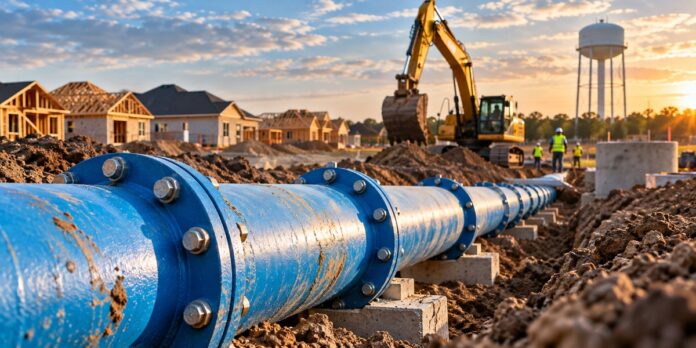
Seagoville approved $849,245 in engineering work, then requested $8 million in state funding. But how much will developers and existing water customers ultimately pay
SEAGOVILLE — As Seagoville prepares its water system for future development, an increasingly important financial question faces residents: Who should pay for the infrastructure needed to support growth?
The City Council approved an $849,245 engineering agreement in June for two major waterline projects totaling approximately 3.4 miles.
The improvements are intended to strengthen water distribution across the city, including areas affected by aging infrastructure.
But a review of municipal documents and Texas Water Development Board records reveals a larger financial picture.
Seagoville subsequently applied for $8 million in state grant funding, considerably less than the $21 million maximum discussed in July.
Meanwhile, the city’s published project records do not establish the final construction cost or identify specific developer contributions toward the two improvements.
Those unanswered questions matter because existing utility customers are already helping finance the engineering work.
Two Major Waterlines Planned
On June 8, the City Council unanimously approved Resolution 2026-40, authorizing professional engineering services from Garver LLC under Work Order No. 26.
The agreement covers two waterline improvements identified in the city’s water master plan.
The first, PL1, includes approximately 5,800 linear feet of 18-inch waterline connecting the Ard Road pump station to Simonds Road.
The second involves approximately 12,000 linear feet of 12-inch waterline extending from Environmental Way toward North Watson Street.
City documents primarily identify that second improvement as PL9, although portions of the supporting memorandum call it PL2.
The discrepancy does not change the described route but warrants clarification in final construction documents.
Public Works Director Chris Ryan explained during the June meeting that both projects would improve water flow throughout Seagoville.
He also described an existing infrastructure problem beneath Highway 175. According to Ryan, a previous waterline failure had been addressed with a smaller six-inch connection rather than restoration of the original larger line.
The proposed improvement would address that deficiency.
That detail is important: The projects are not exclusively about future subdivisions. Existing households, businesses and public facilities could benefit from stronger distribution capacity and improved system reliability.
However, the available engineering agreement does not identify individual subdivisions, commercial developments or property owners that would receive measurable benefits.
Nearly $850,000 Before Construction
The June approval was for professional services, not installation of waterlines.
Garver’s agreement includes $272,863.50 for topographic surveying, $134,142 for locating underground utilities and $204,514 for initial engineering design.
Additional expenses include geotechnical investigations, advanced design, bidding assistance and construction-phase services.
The total authorized amount is $849,245.
The agreement also provides for a six-percent annual increase on unused fees under specified delays beyond Garver’s control, beginning around July 2027.
Importantly, the engineering scope requires Garver to prepare estimates of probable construction costs during the design process.
That means the contract provides a method for developing more precise cost estimates, but the June packet itself does not establish the final price of installing either pipeline.
Construction could involve excavation, highway crossings, utility relocations, easements, materials, labor and restoration of affected property.
Until detailed estimates and competitive bids are available, the eventual construction cost remains unresolved in the records reviewed.
An $8 Million Grant Request
A significant development emerged in September.
The Texas Water Development Board’s official application intake report lists Seagoville’s PL1 and PL9 Waterline project with an $8 million funding request.
That differs from the city’s July proposal authorizing an application for up to $21 million.
The $8 million figure is the amount requested from the state—not a confirmed construction contract, final project cost or approved grant.
The distinction matters.
The state’s Water Supply and Infrastructure Grant program received applications requesting approximately $6.9 billion against a funding appropriation of approximately $1.038 billion.
Competition is substantial, and the state specifically cautions that inclusion in its application report does not establish eligibility or guarantee funding.
The program offers 100-percent grants without a mandatory local match.
Certain engineering expenses incurred after June 22, 2025, may also qualify for reimbursement if the project is awarded funding and satisfies program requirements.
A successful grant could significantly reduce the amount Seagoville must finance locally.
Without sufficient outside funding, however, city officials would need to determine whether to use additional reserves, seek alternative financing, revise the project scope or postpone construction.
Are Developers Paying Their Share?
Seagoville’s municipal code establishes specific responsibilities for developers constructing new subdivisions.
Under Section 19.06.004, developers generally must pay for water and sewer mains installed entirely within their subdivisions.
Developers may also be responsible for off-site extensions needed to connect their properties to existing utilities.
The ordinance provides certain reimbursement mechanisms. For example, when a developer installs an oversized main benefiting other properties, the city may reimburse qualifying additional costs under established conditions.
Other provisions allow developers to recover specified charges when additional properties connect to infrastructure they originally financed.
Those rules demonstrate that Seagoville has a framework for assigning infrastructure expenses to development.
But they do not establish how the city’s two proposed waterline improvements will be divided financially.
The June engineering agreement identifies the city as the contracting party.
It does not specify a developer reimbursement schedule, identify a private development partner or assign a percentage of the project to developers.
Nor do the reviewed documents establish whether new subdivisions will eventually contribute through connection charges or separately negotiated agreements.
Those contributions should not be assumed simply because the waterlines could accommodate future growth.
Existing Customers Are Already Involved
The June council memorandum identifies the Water and Sewer reserves fund as the source for the $849,245 engineering expense.
Those reserves belong to the municipal utility system, which receives revenue primarily through water and sewer charges.
The financial significance extends beyond the initial agreement.
During August budget discussions, city officials identified PL1 and PL9 among anticipated water infrastructure expenditures and described using utility-rate revenue and fund balances to finance capital improvements.
The city’s budget presentation projected the basic monthly water charge for a residential customer with the smallest meter increasing from $30.82 to $31.30.
The council subsequently approved changes to water rates effective October 1.
However, the record does not establish how much of any individual customer’s increase is attributable to these two waterline projects rather than wholesale water costs or other utility expenses.
It would therefore be inaccurate to assign a specific portion of a household’s monthly bill to PL1 or PL9 without the underlying rate-study calculations.
Nevertheless, the city’s use of utility reserves establishes a current financial commitment from the public water system.
Who Benefits—and Who Pays?
The available documents support three important conclusions.
First, existing Seagoville water customers stand to benefit from improved distribution infrastructure, particularly where older connections restrict the system.
Second, future residential and commercial development could benefit from additional network capacity.
The engineering agreement does not identify specific private beneficiaries or quantify their benefits.
Third, the city has committed utility-system reserves to engineering, while the eventual distribution of construction expenses among state grants, local utility funds and developer payments remains undetermined.
That leaves several financial disclosures residents should expect before construction contracts are awarded.
The city should publish itemized construction estimates for both pipelines, identify developments expected to use the improvements, disclose applicable developer contributions and explain whether state funding would reimburse previously authorized engineering expenses.
Officials should also identify the potential impact on utility reserves and future customer rates if the state awards less than requested.
The Bigger Question for Seagoville
Water infrastructure is essential for a growing city. Aging lines require replacement, distribution systems need reliable connections, and new development creates additional demand.
Investing in those improvements can benefit the entire community.
But determining who receives the benefit is only half of responsible infrastructure planning.
The other half is establishing who pays.
Seagoville has approved the engineering expenditure, submitted an $8 million state grant request and identified two major waterline improvements.
What residents still need is a complete construction budget and an understandable accounting of how much growth-related infrastructure will ultimately be financed by developers, outside grants and existing utility customers.
Before construction begins, Seagoville taxpayers and water customers deserve to know the full financial commitment.