

Shop in Seagoville | Merv Moore | Editorial
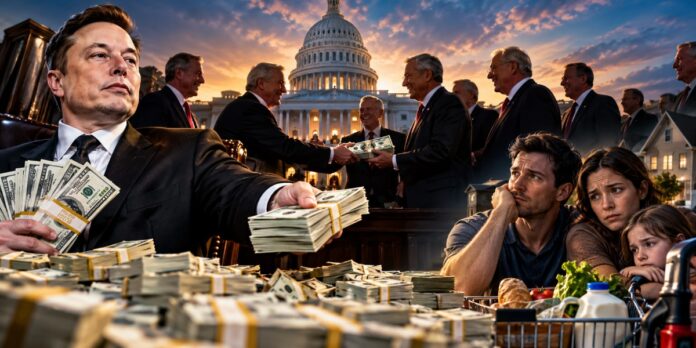
While millions of Americans struggle to afford groceries, health insurance, housing, gasoline and electricity, some of the nation’s wealthiest billionaires are writing campaign checks larger than entire communities will earn in a lifetime.
And Republican politicians are accepting those fortunes to help maintain their grip on Washington.

The disturbing question is no longer whether billionaires influence American elections. They clearly do.
The question is whether elected officials have become more accountable to the billionaires financing their political careers than to the ordinary Americans who put them in office.
Elon Musk’s extraordinary spending in the 2026 midterm elections provides a revealing example of what is wrong with American politics.
One Billionaire. Hundreds of Millions. Enormous Influence.
Musk has committed more than $276 million to Republican political organizations since July, according to figures reported October 12. His contributions during the 2025–2026 federal election cycle total approximately $366 million.

Consider where some of that money is going.
Musk contributed $158 million to the Senate Leadership Fund, the principal super PAC supporting Republican Senate candidates.
Another $76 million went to America PAC, his political organization financing voter-turnout operations.
He also directed $10 million to a super PAC supporting Texas Republican Senate nominee Ken Paxton.

These are not ordinary political donations. They are sums capable of transforming competitive elections by financing advertising, voter outreach, campaign infrastructure and attacks against political opponents.
A single billionaire can now provide financial support on a scale that thousands of ordinary voters could never collectively match without an enormous organizing effort.
Musk cannot simply declare an election winner. Voters still decide elections, and enormous spending sometimes fails.
But a wealthy donor can profoundly change which candidates receive financial support, whose messages dominate television and social media, and which political arguments reach millions of households.

When one individual can spend hundreds of millions trying to determine who controls Congress, the principle of equal political representation becomes increasingly difficult to defend.
The Billionaire Donor Club
Musk is hardly alone.
Federal campaign-finance disclosures reviewed by Business Insider in September identified a remarkable concentration of political wealth.
Billionaire investor Jeff Yass had contributed approximately $93 million, much of it supporting conservative political organizations and candidates.
Shipping-supply billionaires Richard and Elizabeth Uihlein had contributed more than $70 million.

Casino billionaire Miriam Adelson had donated approximately $67.6 million, including major contributions to Republican-aligned super PACs.
Hedge-fund billionaire Paul Singer had contributed more than $53 million.
These donors have different priorities, but their financial resources give them extraordinary opportunities to support candidates whose governing philosophies align with their interests.
Democrats also have wealthy benefactors. George Soros and his family’s political network were responsible for more than $103 million in disclosed giving at the time of the September review.
That deserves scrutiny, too.

Nevertheless, the Republican Party’s overwhelming reliance on enormous contributions from Musk and other conservative billionaires raises urgent questions about political accountability.
An American worker might contribute $25 or $100 because a candidate promises to improve health care or reduce household expenses.
A billionaire can contribute $20 million because a candidate supports favorable tax treatment, industry deregulation, or a particular economic agenda.
Both have political opinions. Only one possesses the financial power to reshape an entire congressional race.
When Campaign Support Creates Political Debt
Republican politicians frequently praise wealthy entrepreneurs as job creators, economic innovators, and defenders of free enterprise. Those descriptions may sometimes be justified.

But campaign contributions introduce another consideration: political indebtedness.
Imagine a Republican senator whose election prospects are significantly strengthened by a billionaire-funded advertising campaign.
After winning, that senator faces decisions involving corporate taxation, government contracts, industry oversight and regulations affecting the donor’s business interests.
Does the senator owe the billionaire a political favor? Legally, no.
Could the senator feel grateful, recognize the donor’s financial importance and hesitate before supporting legislation that would anger that benefactor?

Absolutely. That is a legitimate concern about a political system dependent on enormous contributions.
Politicians also understand that today’s donor can become tomorrow’s financial opponent.
A billionaire who contributes millions to elect a senator could instead spend millions supporting a primary challenger in the next election.
That is the hidden power of billionaire political spending: the ability not only to help politicians win, but potentially to influence what they dare oppose after taking office.
This does not prove that any particular politician accepted a bribe or exchanged an official action for a donation. Such claims require evidence.

But Americans should not have to prove an illegal transaction before questioning a system that creates such enormous conflicts of interest.
Permanent Tax Benefits, Temporary Relief for Everyone Else
The clearest example of Washington’s economic priorities came in July 2025, when President Donald Trump signed a sweeping Republican-backed tax and spending law.
The legislation permanently extended major provisions of the 2017 tax cuts, including the top individual income-tax rate of 37%, rather than allowing it to return to 39.6%.
It also established a $15 million federal estate-tax exemption for 2026, indexed for inflation thereafter, allowing substantial wealth to pass to heirs without federal estate tax.
Business-related deductions and investment incentives received favorable treatment, including permanent provisions benefiting qualifying businesses.

These are not literal government checks mailed to billionaires. They are tax advantages that can preserve substantial private wealth.
Republicans argue that lower taxes encourage investment, business expansion and job creation. The law also provides tax relief to many middle-income households.
But the distribution of its benefits matters.
The nonpartisan Congressional Budget Office concluded that the law generally increases economic resources for households toward the top of the income distribution while reducing resources for households near the bottom.
Its projections also show substantial reductions in federal spending on Medicaid and food assistance.

CBO estimated that the law’s Medicaid provisions would increase the number of uninsured Americans by approximately 7.5 million in 2034.
Meanwhile, the legislation is projected to add approximately $4.2 trillion to federal deficits over 2025–2034, including estimated economic and interest effects.
Those are governing choices, not unavoidable economic necessities.
The 2025 law predates Musk’s latest midterm contributions and is not evidence that those donations purchased its provisions.
It does, however, demonstrate the kind of economic agenda that wealthy conservative donors frequently support.
Washington has shown remarkable determination to make major tax advantages permanent for billionaires, multi-millionaires, and wealthy corporations.
American middle-class voters deserve comparable determination to make health care, housing, and everyday necessities affordable.
Corporate Interests Have a Seat at the Table
Musk’s companies illustrate why political access deserves scrutiny.
His business empire includes Tesla, SpaceX and other enterprises affected by federal contracts, safety standards, environmental requirements, artificial-intelligence policy and government oversight.
A 2025 Washington Post investigation identified at least $38 billion in government contracts, loans, subsidies and tax credits received by Musk’s businesses over roughly two decades.
Government support does not mean those companies provided nothing valuable in return. SpaceX, for example, supplies services purchased by federal agencies.
Nevertheless, companies dependent on federal decisions have powerful reasons to influence the politicians making them.
The same principle applies to wealthy investors in finance, energy, technology, real estate and other heavily regulated industries.
Favorable laws can protect profits for years. Weakened oversight can reduce compliance costs. Tax provisions can preserve fortunes across generations.
Political donations do not automatically produce these outcomes, and no specific favor should be attributed to a donor without evidence.
But the alignment between concentrated wealth, political financing and economic policymaking deserves far more attention than Washington often gives it.
What About the Americans Paying the Bills?
Here is what makes this political arrangement particularly frustrating. Working Americans are not asking for extraordinary privileges.
They want affordable housing without exhausting their paychecks. They want grocery prices that allow them to feed their families without sacrificing other necessities.
They want gasoline prices that do not make commuting an increasingly expensive burden. They want reasonable electricity, water and insurance bills.
They want health care without premiums, deductibles, and unexpected charges that threaten their financial security.
And they want wages that provide a realistic opportunity to save for retirement.
These concerns are especially familiar to families in communities such as Seagoville, Crandall and Combine, where transportation, property expenses and household necessities consume significant portions of family budgets.
Yet the political conversation repeatedly returns to corporate tax incentives, regulatory changes, and the demands of wealthy campaign financiers.
Republicans often campaign as champions of working Americans. They promise prosperity, lower prices and relief from government interference.
Those promises should be judged against actual policy results, not campaign advertising.
A permanent tax advantage for a wealthy investor does not automatically translate into lower grocery prices. Reduced corporate regulation does not guarantee cheaper electricity.
And favorable treatment for major businesses does not necessarily produce affordable homes or medical coverage.
The measure of economic success should not be how much wealth billionaires retain. It should be whether ordinary American families can afford a decent life.
Americans Deserve Politicians Who Cannot Be Bought
The Supreme Court’s campaign-finance decisions and federal election rules permit super PACs to accept unlimited contributions for legally independent political expenditures.
That arrangement has helped create a political marketplace in which enormous private fortunes can dominate campaign financing.
Congress should strengthen donor transparency, enforce coordination restrictions, consider stronger public-financing options, and require greater disclosure when government officials make decisions affecting major political benefactors.
These reforms should apply to Republicans, Democrats, and every wealthy political donor.
A fair democracy does not require wealthy Americans to surrender their political opinions. It requires a system in which their fortunes do not overwhelm everyone else’s voice.
Billionaires have every right to advocate policies they believe will benefit the country.
But ordinary Americans have an equal right to demand that elected officials serve the public rather than the financial interests of their most powerful supporters.
The 2026 midterm elections will determine which party controls Congress. They should also force a more fundamental question into the national conversation.
Why can Washington find permanent financial advantages for the extraordinarily wealthy while millions of Americans still struggle to afford the basic necessities of life?
A democracy cannot function as intended when politicians become more concerned about disappointing a billionaire donor than disappointing thousands of ordinary voters.
Elections belong to the American people. Not Elon Musk. Not Wall Street billionaires. Not corporate empires. Not the richest individuals financing either political party.
Until elected officials treat ordinary voters as more important than billionaire benefactors, the wealthy will continue buying extraordinary political influence, and Americans will continue paying the price.
The views expressed in this editorial are opinions on campaign finance, economic policy and political accountability.