

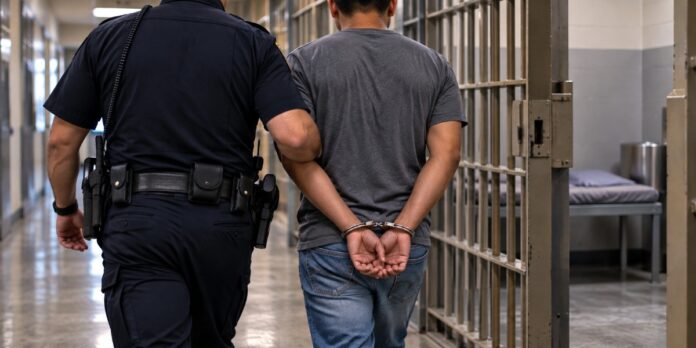
Dallas County records reveal hundreds of jail releases following rejected criminal cases, while documented mistaken arrests raise questions about evidence, accountability and what happens after prosecutors decline to proceed.
DALLAS COUNTY — An arrest can make headlines, cost someone their job and leave a permanent mark on their reputation. But what happens when the evidence falls apart, prosecutors reject the case or investigators discover they arrested the wrong person?
Dallas County’s own jail records show that hundreds of people have been released after prosecutors declined to pursue their cases. Yet determining precisely why individual cases collapsed—and whether the original arrests were justified—remains considerably more difficult.
A review of the county’s September 2026 Criminal Justice Advisory Board report, prosecutor procedures and documented North Texas arrests reveals a criminal justice system in which an arrest does not necessarily lead to prosecution.
Hundreds Released After Prosecutor Rejections
Dallas County reported 335 jail releases in 2025 classified as cases rejected by the district attorney.
Another 109 releases were classified as cases receiving a grand-jury no bill, meaning the grand jury declined to indict.
Through August 2026, the county recorded an additional 189 releases under the prosecutor-rejection category and 92 involving no bills.
| Jail release classification | 2025 | Jan.–Aug. 2026 |
|---|---|---|
| Case rejected by district attorney | 335 | 189 |
| Grand jury declined indictment | 109 | 92 |
These are jail-release classifications, not a complete count of arrests rejected by prosecutors. People released on bond before a charging decision might not appear in either category.
The county’s official glossary describes a prosecutor rejection as a decision not to proceed because of insufficient evidence, while preserving the possibility of filing later if investigators obtain additional evidence.
The figures do not establish how many arrests were unlawful, how many involved mistaken identification or how many resulted from weaknesses discovered after a legitimate arrest.
But they confirm something important: being booked into jail does not guarantee that prosecutors will ultimately pursue criminal charges.
The Wrong Man Was Arrested
One particularly troubling Dallas County case demonstrates how investigators can reverse an arrest after obtaining new evidence.
On February 7, 2024, authorities arrested Joshua Quintairo Watson in connection with the hit-and-run death of Arlington police Officer Darrin McMichael, who was killed while riding his motorcycle to work in September 2023.
Investigators initially relied on cellphone information and statements identifying Watson as the driver involved.
Five days after Watson’s arrest, however, another man, Ryan Luckett, admitted that he had been driving, according to an arrest affidavit described by FOX 4.
Watson’s accusation was dropped, and he was released from the Dallas County Jail.
Dallas County Sheriff Marian Brown subsequently acknowledged that continuing the investigation after the arrest revealed inconsistencies.
By June 2024, the Sheriff’s Office said it was no longer pursuing charges against Watson.
The development raised another question: Why did the public hear about the arrest months before receiving official clarification that investigators had identified a different driver?
The Sheriff’s Office’s decision to abandon Watson’s case is documented. Available reporting does not establish that a prosecutor formally rejected his case or specify whether a criminal charging instrument had been filed.
Nevertheless, the case demonstrates the consequences of identification errors—and the importance of publicly correcting an arrest announcement when investigators change their conclusions.
A Murder Arrest Without an Indictment
Another documented case involved Kevin Jackson Sr., who was arrested after fatally shooting Phillip Betts outside a Dallas Family Dollar store in November 2022.
Police alleged that Jackson shot Betts following a confrontation between Betts and store employees.
Jackson told investigators he had been concerned for the employees’ safety.
In July 2023, a Dallas County grand jury declined to indict Jackson on the murder allegation, according to court records reported by the Fort Worth Star-Telegram.
That decision prevented the proposed felony prosecution from advancing through an indictment.
It did not constitute a jury verdict of innocence, and the confidential grand-jury proceedings do not establish which specific evidence or legal considerations influenced the decision.
The distinction matters.
A grand jury’s refusal to indict is different from a prosecutor rejecting a case before presentation. Neither automatically proves that police acted improperly in making the original arrest.
When Prosecutors Dismiss Filed Charges
A third example demonstrates another outcome: prosecutors can drop charges after a criminal case has already entered the court system.
In October 2025, CBS Texas reported that Dallas County prosecutors dismissed four of five charges against Kendral Pickett following his arrest earlier that year.
The dismissed allegations included an accusation involving bodily fluids thrown at a police officer. Pickett received probation on a remaining theft charge.
The dismissals prompted criticism from a police association, while District Judge Amber Givens publicly emphasized that prosecutors—not the court—had dismissed those four counts.
The district attorney’s office declined to explain the decision to CBS Texas.
Unlike an arrest that never produces a filed criminal case, Pickett’s prosecution had already advanced into court. His case therefore should not be counted as an example of someone never charged.
Why Do Cases Fall Apart?
Dallas County’s District Attorney’s Office says its intake division processes approximately 60,000 criminal cases annually, examining both the factual and legal sufficiency of police submissions.
Several circumstances can prevent a case from proceeding:
- Insufficient evidence: Witness statements, physical evidence or other proof may not support prosecution.
- Mistaken identification: New information may reveal that investigators accused the wrong person.
- Unlawful searches: Evidence may become unusable if a court suppresses it following a constitutional violation.
- Conflicting testimony: Witness accounts may change or undermine essential elements of an allegation.
- Additional investigation: Prosecutors may decline an incomplete submission while allowing investigators to develop further evidence.
These are potential explanations, not verified findings about every Dallas County rejection.
The available aggregate records do not identify how many rejected cases involved an unlawful search, identification error or other specific deficiency.
Answering that question requires examining individual arrest affidavits, prosecutor dispositions and court documents.
More Than 7,000 Arrest Records Needed Closure
Another Dallas County finding raises concerns about the accuracy of criminal-history reporting.
During a June 15, 2026, Criminal Justice Advisory Board meeting, county representatives reported that more than 7,000 historical arrest records remained open for a state reporting-compliance project covering arrests from 2020 through 2024.
Officials explained that closing a record may require documenting that police dropped an allegation, prosecutors rejected it, a grand jury declined indictment or a court resolved the case.
They also described problems involving incorrect case identifiers, agency assignments and computer-system matching.
An open reporting record does not mean someone remains jailed or was never charged. Some records may concern cases already resolved in court.
However, incomplete disposition reporting can create uncertainty about how an arrest ultimately ended.
What About Seagoville Arrests?
The countywide figures do not establish how many cases originated with Seagoville police or other individual departments.
Determining that requires matching local police arrest records and Dallas County jail bookings with district attorney intake decisions, grand-jury outcomes and court filings.
The most revealing records would identify the arresting agency, original accusation, booking date, prosecutor decision, disposition date and documented reason for rejection.
The Dallas County District Attorney’s Office accepts Texas Public Information Act requests through its online portal and by email.
Some investigative documents and internal prosecutorial explanations may be withheld under applicable legal exemptions. An unanswered request also should not be interpreted as proof that a rejected case involved misconduct.
The county’s existing public reports establish the overall scale, but do not provide a verified, case-by-case breakdown of rejection reasons for Seagoville.
The Arrest Ends. The Consequences May Not.
A declined prosecution does not automatically erase a booking photograph, news report or arrest-history entry.
Texas law allows certain arrests that never result in prosecution to qualify for expunction, subject to statutory requirements and exceptions.
For residents, the stakes can include lost employment opportunities, legal expenses and reputational damage—even without a conviction.
For law enforcement, prosecutor screening provides an essential safeguard against advancing cases that cannot be supported in court.
The remaining public accountability question is straightforward: When an arrest leads nowhere, does the public learn why?
Dallas County records demonstrate that hundreds of jail releases follow rejected cases and grand-jury decisions. What they do not yet reveal is which underlying mistakes, evidentiary problems or investigative deficiencies most frequently explain those outcomes.
That distinction deserves closer scrutiny—from the original arrest through the final prosecutorial decision.