

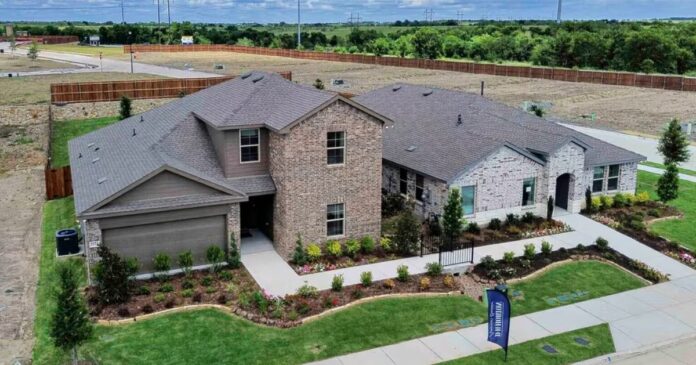
New neighborhoods, expanding schools and major retailers point toward a larger, more connected community over the next decade.
CRANDALL — A growing population brought new rooftops to Crandall. Now, major retailers, expanding school enrollment and infrastructure plans are showing how those neighborhoods could transform the community into a substantially larger city.
Kroger has broken ground on a nearly $40 million Marketplace store expected to employ approximately 200 people. Home Depot has committed to a major investment under an economic-development agreement. Meanwhile, Crandall ISD’s enrollment has more than doubled over the past decade.
Together, those developments suggest a community moving toward a future with more shopping, services and employment opportunities close to home. The pace will depend on housing demand and infrastructure, but the scale of the change is already substantial.
A population more than twice its former size
The annual population series published by World Population Review places Crandall at 3,377 residents in 2015 and 7,730 in 2025.
That represents approximately 4,353 additional residents — an increase of about 129% over 10 years. Put another way, the city had roughly 229 residents in 2025 for every 100 it had in 2015.
The same series lists 3,486 residents in 2016. Comparing that figure with 2025 shows that Crandall more than doubled even before a full additional decade had passed.
These figures describe the municipality. They should not be confused with the population of the larger Crandall school district, surrounding subdivisions or utility service areas. Each covers a different geographic footprint.
What the next decade could bring
One of the clearest indications of the scale of anticipated growth appears in Crandall’s 2025–2035 water and wastewater impact-fee study.
The report uses a water-service-area population of 7,344 in 2025 and projects 40,141 at buildout in 2035. Its wastewater-service-area assumptions rise from 6,691 to 32,989 over the same period.
Those figures are engineering planning assumptions based on expected development, with buildout assumed by 2035. They are not a promise that Crandall’s incorporated population will reach 40,000.
Nevertheless, they show that the city is planning infrastructure for a service population several times larger than today’s. No verified city-limit forecast for exactly 2036 was established in the records reviewed.
The practical picture is a community preparing for thousands of additional households, with substantially greater demand for water, sewer capacity and supporting services. Whether that development arrives on schedule will depend on construction, financing and homebuyer demand.
Large neighborhoods are driving the transformation
Crandall’s housing expansion involves multiple major developments rather than a single subdivision.
In a September 2025 interview with Business View Magazine, city officials described five large developments approved in recent years, each containing hundreds of residential lots.
That is a useful dated measure of the city’s development activity, although it is not a complete October 2026 inventory of every subdivision and phase.
Across the broader Crandall area, several projects illustrate the scale:
| Development | Documented scope |
|---|---|
| Wildcat Ranch | Approximately 3,100 single-family homes in the community’s overall plan |
| Eastland and Arbors at Eastland | A combined 3,700 homes described in 2024 reporting on Lennar’s plans |
| Eaglecrest | A 2022 city agenda described a proposed land study containing 1,646 residential lots |
| River Ridge | Multiple residential phases appear in city planning records, including River Ridge North |
These figures describe different stages of development. They are not counts of homes completed this year, and Eaglecrest’s historical proposal should not be treated as a current construction total. Some projects also lie outside the city limits.
Even with those distinctions, the direction is clear: individual communities are large enough to add hundreds or thousands of households over time.
Thousands more students
Crandall ISD provides another measure of the area’s transformation.
The Texas Tribune’s state-data-based Schools Explorer reports enrollment of 7,485 students in 2026, up 116.8% since 2016. That indicates an increase from approximately 3,450 students a decade earlier — roughly 4,000 additional children.
The published campus figures include approximately 3,600 students across six elementary schools and another 1,700 across two middle schools.
Those younger students represent substantial enrollment moving toward high school in coming years, although future totals will also depend on families moving into and out of the district.
District records independently document recent growth. Crandall ISD’s fall 2025 enrollment snapshot counted 7,449 students, an increase of 525 from the comparable 2024 figure, or approximately 7.6%.
That report placed Crandall High School at 2,190 students against a listed capacity of 2,700. It also showed that capacity pressures varied among campuses, with Martin Elementary at approximately its listed capacity.
Because Crandall ISD serves communities beyond the municipality, these students should not be counted as children living exclusively within Crandall’s city limits.
Is a move to 6A coming?
Crandall High School remains a Class 5A school for the 2026–2028 University Interscholastic League cycle.
UIL’s official realignment list records Crandall’s classification enrollment at 2,188. The 6A threshold for that cycle is 2,215 students — a difference of just 27.
That makes a future move to 6A a realistic possibility if enrollment continues growing. It does not establish a guaranteed date.
UIL classifications apply to individual high schools, rather than an entire district’s elementary-through-high-school enrollment. Future classification will depend on the enrollment submitted for the next realignment, the cutoff UIL establishes and any changes in how students are assigned among campuses.
For residents, the meaningful point is that Crandall High is already near the upper end of 5A. A move into the state’s largest classification would be another visible marker of the area’s growth.
Kroger brings shopping and employment
Kroger’s September 25 groundbreaking marked a major step in the community’s commercial development.
The company plans a nearly 100,000-square-foot Marketplace store representing an investment of almost $40 million and approximately 200 jobs. Planned offerings include groceries, a pharmacy, home goods, toys and a fuel center with 14 fueling positions.
A Kroger spokesperson told CultureMap that the store is scheduled to open in late 2027. That remains an anticipated opening window.
For households, the potential benefit is straightforward: more everyday needs could be met nearby. The project also introduces employment opportunities in grocery operations, pharmacy services, customer service and store management.
Home Depot adds another commercial anchor
Home Depot’s plans are supported by an economic-development agreement recorded in the Texas comptroller’s public database.
The agreement lists a minimum $30 million investment in construction and improvements, an opening deadline of September 1, 2028, and a commitment to maintain at least 42 full-time positions.
The employment figure is a contractual minimum, not a forecast of the store’s entire workforce. Similarly, the opening deadline is an agreement requirement rather than an announced grand-opening date.
A home-improvement store would serve a growing customer base of homeowners and contractors as neighborhoods expand. Alongside Kroger, it signals investment in businesses serving the community’s daily needs.
Walmart also appears in official planning records. Minutes from a May 13, 2025, city Planning and Zoning meeting record approval of a site plan for a proposed Walmart Supercenter and fuel station north of U.S. 175, between Spring Creek and FM 741.
That approval establishes a documented project, but does not establish that the store is open or confirm an opening date.
Growing while keeping a community identity
A larger Crandall could offer residents more than additional subdivisions and national stores.
City officials have described a vision for a walkable downtown shopping area extending across several streets, giving smaller businesses a place alongside larger commercial developments. That vision remains a development goal.
Crandall’s completed Envision Crandall 2050 Comprehensive Plan provides a framework for decisions about land use, transportation, housing and economic growth. Those decisions will help determine whether new neighborhoods connect effectively with schools, shopping and public spaces.
For local residents, the next decade could mean more errands completed close to home, more nearby jobs and a broader range of businesses supported by a larger customer base.
Crandall’s growth is already measurable in its population, classrooms and development commitments. The opportunity now is to turn that expansion into a city where longtime residents and newcomers can share in the benefits.