

Government Fee Check: What Local Cities Charge to Build or Remodel
A homeowner building a new house, adding a room or even putting up a fence can pay very different city fees depending on which of the three towns the property sits in.
Anyone planning to build, remodel, replace a roof or put up a fence in Seagoville, Crandall or Combine should know the price tag can shift dramatically at the city line.
A Shop in Seagoville review of the current published fee schedules and municipal codes for all three cities found differences ranging from a few dollars to several thousand dollars for similar projects.
All figures below come directly from each city’s published FY 2026 fee schedule and municipal code, current as of August 27, 2026.
A 2,000 Square Foot House: Three Different Price Tags
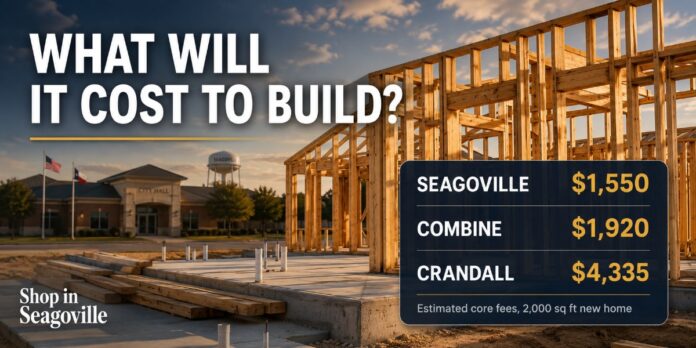
Seagoville’s FY 2026 Master Fee Schedule charges 75 cents per square foot for a residential building permit, plus a flat $50 plan review fee for a new single family dwelling. For a 2,000 square foot house, that totals $1,550.
Combine calculates it differently. City code charges $1,570 for the first 1,500 square feet, then 70 cents for each additional square foot up to 10,000 square feet. The city states this single fee covers the plan review, inspection and building permit together. A 2,000 square foot house lands at $1,920.
Crandall’s FY 2026 schedule is the most layered of the three. It charges $1.20 per square foot for new residential construction, adds a plan review fee equal to 65 percent of the permit cost, and assesses a separate $375 first responder fee on every new residential dwelling unit. Here is how that breaks down:
| Crandall Charge | Amount |
|---|---|
| Building permit: 2,000 sq ft x $1.20 | $2,400 |
| Plan review: 65 percent of permit | $1,560 |
| First responder fee | $375 |
| Total listed core charges | $4,335 |
Crandall’s first responder fee is due when the application for new construction is submitted and must be paid before the building permit is issued. City code directs that money into a separate account for police facilities, equipment and related capital needs.
On this example alone, Crandall’s listed core charges run about $2,785 higher than Seagoville’s and $2,415 higher than Combine’s.
Remodeling Can Produce an Even Stranger Comparison
Combine applies its residential formula to more than new construction. The code also covers alterations and additions to existing homes, meaning a modest addition can trigger the same $1,570 starting fee charged to a 1,500 square foot new build.
Seagoville charges remodeling work at the same flat rate as new construction: 75 cents per square foot.
Crandall requires the most caution. One part of its current FY 2026 schedule lists residential alteration, addition and remodeling work at $1.20 per square foot.
Another part of that same schedule lists remodels as valuation based permits, starting at $100 for projects valued at $10,000 or less.
Because these provisions can apply differently depending on the scope of work, homeowners in Crandall should request a project specific calculation from the city before relying on either number.
| Project | Seagoville | Crandall | Combine |
|---|---|---|---|
| Residential fence | $35 | Valuation based, starting at $100 | No permit needed |
| Roof repair | $75 | Valuation based, starting at $100 | No permit needed |
| Demolition | $100 | Valuation based, starting at $100 | No charge for demolition or removal |
| Residential electrical | $75 | Valuation based, starting at $100 | $150 inspection only fee per trade |
| Residential plumbing | $75 | Valuation based, starting at $100 | $150 inspection only fee per trade |
| Residential HVAC | $75 | Valuation based, starting at $100 | $150 inspection only fee per trade |
Seagoville’s current schedule sets the $75 charge for residential electrical, plumbing and mechanical permits, along with the $75 residential roofing permit and $100 demolition permit.
Crandall’s current master schedule places electrical, mechanical, plumbing, roofing, demolition, fencing, pools, solar panels and several other residential projects under its valuation system rather than flat fees.
Combine’s code states plainly that fences and roof repairs need no permit at all, and that demolition and removal carry no charge. Accessory buildings under 500 square feet also need no permit, unless utilities or a foundation are added. In that case the city charges a $150 inspection fee.
Want a Zoning Variance? Crandall Is the Most Expensive of the Three
A Board of Adjustment variance request costs $100 in both Seagoville and Combine. Crandall charges $300 for the same request, plus $3 for every property owner who must be notified within 200 feet. Crandall’s development schedule also lists a separate $100 city administrative and processing fee.
Zoning changes follow the same pattern. Combine charges $200 for a zoning or rezoning request. Crandall charges $400, plus the same $3 per property owner notification fee. Seagoville bases its zoning change fee on acreage instead of a flat rate.
| Seagoville Zoning Change Fee | Acreage |
|---|---|
| $250 | 1 to 2 acres |
| $500 | 2.1 to 5 acres |
| $750 | 5.1 to 15 acres |
| $60 per acre, capped at $1,500 | 15.1 acres or more |
Even Garage Sales Are Different
Residents do not need to build anything to notice how differently the three cities operate.
Seagoville’s Fee Schedule Goes Well Beyond Construction
Seagoville publishes one of the more detailed all department fee schedules of the three cities, covering everything from police records to recreation and water service. Current charges include:
- $6 for an accident report
- $10 for fingerprinting
- $20 per year for a residential alarm permit
- $30 per year for a commercial alarm permit
- $15 per hour to reserve the C.O. Bruce Central Park pavilion
- $50 per hour for a lighted field
- $20 per year for a nonresident library card
- $25 to turn on water during regular hours
- $50 for an after hours or weekend water turn on
These police and recreation fees appear alongside dozens of other city service charges in Seagoville’s FY 2026 schedule.
Seagoville’s master schedule doubles the applicable permit fee when construction begins before a permit is obtained. Combine imposes the same penalty on electrical, plumbing or HVAC work started before a required permit is issued. Crandall is the most punitive of the three. A first offense for building code work performed without a permit costs double the standard permit and plan review fee, plus the cost of the original permit and plan review. A second offense adds another $500 on top of that.
The Cheapest City Depends on What You Are Doing
There is no single city that comes out cheapest for every project. Combine requires no permit at all for several common jobs, including fences and roof repairs, but its residential construction fee starts at $1,570 even for projects at or below 1,500 square feet.
Seagoville generally carries lower published charges for ordinary homeowner projects, including $35 fences and $75 roofing and trade permits.
Crandall’s fast growing development environment brings higher charges across the board, from its $1.20 per square foot new home permit to its 65 percent plan review charge and $375 first responder fee. Its 2026 schedule also shifted many common residential projects onto a valuation based fee system.
The larger lesson for residents is simple. The cost of a project is never just materials and labor. Where the property sits can change the government cost considerably.
Before breaking ground, homeowners should confirm the current fee schedule with their city and ask which charges apply to their specific project. Fee schedules can be amended, and some projects trigger inspections, reviews or utility charges beyond the base permit.
Have a building or remodeling project on the horizon? Check with your city’s building department before you break ground.
Read More Local Government Coverage