

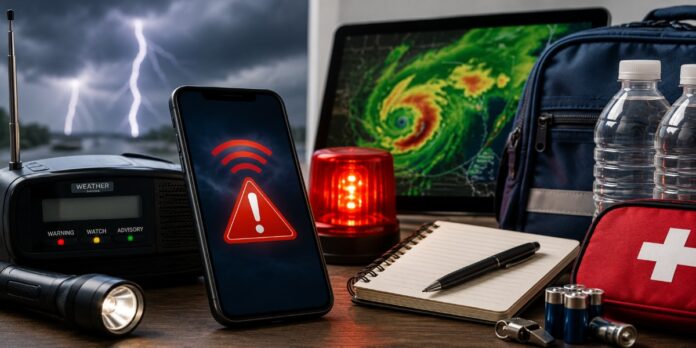
Severe thunderstorms, tornadoes, flash flooding, utility emergencies and public-safety incidents can develop quickly, making reliable emergency notifications an important part of household preparedness.
Residents of Seagoville, Crandall and Combine have several ways to receive warnings, but the systems available differ by community. Local notification services can also provide information that may not trigger a nationwide cellphone alert, including road closures, utility problems and localized public-safety situations.
Seagoville: City Alert Center and Notify Me
The City of Seagoville operates an online Alert Center for emergency information affecting the community. Residents can subscribe through the city’s Notify Me service to receive notifications when alerts are issued rather than relying solely on periodically checking the city’s website. The Alert Center also offers an RSS subscription option.
Seagoville’s website uses an Emergency Alert indicator to show whether an emergency condition is currently affecting the city. A green indicator signifies no current emergency condition, while red indicates an emergency condition exists and directs residents to additional information.
Seagoville residents can access the city’s online Alert Center and use the Notify Me option to subscribe to alerts and emergency notifications.
Seagoville also uses outdoor emergency notification sirens as another warning tool. Residents should never depend on an outdoor siren as their only method of receiving severe-weather information, particularly while sleeping or when inside buildings.
Crandall: Alerts Powered by Everbridge
Crandall residents have access to Crandall Alerts, the city’s emergency notification system powered by Everbridge.
The service can deliver severe-weather warnings and public-safety notifications along with information about road closures, utility outages, service interruptions and other community updates. Residents can select text messages, emails or telephone calls as notification methods.
Weather notifications available through the system include tornado warnings, storms and extreme heat alerts.
Residents can register by visiting the City of Crandall website and selecting the “Receive Alerts and Text Messages” page. The city provides both video and written instructions for completing Everbridge registration.
Crandall also maintains an online Alert Center where residents can view active emergencies and subscribe through Notify Me or RSS.
Combine: Kaufman County Emergency Alert System
The City of Combine directs residents to the Kaufman County Emergency Alert Notification System, which is also powered by Everbridge. A registration link is available directly through the City of Combine website.
Kaufman County’s system can send alerts countywide or target a specific geographic area affected by an emergency. The county says its emergency management staff coordinates with the National Weather Service and activates weather notifications based on warning polygons when tornado or flash-flood warnings are issued.
The system can also be used for other critical situations, including law-enforcement emergencies and missing-person incidents. Residents can receive notifications by text message, telephone call or email.
Registration is particularly important in Combine because the city does not operate outdoor tornado sirens. The city says multiple sirens would be necessary to adequately cover Combine and instead directs residents toward modern warning technology, including the Kaufman County emergency alert program, smartphone applications and weather radios.
Your Cellphone May Already Receive Wireless Emergency Alerts
Residents of all three communities may also receive Wireless Emergency Alerts, commonly called WEAs, directly on compatible cellphones.
Unlike local opt-in systems, residents do not have to register for WEA. Authorized government agencies can transmit geographically targeted emergency messages through participating wireless carriers. These can include tornado warnings, certain significant flash-flood and severe-thunderstorm warnings, evacuation notices and other emergencies requiring immediate action.
Because WEA is separate from municipal and county subscription services, residents should check their phone settings to make sure emergency alerts have not been disabled.
Local alert programs and WEA complement one another. A local system may provide detailed information about a road closure, water outage or police situation that does not meet the threshold for a nationwide Wireless Emergency Alert.
A Weather Radio Adds Another Layer of Protection
A NOAA Weather Radio can provide another source of information when severe weather threatens, especially during overnight storms or when internet and cellular service are unreliable.
NOAA Weather Radio broadcasts National Weather Service warnings, watches, forecasts and other hazard information around the clock. The system can also carry information about non-weather emergencies, including environmental hazards and certain public-safety situations.
Battery-powered weather radios with an automatic alert function can be particularly useful during power outages.
The safest approach is not to depend on a single notification source. Combining local emergency-alert registration, Wireless Emergency Alerts and a weather radio gives residents several opportunities to receive critical information when minutes matter.