

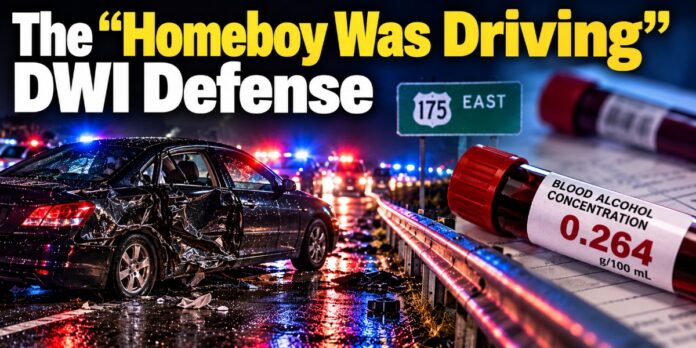
A nighttime crash on U.S. Highway 175, a damaged black sedan against a guardrail, a man found beneath a bridge, and an unnamed “homeboy” became the central pieces of a Kaufman County DWI case that eventually reached the Texas Fifth Court of Appeals.
The appellate court ruled in July 2026 that jurors had enough evidence to conclude Luis Velazquez-Rosa was driving the sedan, rejecting his challenge that prosecutors failed to prove he was behind the wheel.
Velazquez-Rosa had been convicted of driving while intoxicated, third or more, following the January 21, 2024 crash. A jury sentenced him to five years in the Texas Department of Criminal Justice and assessed a $7,500 fine.

The appeal did not center on whether Velazquez-Rosa was intoxicated. Instead, the question was much narrower: Who was driving the car?
Velazquez-Rosa maintained that someone else was.
According to testimony preserved in the appellate opinion, when Seagoville Police Corporal Jason Hoveln asked Velazquez-Rosa whether he had been driving, Velazquez-Rosa said his “homeboy” had been behind the wheel.
He could not provide the alleged driver’s name.

A Crash on Highway 175
The case began on a rainy night along U.S. Highway 175 in Kaufman County.
Texas Department of Public Safety Trooper Alejandro Rodriguez was traveling east when he approached a bridge and noticed vehicles stopped with hazard lights.
He saw skid marks across the roadway, a silver Chevrolet pickup on one shoulder, and a black sedan resting against a guardrail on the other.
The black sedan had significant damage to the driver’s side, including damage that made the driver’s door unusable.

Rodriguez also saw what he described at trial as a dark silhouette going over the edge of the bridge. Other people at the scene reported seeing someone jump over the bridge.
Emergency personnel eventually located Velazquez-Rosa underneath the bridge, approximately 20 feet from the crash area.
Rodriguez testified that Velazquez-Rosa smelled strongly of alcohol, had slurred speech, and had glassy eyes. The trooper described him as appearing highly intoxicated.
But establishing intoxication was only part of the prosecution’s case. Prosecutors also had to establish that Velazquez-Rosa had actually operated the vehicle.

Witness Says One Man Left Car
Edgar Gonzalez-Ramirez was driving the silver Chevrolet Silverado involved in the collision. According to his testimony, the black sedan struck his pickup and then crashed into the guardrail.
After the sedan stopped, Gonzalez-Ramirez said he saw the driver climb out through the passenger-side door and run away. He did not report seeing another person leave the vehicle.
Another witness, John Michael Morton Jr., provided particularly important testimony about what happened immediately before and after the collision.
Morton said the black car aggressively passed him, changed lanes without signaling, and then struck the pickup before hitting the guardrail.
Most importantly for the eventual appeal, Morton testified that the black sedan remained within his view.

He said he saw one person emerge from the passenger side because the damaged driver’s-side door could not be used. That man then went over the guardrail.
Morton checked the vehicle afterward and found no other occupant. Police later found Velazquez-Rosa underneath the bridge.
Seagoville Officer Makes Arrest
Seagoville Police Corporal Jason Hoveln responded and arrested Velazquez-Rosa at the scene.
Hoveln testified that Velazquez-Rosa had slurred speech, bloodshot and red eyes, smelled strongly of alcohol, and was swaying.
Inside the damaged sedan, Hoveln observed an 18-pack of 12-ounce Modelo beer bottles on the passenger-side floorboard.

That location became part of the circumstantial evidence officers used to evaluate Velazquez-Rosa’s claim that another person had been driving.
Hoveln testified that the beer occupied much of the area where a passenger’s feet normally would have been. Combined with the witness accounts reporting only one occupant, the officer concluded there had not been a second person riding in the passenger seat.
Hoveln also noticed a red mark extending from Velazquez-Rosa’s left shoulder toward his right hip. He testified that he believed the mark was consistent with the path of a driver’s-side seat belt during a collision.
“My Homeboy Was Driving”
After the arrest, Hoveln asked Velazquez-Rosa whether he was driving.
Velazquez-Rosa denied it. He told the officer that his “homeboy” had been driving, according to Hoveln’s trial testimony. But when Hoveln asked who that person was, Velazquez-Rosa could not identify him.

Velazquez-Rosa continued repeating that he had not been driving and declined to participate in standardized field sobriety testing. He also refused to consent to a blood draw.
Hoveln subsequently obtained a warrant authorizing the collection of a blood sample. The resulting test showed an alcohol concentration of 0.264 grams per 100 milliliters of blood.
Texas law defines a person as intoxicated at an alcohol concentration of 0.08 or greater. The reported 0.264 concentration was approximately 3.3 times that threshold.
The appellate opinion also notes that two previous DWI convictions—one from Dallas County and another from Tarrant County—were introduced at trial. Under Texas law, two qualifying prior intoxication-related driving convictions can elevate a subsequent DWI to a third-degree felony.
The Appeal Focused on One Question
After the jury convicted Velazquez-Rosa, he appealed.

His argument was not that the State had failed to prove intoxication. His defense attorney had conceded intoxication during closing arguments, according to a footnote in the appellate opinion.
Instead, Velazquez-Rosa argued that the evidence was legally insufficient to establish that he had been driving the black sedan. That distinction was critical.
A DWI conviction requires proof that a person was intoxicated while operating a motor vehicle in a public place. Being intoxicated near a wrecked vehicle, by itself, does not automatically establish who was operating it.
The Fifth Court of Appeals therefore examined the evidence jurors had available when deciding whether Velazquez-Rosa was the driver.
Court Points to Combined Evidence
The appellate court concluded the evidence was sufficient.

Among the evidence considered by the court were the eyewitness accounts indicating that only one person was in the sedan, testimony that the same person climbed from the passenger side after the driver’s door was damaged.
The fact that only Velazquez-Rosa was found beneath the bridge, and the absence of another occupant when the car was checked.
The court also considered the testimony about the beer occupying the passenger floorboard and the seat-belt-type mark observed on Velazquez-Rosa.
There was also an apparent inconsistency in Velazquez-Rosa’s statements.
While Hoveln testified that Velazquez-Rosa claimed an unidentified “homeboy” had been driving, Trooper Rodriguez recalled Velazquez-Rosa saying there had been nobody else in the vehicle.

Jurors were entitled to decide which testimony they believed and what conclusions to draw from the circumstances.
Appellate judges do not retry a case or decide whether they personally would have reached the same verdict.
Their task in a legal-sufficiency challenge is to determine whether a rational jury, viewing the evidence in the light most favorable to the verdict, could have found the required elements beyond a reasonable doubt.
The Dallas-based appellate court determined that standard had been met.
Conviction and Sentence Affirmed
The Fifth Court of Appeals rejected Velazquez-Rosa’s single appellate issue and affirmed the Kaufman County trial court’s judgment on July 21, 2026.

That left intact his conviction for DWI, third or more, his five-year prison sentence, and the $7,500 fine imposed by the jury.
The case illustrates how a DWI prosecution does not necessarily depend on an officer actually seeing a defendant driving.
In this case, prosecutors relied on a chain of circumstantial and eyewitness evidence: a witness who kept the sedan in view, a single person leaving the crashed vehicle, the damaged driver’s door, no second occupant found inside.
Also, Velazquez-Rosa was beneath the bridge, the passenger-floorboard beer, the mark officers associated with a driver’s seat belt, and conflicting accounts about whether another person had ever been in the car.
Velazquez-Rosa’s explanation was that his “homeboy” was driving. The jury rejected that explanation.
In 2026, the Texas Fifth Court of Appeals concluded there was legally sufficient evidence for it to do so.