

The headline number on municipal debt is usually the amount borrowed. The number taxpayers ultimately repay can be considerably larger.
Seagoville’s own financial records provide a clear example.
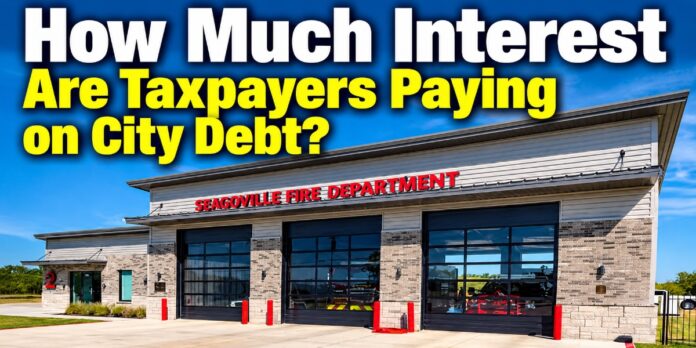
The city is currently considering up to $7.15 million in certificates of obligation for construction of a new fire station near Kaufman Street and Hall Street.
Under the city’s required notice, that $7.15 million principal could require an estimated $11.432 million in total principal and interest payments if the debt carries an assumed 5% interest rate.
That means the illustrative financing cost is approximately $4.282 million in interest over the life of the debt. Put another way, the interest estimate alone is equal to nearly 60% of the amount borrowed.
The city emphasizes that the figure is an estimate, not a final borrowing cost. The actual interest rate will depend on market conditions when the certificates are sold, and the certificates could mature over a period of up to 40 years.
Still, the notice illustrates an important part of municipal borrowing that residents do not always see when major projects are discussed: borrowing $7 million does not necessarily mean taxpayers ultimately pay $7 million.
Existing Debt Carries Millions in Interest
The fire-station proposal is only one part of the city’s debt picture.
As of the August 2026 notice, Seagoville reported $16.25 million in outstanding public securities secured by property taxes. The city estimated that paying those securities on time and in full would require approximately $20.189 million in combined principal and interest.
The difference is about $3.939 million.
That figure represents the remaining estimated interest associated with those outstanding securities under the scope used in the city’s notice.
The city specifically excluded securities that are backed by property taxes but designated as self-supporting, meaning residents should be careful about comparing that number directly with every debt figure appearing elsewhere in the budget or annual financial report.
Different city financial documents can include different categories of debt.
A Closer Look at Certificate Debt
Seagoville’s FY 2026 budget documents provide another useful view.
The city listed approximately $14.017 million in remaining principal on its existing certificate-of-obligation bond series, with approximately $4.016 million in scheduled future interest.
Total remaining payments on those certificate obligations were listed at approximately $18.033 million through fiscal year 2043.
That means for every $1 of remaining principal in that particular debt schedule, the city is scheduled to pay roughly another 29 cents in interest.
Those figures apply to the existing certificate-of-obligation series shown in the city’s debt-service schedule and should not be confused with the broader $16.25 million figure in the 2026 fire-station notice.
Interest Is Already a Major Annual Expense
The effect is visible in the annual budget.
For fiscal year 2026, Seagoville’s debt-service schedule shows:
- Principal payments: $805,000
- Interest payments: $453,056
- Total debt service: $1,258,056
That means roughly 36% of that scheduled certificate debt payment is interest, while about 64% goes toward reducing principal.
The balance changes over time because municipal bonds are structured so that principal and interest payments vary by year.
In 2027, the schedule calls for approximately $826,250 in principal and $431,338 in interest. By 2030, principal rises to $760,000 while interest falls to about $346,594.
By 2039, the city is scheduled to pay approximately $1.02 million in principal and just $86,600 in interest. That declining interest pattern is normal as principal is gradually retired.
Why Long-Term Debt Costs More
Interest is essentially the price a city pays for being able to build something now instead of saving enough money to pay cash later.
A city issuing bonds or certificates receives money from investors. In exchange, the city promises to repay the principal plus interest over a specified period.
The length of that repayment period can make a major difference.
A longer term can lower annual payments, making a project easier to fit within a city budget. But extending repayment can also increase the total amount of interest paid.
That tradeoff is particularly important in Seagoville’s proposed fire-station financing because the city’s notice permits a maturity period of up to 40 years.
The notice does not say the city will necessarily issue 40-year debt. It establishes the maximum permitted term.
The Fire Station Example
The proposed certificates provide an easy way to see the difference between principal and total cost.
Under the city’s published illustration:
Amount borrowed: $7.15 million
Estimated total repayment: $11.432 million
Estimated interest: $4.282 million
The total estimated repayment is approximately 160% of the original principal. That does not mean the city is paying a 60% interest rate.
The assumed rate in the notice is 5% annually. The much larger cumulative figure results because interest is paid over many years while portions of the principal remain outstanding.
That distinction is important when residents evaluate long-term borrowing.
Existing Interest Rates Vary
Seagoville’s 2025 annual financial report shows that the city’s existing debt was issued at a range of interest rates.
Among the city’s certificates of obligation:
The 2018 series carried an interest rate of approximately 1.93%.
The 2019 series carries rates ranging from approximately 3% to 4%.
The 2021 series carries rates ranging from approximately 1.5% to 4%.
The 2023 series carries rates ranging from approximately 4% to 5%.
Those differences reflect, among other factors, prevailing market conditions when each issue was sold. Older low-rate debt can therefore be considerably cheaper to carry than debt issued when interest rates are higher.
Debt Is Not Automatically Bad
The existence of interest costs does not by itself indicate that borrowing is inappropriate.
Cities routinely finance fire stations, police facilities, roads, water systems, sewer systems, major equipment, and other assets that may serve residents for decades.
Financing can spread the cost of a long-lived asset among both current and future residents who benefit from it.
The relevant financial questions are more specific.
How much is being borrowed? What interest rate will the city pay? How long will repayment take? How much total interest will accumulate? What revenue source will repay the debt? What alternatives were considered? And how much borrowing capacity will remain for future projects?
Those questions give residents a more complete picture than the principal amount alone.
Why Residents Should Watch Total Repayment
Municipal debt discussions frequently focus on project cost.
A proposed fire station may be described as a $7.15 million financing. A road project might be described as a $10 million bond. A utility improvement might carry another multimillion-dollar principal figure.
But taxpayers ultimately fund debt service, not simply principal.
For Seagoville’s existing certificate obligations, the current schedule shows more than $4 million in future interest in addition to approximately $14 million in principal.
For the proposed fire-station certificates, the city’s own illustration shows another potential $4.282 million difference between principal and total repayment.
The final fire-station borrowing cost remains unknown because the certificates have not yet been issued and the final interest rate has not been established.
But the city’s published figures already make one thing clear: when Seagoville borrows money, the principal tells only part of the story.
For residents trying to understand the cost of city debt, the more revealing number may be the one printed beside it — principal plus interest.