

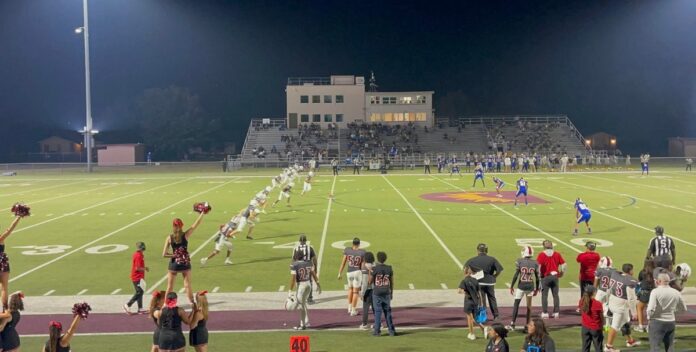
Long before artificial turf and modern lighting arrived, the football stadium on Jack Street was simply Seagoville’s home field.
Built in 1955, the stadium has stood for more than seven decades as one of Seagoville’s most recognizable community institutions. Generations of Seagoville Dragons have played there. Repeated renovations have transformed the facility while preserving its place in the city’s athletic history.
Today the facility is officially identified by Dallas ISD as Seagoville Stadium, with the playing surface designated James Ray Henry Field. To generations of local football fans, the venue has long been known simply as James Ray Henry Stadium.
Its history began well before Henry’s name was attached to it.
A Stadium Built in 1955
The clearest surviving public record establishing the stadium’s age comes from the City of Seagoville.
During a February 2010 Planning and Zoning Commission meeting, a Dallas ISD representative told commissioners that the stadium had been built in 1955. Dallas ISD had proposed improvements to the property at that time.
That places the facility’s origins in an era when Seagoville schools and the surrounding community looked much different than they do today.
For decades after its construction, the stadium served as the exclusive football home of the Seagoville Dragons. Friday nights there belonged to Seagoville.
Students and parents gathered to watch the Dragons play. Alumni and residents filled the stands alongside them at a stadium embedded directly in the community, rather than at a remote athletic complex.
That distinction matters to the stadium’s history. Its original purpose was not to serve as a rotating home for teams from across Dallas ISD. It was Seagoville’s field alone. The broader district use familiar to more recent fans developed much later.
The Man Behind the Name
James Ray Henry was a former Seagoville High School teacher who later left the classroom and became an insurance agent. His connection with the school and community remained strong. Following his death in 1991, an effort developed to place his name on Seagoville’s longtime stadium.
A trio of former Seagoville High School teachers led the renaming effort. Rather than a simple administrative decision by Dallas ISD, the naming is better understood as a locally driven tribute. Educators wanted Henry remembered by the community he had served.
Over time, “James Ray Henry Stadium” became the widely used name. It appeared in newspaper coverage, football schedules, and everyday conversation.
From Grass to Artificial Turf
One of the biggest physical changes came in the early 2000s. Seagoville received an artificial playing surface in 2003. The upgrade was part of a broader Dallas ISD move toward synthetic turf at several athletic facilities.
The installation marked a major shift for a stadium that had spent nearly half a century as a traditional grass field. Artificial turf reduced many of the maintenance problems associated with natural grass. It also allowed the field to withstand considerably heavier use.
That change coincided with a broader shift in how Dallas ISD used the stadium. During the 2000s, James Ray Henry Stadium increasingly became part of the district’s network of football venues. It no longer served exclusively as the home field of Seagoville High School.
Games involving other Dallas ISD programs gradually became a more common part of the schedule. The change marked a significant departure from the stadium’s first several decades.
Major Improvements in 2010
By 2010, the aging facility was again receiving significant attention. City of Seagoville Planning and Zoning Commission records show that Dallas ISD brought plans before the city for improvements to the football stadium and press box.
The work was tied to the district’s 2004 bond program. Plans included new press box construction along with upgrades to concessions and restroom facilities. The city minutes offer an unusually detailed glimpse into the condition of a stadium that was already approximately 55 years old.
The improvements extended the useful life of the original 1955 facility. Dallas ISD chose renovation over abandoning the historic site for a new stadium elsewhere.
The 2019 Renovation
Another substantial renovation followed less than a decade later. In August 2018, Dallas ISD trustees authorized a contract covering renovations to both Forester Athletic Complex and Henry Field at Seagoville Stadium.
The contract carried a maximum authorization of approximately $10.47 million. That figure covered both facilities and should not be read as the cost of the Seagoville project alone. The Henry Field portion included significant upgrades.
District documents called for improvements to the press box, replacement of stadium lighting, and upgrades to the audio system and play clocks. Roughly 1,000 bleacher seats were also added. Dallas ISD formally accepted completion of the Henry Field work in November 2019.
The project helped shape the stadium that spectators recognize today. Despite repeated modernization, the facility remained on essentially the same historic ground where Seagoville football had been played since the 1950s.
Becoming a District Football Venue
The stadium’s modern identity differs substantially from its original one. For decades, it belonged entirely to the Seagoville Dragons. By the 2000s and particularly the 2010s, Dallas ISD increasingly scheduled games there involving other district schools.
Newspaper archives document numerous contests involving teams with no direct connection to Seagoville High School. One clear example occurred in 2016. Dallas ISD moved a game between Arlington Seguin and Bryan Adams to James Ray Henry Stadium because new turf installation at Forester Field had not been completed.
By then, Henry Stadium had become a useful part of the district’s larger stadium inventory. That role has continued. The venue today can host Dallas ISD games involving schools from across the district. At the same time, it remains the traditional home of Seagoville football.
Memorable Games at Henry Stadium
The stadium has hosted thousands of football plays across seven decades. Newspaper archives preserve snapshots of some of its most notable modern games.
One came in October 2011, when Seagoville defeated Carter 15-7 in overtime. Quarterback Roland Hyder scored the game winning touchdown on a 22-yard run, breaking a tackle to escape defenders for a dramatic home victory.
Two years later, James Ray Henry Stadium hosted one of the most anticipated Seagoville games of the modern era. Seagoville and South Oak Cliff entered their October matchup both undefeated at 5-0. The Dragons built a 20-10 advantage before South Oak Cliff rallied.
SOC ultimately escaped with a 24-20 victory after scoring on a 47-yard touchdown pass with just more than a minute remaining.
The following season, Seagoville again produced one of its strongest starts in recent memory. The Dragons defeated Molina 47-2 at Henry Stadium to improve to 7-0.
Those games represent only a small portion of the stadium’s history. Seagoville teams were creating similar Friday night memories on the same property long before digital archives and social media existed.
More Than a Football Field
James Ray Henry Stadium has never been significant because of its size. Its current capacity of approximately 3,500 makes it modest by Texas high school standards. Some school districts operate stadiums seating well over 10,000 spectators.
Its value is historical rather than architectural.
The stadium has survived changing school districts and generations of students. New coaching staffs and shifting classifications have also come and gone. Artificial turf and modern electronics have arrived too, keeping the facility current through repeated renovations.
It began in 1955 as the football home of the Seagoville High School. Nearly 70 years later, it remains the home of the Dragons.
The venue now serves a broader Dallas ISD athletic function than it did in its earliest decades. Its identity remains closely connected to the community that built its football tradition.
The name attached to that field preserves another piece of that history. A former Seagoville teacher’s colleagues believed his contribution deserved to be remembered.
Seven decades after the stadium was built, James Ray Henry Stadium remains one of the few places in Seagoville where multiple generations can say they watched the Dragons play on the same ground.