Seagoville secured a $38,600 state grant for a ten camera system approved unanimously by City Council. Crandall confirmed it uses the same technology, but the city has released almost no other details.
By Merv Moore • Shop in Seagoville • August 20, 2026
Drivers passing through Seagoville or Crandall this year have very likely had their license plate photographed by a small camera mounted on a pole, whether they noticed it or not. Both cities have confirmed the use of Flock Safety automated license plate readers, a rapidly spreading surveillance technology now installed across dozens of North Texas communities.
Police departments say the system helps recover stolen vehicles and locate wanted suspects in minutes. Privacy advocates counter that it quietly builds a searchable record of where every driver goes.
Here is what Shop in Seagoville confirmed about each city’s program, what remains unknown, and how Seagoville and Crandall compare to the fast expanding systems next door in Forney, Terrell, and Kaufman.
What A Flock Camera Actually Does
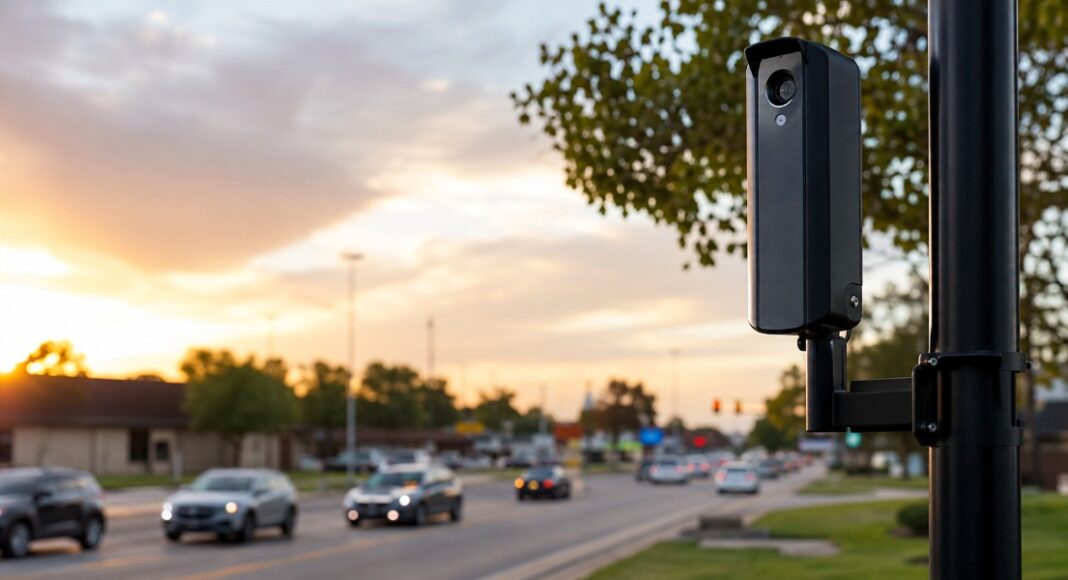
A Flock camera is a solar powered, pole mounted unit that photographs the rear of every vehicle that passes it. The system reads the license plate and also catalogs details such as the vehicle’s make, model, color, and even bumper stickers or a damaged taillight.
That information is checked automatically against law enforcement databases for stolen vehicles, active warrants, and alerts such as AMBER or Silver Alerts. If a match comes back, officers are notified in real time.
Most departments that use the system, including several in this region, say non matching data is deleted after 30 days unless it becomes part of an active investigation.
Seagoville’s Program: Ten Cameras, A $38,600 State Grant
Seagoville’s Flock camera system is the best documented of the two. According to City Council meeting minutes, a high-ranking Seagoville police official told council that grant funding would allow the department to purchase a Flock camera system made up of eight stationary cameras and two remote units, ten cameras total.
The police department added that the system is capable of identifying recognizable vehicle features beyond the license plate itself. Council approved the underlying resolution, Resolution No. 2025 04, unanimously by a vote of four to zero.
The paper trail: Seagoville’s application, listed as Grant Number 5092601 and titled “Safer City Program,” appears on the North Central Texas Council of Governments’ FY25 Criminal Justice Program priority list for the Justice Assistance Grant. The city requested and was recommended for $38,600, funded through the Office of the Governor’s Criminal Justice Division and serving both Dallas and Kaufman counties. That $38,600 figure is the clearest public dollar amount tied to either city’s camera program.
Crandall: Confirmed Use, But Very Few Public Details
Crandall’s Flock camera program is real, but it is far less transparent than Seagoville’s. The Electronic Frontier Foundation’s Atlas of Surveillance project, which catalogs police technology nationwide, lists the Crandall Police Department as a confirmed user of Flock Safety automated license plate readers based on public records obtained in July 2025.
The technology has already played a role in at least one publicized case. In September 2025, Crandall officers were alerted by the Flock camera system that a stolen vehicle had entered the Wildcat Ranch community. The alert led to a pursuit near Noble Reed Elementary School, a brief foot chase, and an arrest, according to a Crandall Police Department press release reported by a Kaufman County news outlet.
What’s missing: Shop in Seagoville could not locate a City Council resolution, budget line item, or grant record specifying how many cameras Crandall operates, what the system cost, which fund paid for it, how long the data is kept, or which outside agencies can access it. Residents who want exact figures can file a request under the Texas Public Information Act directly with the Crandall Police Department.
How Seagoville and Crandall Compare To Their Neighbors
Every city bordering Kaufman County appears to be moving in the same direction, just at very different speeds and budgets.
Forney’s City Council originally approved 26 Flock cameras in February 2022 for $78,000, but an August 2026 review of city records by inForney.com found the program has since grown to 31 “Flock Falcon” readers under a five year agreement now valued at $390,100.
Terrell’s Police Department had 28 Flock Safety cameras installed as of public records obtained in July 2025.
Kaufman’s system is shared with the county: the Kaufman County Sheriff’s Office operates 11 Flock Safety cameras, and the City of Kaufman has historically helped fund and use that shared network around the courthouse area.
Measured against those figures, Seagoville’s ten camera, $38,600 program is modest, closer in scale to what county records show around Kaufman than to Forney’s rapidly expanding, six figure contract. Crandall’s true scale, for now, is simply unknown.
Are Seagoville or Crandall Planning To Expand?
Based on everything publicly available as of August 20, 2026, neither city has an announced plan to add cameras beyond what is already confirmed.
Seagoville’s program remains the ten camera Safer City Program approved through Resolution No. 2025 04. Crandall’s system, whatever its current size, has no publicly posted council item proposing additional units. That does not mean expansion will not happen.
Neighboring cities like Forney and Terrell started with far smaller systems and grew them significantly within a few years, and both Dallas County and Kaufman County have continued directing state grant dollars toward license plate reader technology. Shop in Seagoville will continue monitoring both cities’ council agendas and will report any new camera purchases as soon as they appear on the record.
What This Means For Residents
Supporters of the technology, including police departments across North Texas, point to real results: faster recovery of stolen vehicles, quicker location of missing persons, and investigative leads that would otherwise take far longer to develop.
Critics, including national organizations such as the Electronic Frontier Foundation and the Institute for Justice, point to documented cases elsewhere in the country of officers misusing the same systems to track romantic partners or personal acquaintances, and they argue that even lawful use creates a searchable record of where ordinary residents drive, worship, and spend their time.
Neither Seagoville nor Crandall has published a detailed data access or retention policy the way some larger departments have. Residents who want to know exactly who can search their local Flock data, how long it is kept, and whether it is shared with outside agencies are encouraged to contact their police department directly or raise the question at an upcoming City Council meeting.
Have documents, council records, or firsthand knowledge of either city’s Flock program?
Shop in Seagoville is continuing to track this story. Reach out and let us know what you have found.